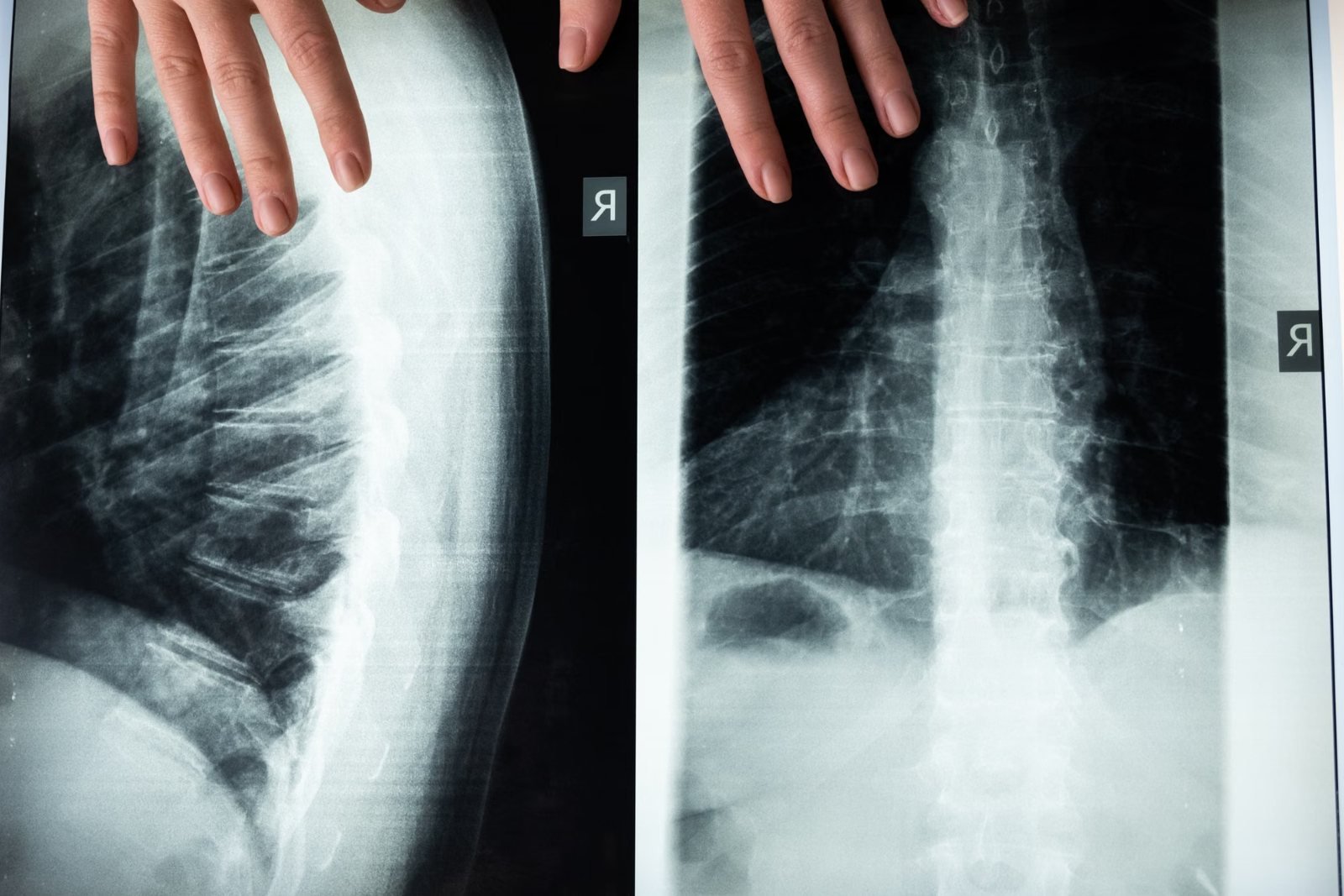
Can a DEXA Scan Show Cancer?
A DEXA scan answers one question well: how dense your bones are. It is not a cancer test, but it does matter to some people having cancer treatment.
The short answer is no. A DEXA scan is built to measure how dense your bones are, and doctors use it to diagnose osteoporosis and to estimate how likely you are to break a bone. It is not designed to find cancer, and a normal DEXA result does not rule cancer out.
That does not make DEXA irrelevant to cancer. Some cancer treatments thin the bones, so people having those treatments are sometimes offered a DEXA scan to keep an eye on their bone health. This guide explains what the scan measures, which scans are used when doctors are looking for cancer in bone, and where a DEXA fits in.
What a DEXA scan actually measures
The NHS describes a bone density scan as a test that uses low dose X-rays to see how dense, or strong, your bones are. It is usually done at the hip and the lower spine, and the result is compared with reference values to show whether your bone density is normal, lower than expected, or low enough to count as osteoporosis.
The result is used alongside a fracture risk assessment, which also takes into account things like your age, family history and the medicines you take. The NHS is clear that a DEXA scan is not the only way of measuring bone strength and that all of the risk factors need to be considered together. Our guide to what a DEXA scan involves explains the T-score and Z-score in more detail.
Why a DEXA scan is not a cancer test
A DEXA scanner is a measuring instrument. It sends two low-dose X-ray beams through a small area of bone and calculates how much mineral is there. The picture it produces is low in detail and exists to support that measurement, not to examine the structure of the bone or the tissue around it.
That is why nobody uses a DEXA scan to look for a tumour, and why a normal result tells you nothing either way about cancer. If you or your doctor are worried about cancer, a DEXA scan is the wrong test, however reassuring a normal result might feel.
Scans that are used to look for cancer in bone
When doctors need to know whether cancer has affected the bones, they choose from a different set of tests. Which one depends on the type of cancer, the symptoms and what the care team already knows.
- Bone scan. A nuclear medicine scan in which a small amount of radioactive tracer is injected and a gamma camera picks up where it collects in the skeleton. Cancer Research UK notes that changes on a bone scan, called hot spots, are not always cancer and can be caused by things like arthritis.
- MRI. Shows bone marrow and the soft tissue around bones in detail, with no ionising radiation.
- CT. Shows the structure of bone clearly and is often part of staging scans of the chest, abdomen and pelvis.
These scans are arranged by the team looking after you, usually after a specialist assessment. They are not screening tests to have just in case.
Why people with cancer are sometimes offered a DEXA scan
The NHS lists some medicines used to treat breast cancer and prostate cancer that affect hormone levels among the causes of osteoporosis. Long-term high-dose steroid tablets are on the same list. Because these treatments can thin the bones over time, a care team may arrange a DEXA scan before or during treatment to see where bone density stands and whether anything should be done to protect it.
In that situation the DEXA scan is doing exactly its normal job, measuring bone density. It is not checking whether the cancer has spread. If you have been offered a DEXA as part of cancer care and are unsure why, it is a reasonable question to put to your oncology team.
If you are worried about cancer
If you have a symptom that worries you, such as bone pain that does not go away, speak to your GP. They can decide which tests are appropriate and, where needed, refer you on a suspected cancer pathway. Paying for a DEXA scan will not answer that question and may give false reassurance.
This page is general information. It does not replace an assessment by a clinician who knows your history.
Having a DEXA scan privately
The NHS says a bone density scan may be recommended if you are over 50 with a risk of developing osteoporosis, or under 50 with other risk factors, such as smoking or a previous broken bone. Because DEXA uses ionising radiation, UK law requires each scan to be justified by a registered referrer, so private clinics ask for a referral or arrange one through their own clinician.
Our guide to how to get a DEXA scan covers the NHS and private routes, and the DEXA bone density scan page explains what happens on the day. Clinics listed on FindScan publish the price they charge and we show it as the clinic sets it; you can search clinics by location and send an enquiry to the one you choose.
Common questions
Can a DEXA scan detect bone cancer?
No. A DEXA scan measures bone mineral density to assess osteoporosis and fracture risk. It is not designed to find tumours, and a normal result does not rule out cancer. Bone scans, MRI and CT are the tests used when doctors are looking for cancer in bone.
Will a DEXA scan show cancer that has spread to the bones?
It is not the right test for that. When a care team needs to know whether cancer has spread to bone, they use other scans, such as a nuclear medicine bone scan, MRI or CT, chosen to suit the type of cancer and the symptoms.
Why has my cancer team asked for a DEXA scan?
Some treatments, including certain hormone treatments for breast and prostate cancer, can thin the bones. A DEXA scan measures your bone density so the team can decide whether you need anything to protect your bones during or after treatment.
Is a DEXA scan the same as a bone scan?
No. A DEXA scan uses low-dose X-rays to measure bone density. A bone scan is a nuclear medicine test in which a radioactive tracer is injected and a gamma camera shows where it collects, which can highlight areas of bone that are changing for many reasons.
References
- Bone density scan (DEXA scan). NHS. Accessed 7 October 2026.
- Bone density scan (DEXA scan): when it is used. NHS. Accessed 7 October 2026.
- Osteoporosis: causes. NHS. Accessed 7 October 2026.
- Bone scan. Cancer Research UK. Accessed 7 October 2026.
- The Ionising Radiation (Medical Exposure) Regulations 2017, SI 2017/1322. legislation.gov.uk. Accessed 7 October 2026.
This article is general information, not medical advice, and it does not replace an assessment by a clinician. If you have symptoms that worry you, speak to your GP or call 111. In an emergency, call 999.