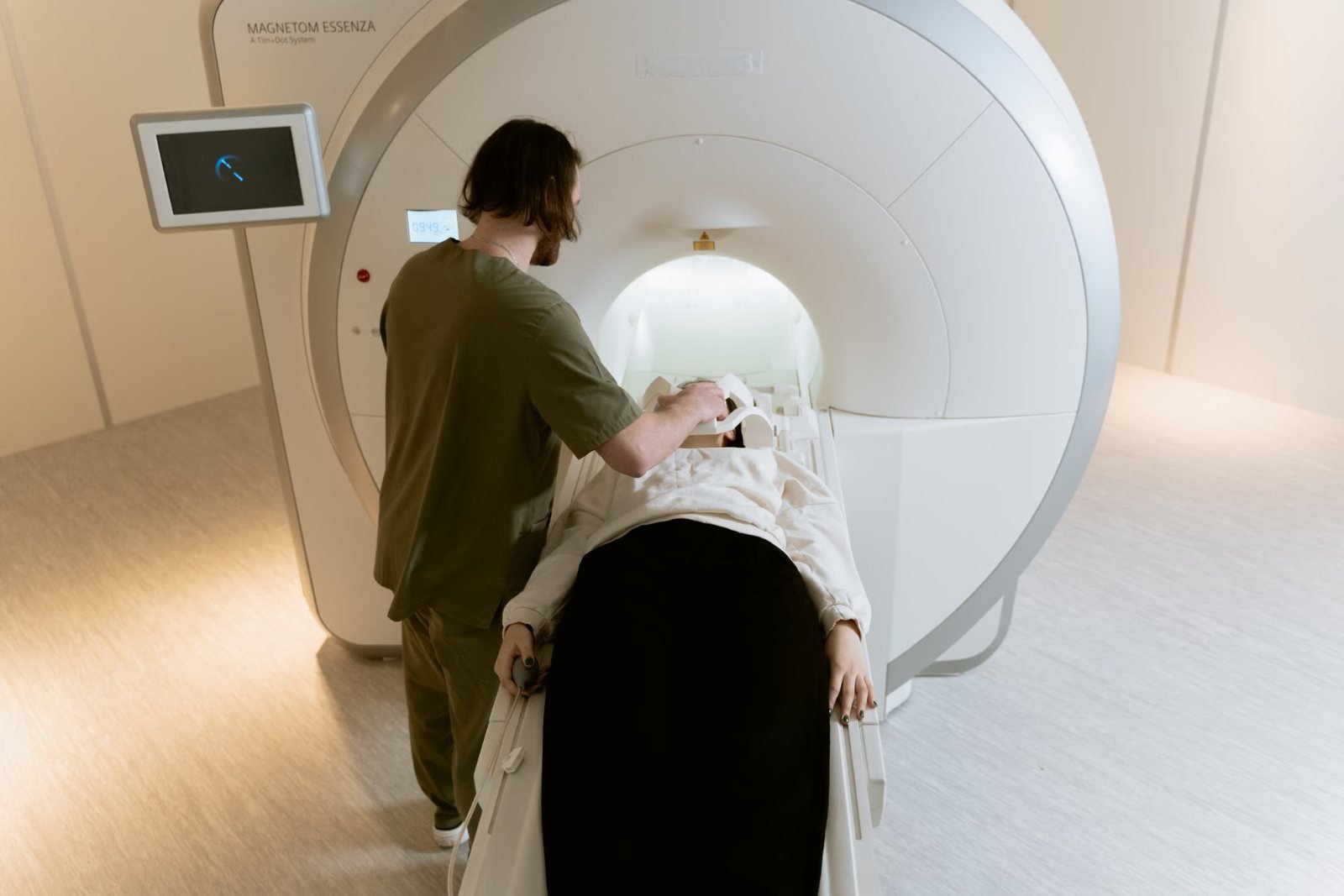
Private MRI scan
An MRI scan takes detailed pictures of the inside of your body without using ionising radiation. FindScan helps you compare private clinics that offer MRI and send an enquiry to the one you choose.
Search MRI providers near youAn MRI scan takes detailed pictures of the inside of your body without using ionising radiation. FindScan helps you compare private clinics that offer MRI and send an enquiry to the one you choose.
Search MRI providers near youMRI stands for magnetic resonance imaging. Clinics list MRI of almost every part of the body, from the brain and spine to single joints. This page explains how it works, what it is used for, who may need extra safety checks and what to expect.
Whether you are comparing private MRI scans for one body area or looking for an MRI scan near you, these guides go into more detail: what an MRI scan shows, MRI with contrast and the cardiac MRI scan.
FindScan is a comparison service, not a healthcare provider. We do not carry out scans or give medical advice. We list private clinics that offer MRI and pass your enquiry to the clinic you choose.
The NHS describes an MRI scan as a test that takes detailed pictures of the inside of your body. Cancer Research UK explains that it uses magnetism and radio waves to create those pictures, and that it does not use radiation. South Tees Hospitals NHS Foundation Trust puts it the same way: MRI uses magnetic and radio waves and a computer to form images, without the use of ionising radiation.
Because the scanner uses a strong magnet, any metal in or on your body matters, which is why every MRI starts with safety screening. See also MRI vs CT and ultrasound vs MRI.
The NHS says MRI scans can be used to find out what is causing symptoms you have been having, to check your bones and organs, and to see how well a treatment is working. Clinics on FindScan list MRI for many areas of the body, including:
Some clinics also offer a full body MRI. Before choosing one, read our guide to the limits of full body scans. Only the clinician assessing you can say whether MRI is the right test for your symptoms.
A private scan does not replace a medical assessment. For many problems a scan is not the first step, and a GP or physiotherapist is the right place to start. Our body-part pages set out where NHS guidance says a scan is not usually needed, for example for most back pain on our spine MRI page. See also seeing a GP before a scan.
Each of our body-part pages lists the warning signs the NHS gives for that area. If you have any of them, do not wait for a private scan.
Some MRI scans include an injection of contrast medium (dye) to help show more detail. The MHRA explains that gadolinium-containing contrast agents are used to enhance MRI, and advises that they are used only when the diagnostic information is essential and not available from MRI without contrast, at the lowest dose that is effective.
The NHS lists possible side effects of contrast, such as feeling sick, a headache or a metallic taste, and says allergic reactions are rare. You may be asked to wait for up to 30 minutes afterwards. The clinic will tell you whether your scan needs contrast, and will ask about kidney problems and allergies.
Cancer Research UK explains that an MRI scan uses strong magnetism which could affect any metal in your body. Before your scan you will complete a safety questionnaire, and a radiographer will go through it with you. Tell the clinic in advance if you have:
The clinic's screening decides whether you can have the scan or need extra checks first. See MRI safety and metal implants and, for children, private scans for children.
Cancer Research UK notes that some people feel claustrophobic during an MRI scan, and that you have a button you can press to ask staff to stop. The NHS says to talk to a healthcare professional if you feel anxious, and that you may be able to have a medicine to help you relax. Tell the clinic when you enquire.
Open scanners are less enclosed than a standard closed scanner, and upright scanners let you sit or stand. NHS Gloucestershire ICB notes that open and upright scanners generally have a lower magnetic field strength, which can reduce image quality and make the scan take longer, and its policy refers to upright scanning where severe pain is relieved by standing or sitting. See open and upright MRI, open vs closed MRI and claustrophobia and MRI.
MRI does not use ionising radiation, so the Ionising Radiation (Medical Exposure) Regulations 2017 (IR(ME)R), which apply to X-ray and CT, do not apply to it. Many private clinics accept self-referral for MRI, usually after their own safety screening, but each clinic sets its own policy. See private MRI without a GP referral and does health insurance cover MRI.
Cancer Research UK says most MRI scans need no special preparation, but for some you may need to stop eating a few hours before. The clinic will tell you if this applies to you. The NHS advises not wearing anything with metal in it, such as jewellery or hair clips, and you may be asked to change into a gown if your clothes contain metal. The British Heart Foundation also advises leaving behind electronic devices and bank cards. See how to prepare for your scan.
You lie on a bed that moves into the scanner. The radiographer controls the scanner from another room but can hear and speak to you. The NHS says the scanner makes loud bangs and clicks, so you are given ear plugs or headphones. You need to lie still so the scanner can take clear images, and may be asked to hold your breath for parts of the scan.
The NHS says an MRI scan usually takes between 15 minutes and 1 hour, but can take longer. You can usually eat and drink as normal afterwards. See what to expect at an MRI scan.
Your images are reported by an appropriately qualified clinician. The clinic will tell you how long its report takes and who it is sent to. Plan to discuss the report with a GP or specialist. See scan results.
Each clinic sets its own price, and prices vary. The main factors are the body part and how many areas are scanned, whether contrast is needed, the type of scanner (for example field strength, or an open or upright scanner), whether a consultation is included, and where the clinic is. Each clinic confirms its price when you enquire. Check what is included, such as the report. See our private MRI cost guide.
Use FindScan search to see clinics near you that offer MRI. Compare locations, scanner types and clinic details, then send an enquiry to the clinic you choose. We pass your details to that clinic, and the clinic contacts you to discuss your request, its referral policy, safety screening and availability.
No. MRI uses magnetism and radio waves to create pictures, and does not use ionising radiation. This is why IR(ME)R, which covers X-ray and CT, does not apply to MRI.
Many private clinics accept self-referral for MRI, usually after their own safety screening, but each clinic sets its own policy. Check with the clinic when you send an enquiry.
The British Heart Foundation says most people with a pacemaker or ICD can have an MRI scan, but your device needs to be checked first. Tell the clinic before your appointment so its safety screening can confirm whether the scan can go ahead.
Not always. NHS Gloucestershire ICB notes that open and upright scanners generally have a lower magnetic field strength, which can reduce image quality and lengthen the scan. Ask the clinic which scanner it uses and whether it suits the area you need scanned.
Only some scans need one. The MHRA advises that gadolinium-containing contrast agents are used only when the information is essential and not available from MRI without contrast. The clinic will tell you if your scan needs it and will ask about kidney problems and allergies.
Search by postcode to see clinics near you that offer this scan. Send an enquiry to the clinic you choose and they will contact you to confirm whether a referral is needed, the final price and an appointment.
FindScan is a comparison service, not a healthcare provider, and nothing here is medical advice. Speak to a GP or another clinician about your symptoms.