Private CT scan
A CT scan uses X-rays and a computer to take detailed pictures of the inside of your body. FindScan helps you compare private clinics that offer CT and send an enquiry to the one you choose.
Search CT providers near youA CT scan uses X-rays and a computer to take detailed pictures of the inside of your body. FindScan helps you compare private clinics that offer CT and send an enquiry to the one you choose.
Search CT providers near youA CT (computed tomography) scan is a test that takes detailed pictures of the inside of your body. It is used for many parts of the body, from the head and chest to the abdomen, pelvis, bones and blood vessels.
CT scanning is also called computed tomography. For more detail, see CT with contrast, the CT abdomen and pelvis scan and CT when lung cancer is suspected.
Because CT uses X-rays, every scan has to be requested by a referrer and justified under UK law before it goes ahead. This page covers uses, contrast, radiation dose, referral, the day itself and price.
FindScan is a comparison service, not a healthcare provider. We do not carry out scans or give medical advice. We list private clinics that offer CT and pass your enquiry to the clinic you choose.
Cancer Research UK describes a CT scan as a test that uses X-rays and a computer to create detailed pictures of the inside of your body. The scanner takes pictures from different angles, and the computer puts them together, which can include building a 3D image.
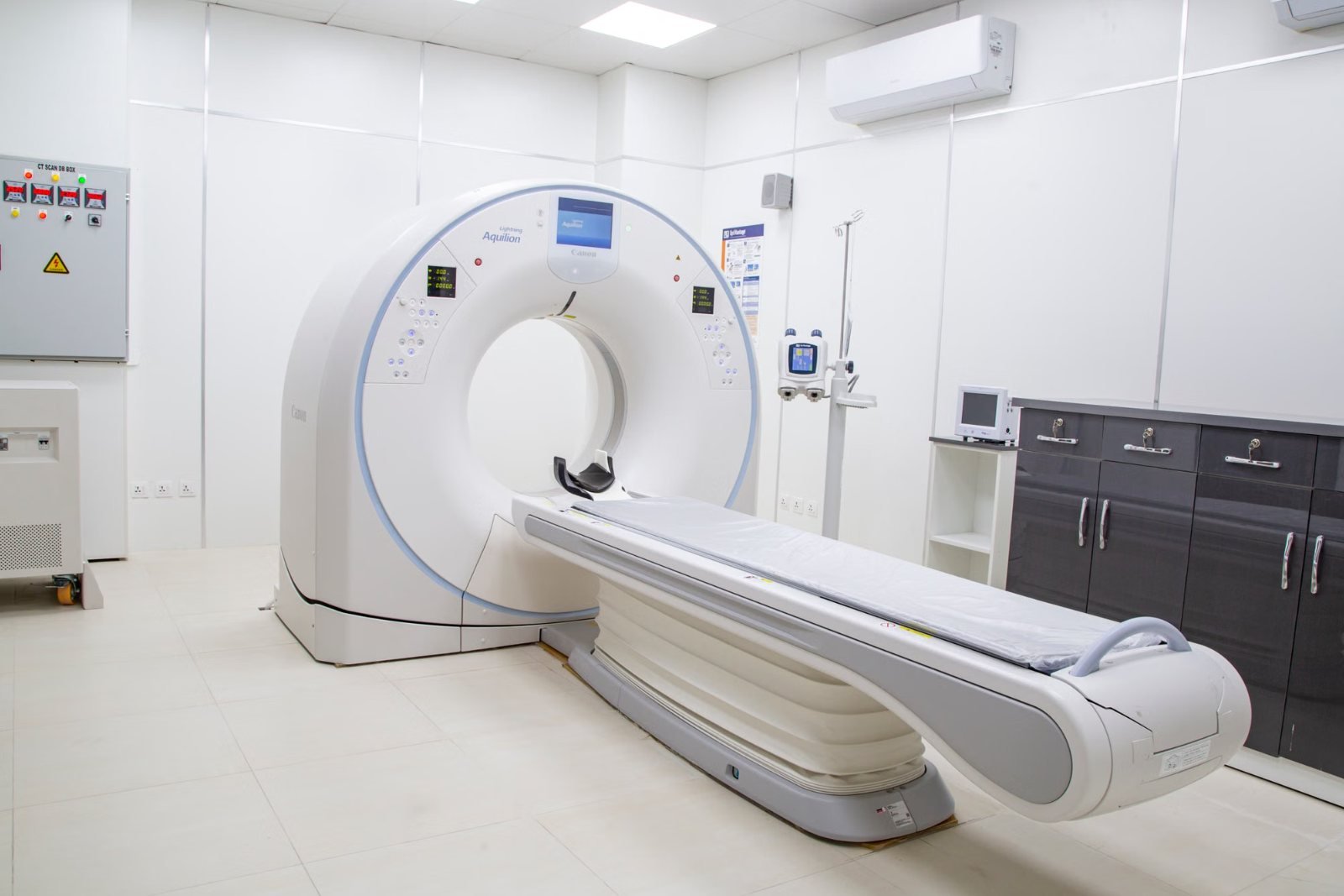
The NHS describes the scanner as a large ring that moves around part of your body while you lie on a flat bed. The scan itself usually takes between 10 and 20 minutes.
The NHS says a CT scan may be used to check your bones or internal organs after an accident, to find out if symptoms you have been having are caused by a condition such as cancer, to see how well a treatment is working, and to help doctors during some procedures, such as a biopsy. Common types of CT include:
Only the clinician assessing you can say whether CT is the right test for your symptoms, and which part of the body should be scanned.
Some CT scans use a dye called contrast medium, which Cancer Research UK says shows up body tissues more clearly on the scan. The NHS says it can be given to you in a drink, injected into a vein, or put in your bottom. If it is injected, you may feel hot and flushed or notice a metal taste in your mouth for a short time.
Cancer Research UK says you might have blood tests before a CT scan to make sure your kidneys are working well. The NHS asks you to tell the hospital if you have kidney or thyroid problems, if you have diabetes, if you have any allergies, or if you have had an allergic reaction to contrast medium before. Mention these when you send an enquiry so the clinic can tell you what checks it needs.
CT uses more radiation than a plain X-ray. The UK Health Security Agency (UKHSA) publishes typical effective doses for common examinations, and gives the UK average natural background radiation as 2.1 mSv per year. Its typical doses for CT are:
For comparison, UKHSA gives a typical dose of 0.02 mSv for a single chest X-ray. The NHS says complications of a CT scan are rare, but that if you have lots of CT scans there is a very small chance the radiation from the X-rays can cause cancer. This is one reason each scan must be justified. Our guide to X-ray radiation safety explains more.
The NHS asks you to tell the hospital if you are pregnant or might be pregnant, or if you are breastfeeding. Under IR(ME)R, before an exposure the person carrying it out must ask anyone of childbearing potential whether they are pregnant or breastfeeding, where relevant. If you are or might be pregnant, tell the clinic when you enquire, so the referrer and the clinic can consider whether CT is still the right test.
Yes, in the sense that every CT scan must be requested by a referrer and justified. CT uses ionising radiation, so it is covered by the Ionising Radiation (Medical Exposure) Regulations 2017 (IR(ME)R). Regulation 11 says a person must not carry out an exposure unless it has been justified by the practitioner as showing a sufficient net benefit and has been authorised, and the practitioner must take account of information supplied by the referrer.
In practice, a referral may come from your GP, a consultant or another healthcare professional who is entitled to act as a referrer. Private clinics often arrange this through their own clinician or a clinical review of your request, but the scan still needs a referrer and justification, and a clinic can decline if it is not justified. Ask each clinic how it handles this when you enquire.
CT and MRI are different tests. CT uses X-rays. Cancer Research UK says MRI creates pictures using magnetism and radio waves, does not use radiation, and shows soft tissues very clearly. The NHS says a CT scan usually takes between 10 and 20 minutes, while Cancer Research UK says an MRI scan takes between 15 and 90 minutes, depending on the area. Which test suits your symptoms is a decision for the clinician assessing you. See our guide MRI vs CT scan and our private MRI scan page.
The NHS says that before a CT scan you may be asked to follow a special diet, take certain medicines, or not eat or drink anything for several hours before the scan. You may also be asked not to wear anything with metal in it, such as jewellery or clothes with zips or poppers. The clinic will send you its own instructions. See how to prepare for your scan.
You lie on a flat bed that moves through the ring of the scanner. You may be asked to hold your breath for a short time while pictures are taken. The radiographer will tell you what to do and when to keep still. If you were given contrast medium, the NHS says you may be asked to wait for up to 30 minutes afterwards.
Your images are reported by an appropriately qualified clinician. The clinic will tell you how long its report takes and who receives it. Plan to discuss the results with your GP or the clinician who referred you, who can explain what they mean for you. See scan results.
If you have new or worrying symptoms, see a GP or contact NHS 111 first. A private CT scan is not a substitute for urgent care. For example, the NHS says to call 999 if someone has hit their head and:
In an emergency, call 999 or go to A&E.
Each clinic sets its own price, and prices vary. The main factors are the part of the body being scanned, whether more than one area is scanned, whether contrast is needed, the type of scanner, whether a referral or consultation is included, and where the clinic is. Each clinic confirms its price when you enquire.
Check what is included, such as the report, before you send an enquiry. See our guides private CT scan cost in the UK and how much does a CT scan cost.
Use FindScan search to see clinics near you that offer CT. Compare locations and clinic details, then send an enquiry to the clinic you choose. We pass your details to that clinic, and the clinic contacts you to discuss your request, how it handles referral and justification, any contrast checks, and availability.
Every CT scan must be requested by a referrer and justified under IR(ME)R, because CT uses ionising radiation. Some private clinics arrange this through their own clinician or a clinical review, but the scan still needs a referrer and justification, and the clinic can decline if it is not justified.
UKHSA gives typical effective doses of 2 mSv for a CT head, 8 mSv for a CT chest and 10 mSv for a CT abdomen/pelvis, and gives the UK average natural background radiation as 2.1 mSv per year. The dose for your scan depends on the area and the scanner, so ask the clinic.
Some CT scans need contrast medium and some do not. It may be given as a drink, an injection into a vein, or put in your bottom. Tell the clinic about kidney problems, diabetes, allergies or any previous reaction to contrast. You might have a blood test to check your kidneys first.
It depends on what the clinician is looking for. CT uses X-rays, while MRI uses magnetism and radio waves and does not use radiation. Ask the clinician assessing you which test suits your symptoms. See MRI vs CT scan.
Tell the clinic if you are or might be pregnant, or if you are breastfeeding. Under IR(ME)R, staff must ask about pregnancy and breastfeeding where relevant before the scan, and the referrer and clinic will consider whether CT is still the right test.
Have your referral letter ready if you have one, or ask the clinic whether its own doctor can review your request. Find CT clinics on FindScan by body part and location, then send an enquiry to the clinic you choose. The clinic asks safety questions and arranges the appointment with you.
Search by postcode to see clinics near you that offer this scan. Send an enquiry to the clinic you choose and they will contact you to confirm whether a referral is needed, the final price and an appointment.
FindScan is a comparison service, not a healthcare provider, and nothing here is medical advice. Speak to a GP or another clinician about your symptoms.