MRI With Contrast: What Gadolinium Dye Is and What to Expect
Some MRI scans use an injection of dye, usually a gadolinium-based contrast agent, to show more detail. Here is why it is used, how it feels, the side effects and what UK regulators have said about it.
If you have been told you need an MRI with contrast, you will be given an injection of dye during your appointment. The NHS explains that the contrast medium helps show more detail in the MRI scan pictures. The dye used for MRI is different from the iodine-based dye used in CT: it is based on gadolinium.
This guide covers what MRI contrast dye is, why it is used, how it is given, possible side effects, kidney checks, pregnancy and breastfeeding, and what the Medicines and Healthcare products Regulatory Agency (MHRA) has said about gadolinium. Always follow the instructions your own clinic gives you.
What is gadolinium?
Cambridge University Hospitals describes gadolinium as a chemical element and a type of metal, used as a contrast agent to give more detail of structures in the body. St George's University Hospitals describes the agent as a clear, colourless fluid used like a dye to make MRI images clearer.
The MHRA groups gadolinium contrast agents into two broad types, linear and macrocyclic. Its review found macrocyclic agents have a lower potential to be retained in the body than linear agents, because they are more chemically stable.
Why an MRI with contrast is used
Contrast is only used for some MRI scans. Royal Devon University Healthcare explains that it is needed in some cases to highlight abnormal structures, assess how certain parts of the body are working, or rule out an abnormality. Cambridge University Hospitals says it is given if it is necessary to answer the clinical question.
The MHRA advises that gadolinium agents should be used only when the diagnostic information is essential and not available from an MRI without contrast, at the lowest dose that is effective. So whether, for example, an MRI brain with contrast is needed depends on what your doctor is looking for. Our guide to what a brain MRI shows explains more about brain scans.
How MRI contrast dye is given
The dye is injected into a vein. Cambridge University Hospitals says that in most cases it goes through a plastic cannula placed in a vein in your arm, and North Cumbria Integrated Care says the cannula may be in the arm or the back of the hand. St George's says the injection is given during the scan.
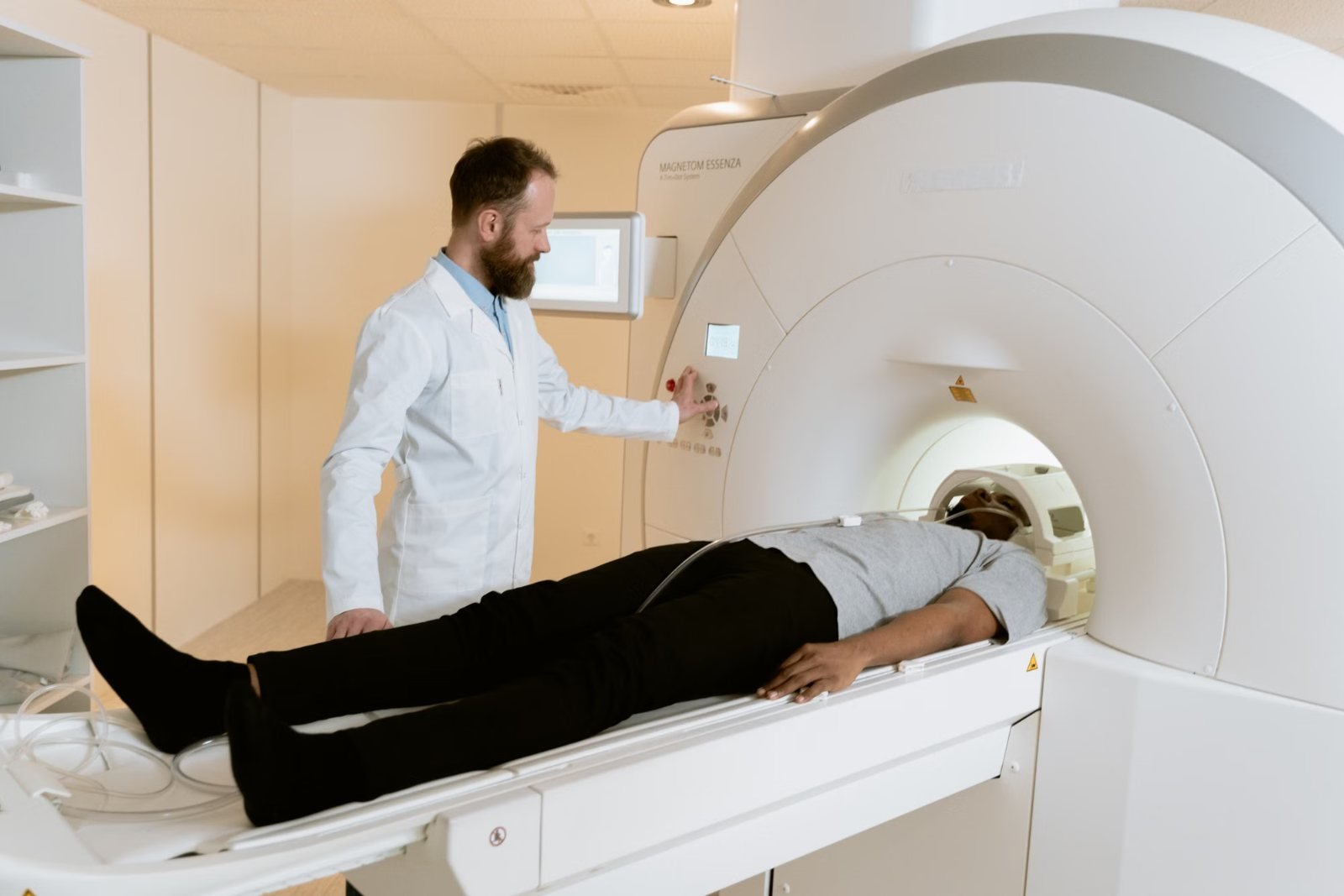
The rest of the scan is the same as any MRI. The NHS says an MRI usually takes between 15 minutes and 1 hour. See what to expect during an MRI scan.
MRI with contrast side effects
The NHS lists possible side effects as feeling or being sick, a skin rash, a headache, a metallic taste and feeling dizzy. Cambridge University Hospitals says up to 1 in 10 patients report a cold feeling in the arm, nausea or a headache, and fewer than 1 in 100 have effects such as a cough, flushing, a blocked nose, light-headedness or an allergic reaction. It adds that anaphylactic shock has been reported only in case reports and is considered rare.
North Cumbria Integrated Care says most side effects happen during the injection or within the first hour, but some can happen up to several days later. Cambridge University Hospitals says delayed allergic reactions, such as a rash or swelling, can occur up to six hours after the injection.
When to get urgent help: Cambridge University Hospitals advises going to an emergency department for a severe reaction, or contacting your GP if mild problems persist. The NHS says call 999 if you think someone is having an anaphylactic reaction, such as swelling of the throat and tongue or difficulty breathing.
Kidney function, pregnancy and breastfeeding
Kidneys. The NHS safety form asks whether you have kidney problems. Cambridge University Hospitals says MRI with gadolinium is not usually recommended for people with severe kidney problems, and North Cumbria Integrated Care explains that a rare condition called nephrogenic systemic fibrosis can occur in patients with severely reduced kidney function. Cambridge also says the contrast usually leaves the body in urine within 24 hours if your kidneys work well, and suggests people with good kidney function drink at least an extra litre of water in the 24 hours afterwards.
Pregnancy. St George's asks you to tell the radiographer if you are or could be pregnant, so the clinic can advise you.
Breastfeeding. The Royal College of Radiologists and Society of Radiographers say no special precaution or stop in breastfeeding is required after gadolinium. Whether to continue or pause for 24 hours is up to the breastfeeding parent, in discussion with the clinician.
What the MHRA says about gadolinium retention
In December 2017 the MHRA published a Drug Safety Update after a review found that low levels of gadolinium can be retained in the brain and other tissues after these agents are given. It said there is currently no evidence that this has caused adverse neurological effects, but that data on long-term effects are very limited.
As a result, two linear agents for intravenous use were suspended in the UK, two others were restricted to liver imaging, and macrocyclic agents remained available. St George's tells patients that small amounts may remain in the brain after a scan, with no evidence that this causes harm.
Having an MRI with contrast privately
MRI does not use ionising radiation, so IR(ME)R does not apply. Many clinics accept self-referral after their own safety screening, but each clinic sets its own policy. If your scan may need contrast, the clinic will check your medical history, including kidney problems and allergies. Our guide to private MRI without a GP referral explains more.
Each scan is reported by an appropriately qualified clinician, and the clinic will tell you how long its report takes. Prices vary by clinic, region, body area, contrast and what is included. FindScan shows each clinic's own listed price, so you can compare MRI clinics near you and send an enquiry.
Common questions
What is an MRI with contrast?
An MRI where a dye, usually a gadolinium-based contrast agent, is injected into a vein to show more detail in the pictures. It is only used for some MRI scans.
Is MRI contrast dye the same as CT dye?
No. MRI contrast is based on gadolinium, while the dye used in CT contains iodine. Tell the clinic about any previous reaction to either.
Is gadolinium safe?
Side effects are usually mild and short-lived, and serious reactions are rare. The MHRA says small amounts can stay in the brain, with no evidence of harm so far but limited long-term data. It advises using these agents only when needed.
Can I eat before an MRI scan with dye?
The NHS says the hospital will tell you if you need to do anything before your scan, and that you can eat and drink as normal afterwards. Follow your clinic's instructions.
Do I need to stop breastfeeding after an MRI with contrast?
The Royal College of Radiologists and Society of Radiographers say no special precaution is required. Pausing for 24 hours is your choice, in discussion with the clinician.
References
- MRI scan. NHS. Accessed 7 October 2026.
- Gadolinium contrast aftercare. Cambridge University Hospitals NHS Foundation Trust. Accessed 7 October 2026.
- Gadolinium based contrast agent injection (Dotarem and Primovist) for MRI scanning. St George's University Hospitals NHS Foundation Trust. Accessed 7 October 2026.
- Radiology: contrast injection (gadolinium). North Cumbria Integrated Care NHS Foundation Trust. Accessed 7 October 2026.
- What is gadolinium and why is it used in MRI?. Royal Devon University Healthcare NHS Foundation Trust. Accessed 7 October 2026.
- Gadolinium-containing contrast agents: removal of Omniscan and iv Magnevist, restrictions to the use of other linear agents (Drug Safety Update, December 2017). MHRA (gov.uk). Accessed 7 October 2026.
- RCR and SoR statement on patients who are breastfeeding who require a CT or MRI with contrast (2022). The Royal College of Radiologists and Society of Radiographers. Accessed 7 October 2026.
- Anaphylaxis. NHS. Accessed 7 October 2026.
This article is general information, not medical advice, and it does not replace an assessment by a clinician. If you have symptoms that worry you, speak to your GP or call 111. In an emergency, call 999.