Types of MRI Scanner Explained
MRI scanners differ in shape and in the strength of their magnet. The design affects how a scan feels, how long it takes and the detail it can show, and the right choice depends on you and on the question your doctor wants answered.
When you start comparing MRI clinics, you will see terms such as wide-bore, open, upright, 1.5T and 3T. They describe two different things: the physical design of the scanner, which affects how enclosed you feel, and the strength of its magnetic field, which affects the images.
This guide explains the main types of MRI scanner used in the UK, how 1.5T and 3T differ, who each type tends to suit, and what to ask a clinic. It is general information. The best scanner for your scan depends on the body area, the clinical question and your own needs, which is a decision for the clinic's radiology team and your referring clinician.
Closed-bore scanners
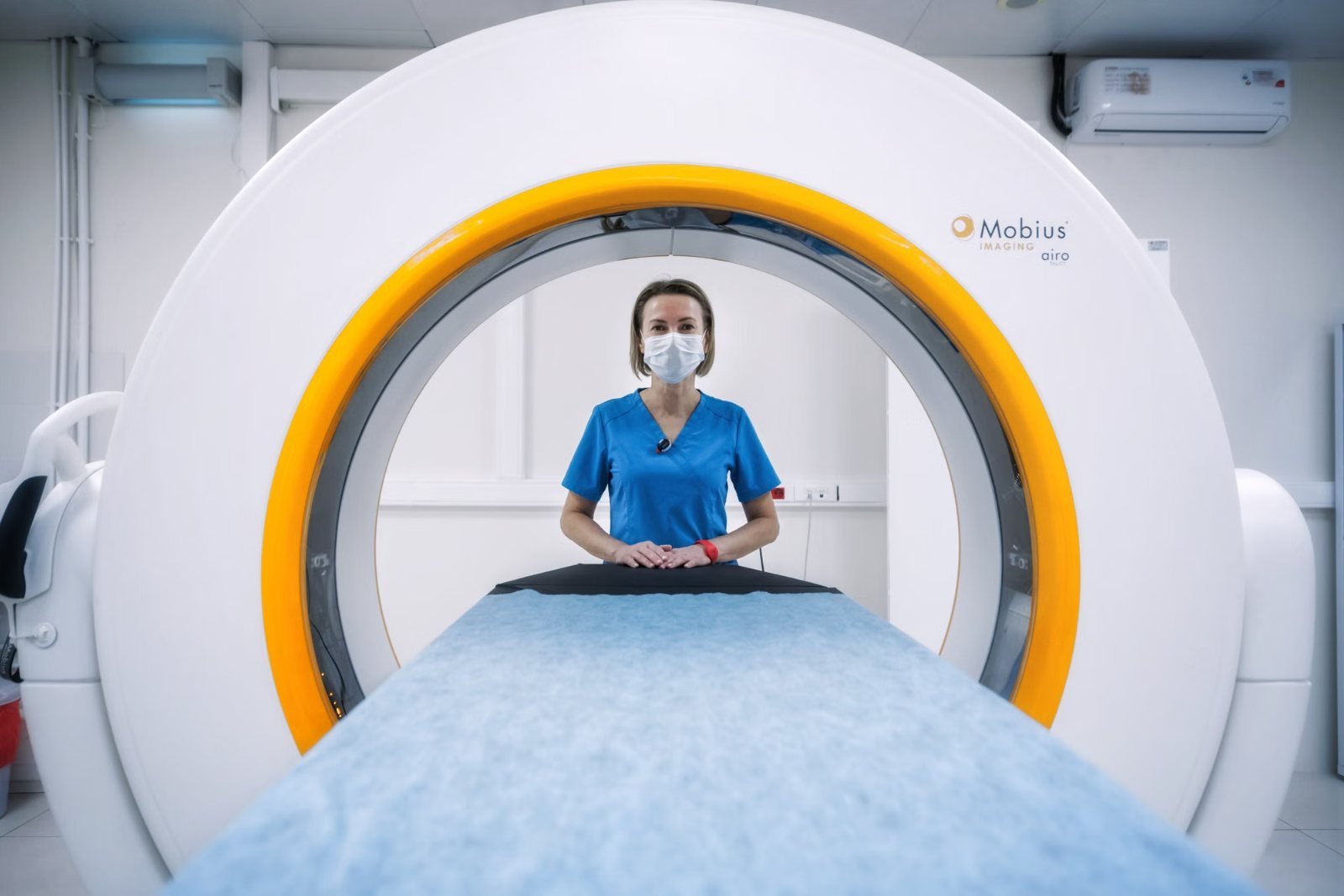
According to MHRA safety guidance, most MRI scanners used clinically in the UK are cylindrical closed-bore systems with a superconducting magnet, typically at a field strength of 1.5T or 3T. The NHS describes the scanner as a large machine with a short tunnel through it. You lie on a bed that moves into the tunnel, and the radiographer runs the scan from another room while being able to hear and speak to you.
It is the standard design, and it suits most people and most body areas.
Wide-bore scanners
A wide-bore scanner is a closed design with a wider opening, so there is more space around you. At least one NHS commissioning policy treats it as a first option for people with claustrophobia. The NHS Gloucestershire policy on open and upright MRI, for example, only funds an open scanner for claustrophobia once a wide-bore scanner has been tried or an oral sedative has not worked. It also mentions people whose body size stops them fitting comfortably in a conventional or wide-bore scanner.
If you feel anxious about enclosed spaces, the NHS says you may be able to have a medicine to help you relax. Our guide to claustrophobia and MRI covers the options.
Open scanners
Open scanners have a different magnet design, with more open sides rather than a tunnel. The MHRA notes that open systems tend to use lower magnetic fields than closed-bore systems. The Gloucestershire policy adds that the lower field strength of open and upright scanners can reduce image quality and lengthen the examination.
That is the trade-off: more space, but a scan that may take longer and show less detail. For some people, especially those who cannot manage a closed or wide-bore scanner, it can still be the right choice. Our guide to open vs closed MRI goes into more detail.
Upright and positional scanners
Upright scanners let you sit or stand during the scan rather than lie down. The Gloucestershire policy considers them where someone has severe pain that is not eased by painkillers but is relieved by standing or sitting, or severe breathlessness caused by a heart or lung condition. In every case it asks for a consultant radiologist to confirm that the scanner type is clinically essential.
The same policy notes the lower field strength of upright scanners and cites a review by the Washington State Health Care Authority that found insufficient scientific evidence to draw conclusions about how effective upright MRI is. If an upright scan is being suggested, ask what it will add for your particular problem.
1.5T vs 3T: what field strength means
The T stands for tesla, the unit used to measure magnetic field strength, so a 3T scanner has a field twice as strong as a 1.5T one. The MHRA says most clinical scanners in the UK are 1.5T or 3T. It also notes that 7T systems, traditionally used in research, are gaining some clinical use, and that there is renewed interest in low-field systems, such as small mobile units.
A stronger field can give a clearer image or a quicker scan, which is the other side of the point the Gloucestershire policy makes about lower-field scanners. But stronger is not automatically better for every person or every scan.
- Implants and devices. The MHRA explains that an MR Conditional implant is safe only within defined conditions, which typically include the static magnetic field. An implant cleared for scanning at 1.5T may not be cleared at 3T, so always tell the clinic about any implant. Our guide to MRI safety and metal implants explains more.
- The clinical question. Whether 1.5T or 3T is more suitable depends on the body area and what the scan needs to show. That is a judgement for the radiology team.
- Design. Field strength and bore design are separate things, so ask a clinic about both.
Which type tends to suit whom
- Most adults with no particular needs: a standard closed-bore scanner, at whichever field strength the clinic recommends for the body area.
- People with claustrophobia: a wide-bore scanner is often the first thing to try, with an open scanner as an alternative if that does not work.
- People with a larger body size: a wide-bore or open scanner may be more comfortable.
- People with implants: whichever scanner the implant's MR Conditional labelling allows.
- People who cannot lie flat because of severe pain or breathlessness: an upright scanner may be considered.
What to ask a clinic
When you send an enquiry, it is reasonable to ask what type of scanner the clinic uses, its field strength, whether it suits the body area you need scanned, and how long the scan is likely to take. Ask too how the safety screening works if you have an implant, and the clinic will tell you how long its report takes. Every scan is reported by an appropriately qualified clinician.
MRI does not use ionising radiation, so IR(ME)R does not apply. Many private clinics accept self-referral, usually after their own safety screening, but each clinic sets its own policy. You can compare MRI clinics near you on FindScan, see each clinic's own listed price and send an enquiry to the one you choose.
Common questions
Is a 3T MRI better than a 1.5T MRI?
Not automatically. A 3T scanner has a stronger field, which can give clearer images or quicker scans, but the best choice depends on the body area, the clinical question and any implants you have. Some implants are only cleared for scanning at certain field strengths.
What is a wide-bore MRI?
A closed MRI scanner with a wider opening, giving you more space. At least one NHS commissioning policy treats it as a first option for people with claustrophobia, before an open scanner.
Are open MRI scans as good as closed ones?
Open scanners tend to use lower magnetic fields. An NHS commissioning policy notes this can reduce image quality and make the scan take longer. They can still be the right option for people who cannot manage a closed or wide-bore scanner.
What is an upright MRI used for?
An upright scanner lets you sit or stand. One NHS policy considers it for people with severe pain relieved by standing or sitting, or severe breathlessness from a heart or lung condition. The same policy notes limited evidence on its effectiveness.
Can I choose which type of scanner I have?
Privately, you can ask clinics which scanners they use before you send an enquiry. On the NHS, the hospital decides, and NHS policy in some areas funds open or upright scanners only when specific criteria are met.
References
- Magnetic resonance imaging equipment in clinical use: safety guidelines. MHRA (gov.uk). Accessed 6 October 2026.
- MRI scan. NHS. Accessed 6 October 2026.
- Upright / Open MRI Scanners (policy statement, April 2023). NHS Gloucestershire ICB. Accessed 6 October 2026.
This article is general information, not medical advice, and it does not replace an assessment by a clinician. If you have symptoms that worry you, speak to your GP or call 111. In an emergency, call 999.