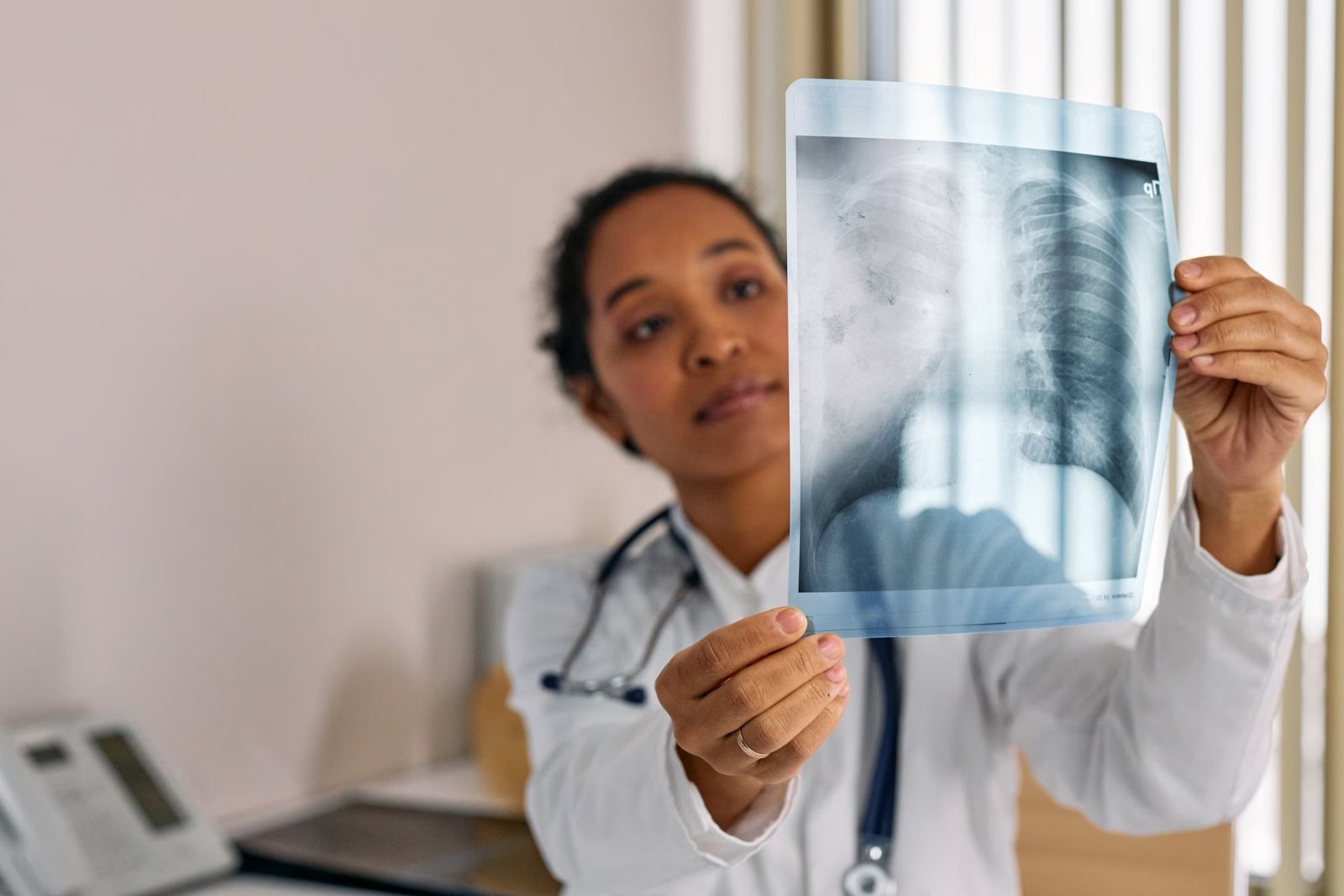
What Can a Chest X-ray Show?
One of the quickest and most common tests in medicine. Here is what a chest X-ray can tell a clinician, where its limits are, and how it fits with other tests.
A chest X-ray is a single picture of the inside of your chest, taken with a small dose of radiation. It shows the lungs, the outline of the heart, the large blood vessels, the ribs and the diaphragm, and it is often the first test a clinician reaches for when someone has a persistent cough, breathlessness or chest symptoms.
It is fast and useful, but it is a two-dimensional picture, and it has limits. This guide explains what a chest X-ray can show, when NICE recommends one, and when a CT scan gives a better answer.
What a chest X-ray shows
The NHS describes an X-ray as a test that takes pictures of the inside of your body using a small amount of radiation, and lists the lungs among the parts of the body it is commonly used for. On a chest X-ray, air in healthy lungs appears dark, while bone, fluid and dense tissue appear lighter, which is what lets a clinician spot changes.
Conditions a chest X-ray can help with
- Chest infection and pneumonia. The NHS says that if you are treated for pneumonia in hospital you may be sent for an X-ray of your chest.
- Heart failure. The NHS lists a chest X-ray among the scans used in testing for heart failure, alongside an echocardiogram and MRI.
- Suspected lung cancer. NICE recommends an urgent chest X-ray for people aged 40 and over with two or more unexplained symptoms such as cough, fatigue, shortness of breath, chest pain, weight loss or appetite loss, or with one or more of these if they have ever smoked.
- Injuries. Rib fractures and some other chest injuries can be seen, although small fractures are not always visible.
What a chest X-ray can miss
Because a chest X-ray squeezes the whole chest into one flat image, structures overlap. Small abnormalities, or ones hidden behind the heart or ribs, can be missed. A normal chest X-ray is reassuring, but it does not rule out every problem.
That is why specialists often move on to CT when there is a specific concern. The NHS says the main tests for lung cancer after a specialist referral are a CT scan and a bronchoscopy. Our guide to chest CT scans explains what CT adds.
A cough that will not go away
The NHS advises seeing a GP if you have had a cough for more than three weeks, if you are losing weight for no reason, or if you have a weakened immune system. It advises asking for an urgent GP appointment or contacting NHS 111 if your cough is very bad or quickly getting worse, you feel very unwell, you have chest pain, you find it hard to breathe, or you are coughing up blood.
A GP can arrange a chest X-ray where it is needed. If you have any of the urgent symptoms, do not wait for a private appointment.
How much radiation a chest X-ray involves
UKHSA patient dose guidance gives a typical effective dose of 0.02 mSv for a chest X-ray (a single back-to-front, or PA, image), which it compares to about 3 days of natural background radiation. UKHSA puts the UK average natural background dose at 2.1 mSv a year. For comparison, the same guidance lists a CT scan of the chest at 8 mSv. Our guide to X-ray radiation safety puts this in more context.
Having a chest X-ray privately
Because X-rays use ionising radiation, UK law requires each one to be justified by a registered referrer, so private clinics ask for a referral or arrange one through their own clinician. Our guide to getting an X-ray without a referral explains what that means in practice, and private X-ray costs covers what clinics charge for.
Clinics listed on FindScan publish the price they charge and we show it as the clinic sets it. You can search X-ray clinics by location and send an enquiry to the one you choose.
Common questions
Can a chest X-ray show lung cancer?
It can show changes that suggest lung cancer, which is why NICE recommends an urgent chest X-ray for some people with unexplained symptoms. It can also miss small or hidden abnormalities, so specialists use CT and bronchoscopy when cancer is suspected.
Does a chest X-ray show the heart?
It shows the outline of the heart and the lungs around it, and the NHS lists it among the scans used when heart failure is suspected. It does not show how well the heart is pumping; an echocardiogram does that.
How long does a chest X-ray take?
The X-ray itself takes a moment, and the whole appointment is usually a few minutes. You may be asked to remove clothing and jewellery from the waist up and wear a gown.
Is a chest X-ray safe?
The dose is very small. UKHSA patient dose guidance gives a typical 0.02 mSv for a chest X-ray, about 3 days of natural background radiation. Tell the clinic if you are or might be pregnant.
References
- X-ray. NHS. Accessed 7 October 2026.
- Suspected cancer: recognition and referral (NG12), recommendations organised by site of cancer. NICE. Accessed 7 October 2026.
- Cough. NHS. Accessed 7 October 2026.
- Pneumonia. NHS. Accessed 7 October 2026.
- Heart failure. NHS. Accessed 7 October 2026.
- Tests and next steps for lung cancer. NHS. Accessed 7 October 2026.
- Patient dose information: guidance. UK Health Security Agency. Accessed 7 October 2026.
- The Ionising Radiation (Medical Exposure) Regulations 2017, SI 2017/1322. legislation.gov.uk. Accessed 7 October 2026.
This article is general information, not medical advice, and it does not replace an assessment by a clinician. If you have symptoms that worry you, speak to your GP or call 111. In an emergency, call 999.