CT Abdomen and Pelvis Explained
A CT scan of the abdomen and pelvis covers the whole of the tummy in one go. Here is what it looks at, why you may be given contrast, how to prepare, and what the radiation dose means.
A CT scan of the abdomen and pelvis takes cross-sectional X-ray pictures of the area from below the chest down to the hips. That area holds many organs, including the liver, gallbladder, pancreas, spleen, kidneys, bowel and bladder, along with the large blood vessels and the bones of the lower spine and pelvis.
Because it covers so much in one scan, it is used to investigate a wide range of problems. This guide explains what the scan is used for, how contrast works, how to prepare, the radiation dose and how referral works for a private scan.
What a CT abdomen and pelvis is used for
The NHS says CT scans are used to find out if symptoms are caused by a condition such as cancer, to check how well treatment is working, and to help doctors during procedures such as biopsies or draining an abscess. For the abdomen and pelvis, NHS guidance mentions CT in several common situations:
- Kidney stones. The NHS says that if you have severe pain that could be caused by kidney stones, your GP should refer you to hospital for an urgent scan, and adults should be offered a CT scan.
- Diverticular disease and diverticulitis. The NHS lists a CT scan among the further tests that may be used.
- Cancer. The NHS says people diagnosed with bowel cancer may need more tests, including a CT scan, to find out how far the cancer has spread. Cancer Research UK explains that CT helps work out where a cancer is, how big it is and how close it is to nearby organs, and is used to check how well treatment is working.
A CT scan cannot answer every question about the abdomen. Depending on the problem, an abdominal ultrasound or an MRI scan may be more suitable, and our guide to MRI vs CT explains the differences.
Contrast: the drink and the injection
Many abdomen and pelvis scans use a contrast medium, a dye that helps body tissues show up more clearly. Cancer Research UK says that if you are having a CT scan of your abdomen you might need to drink a liquid contrast some time before the scan, and possibly more liquid contrast or water in the department.
You may also have contrast injected through a small tube called a cannula in your arm. The NHS says this can make you feel hot and flushed, give you a metallic taste in your mouth, or make it feel as if you are passing urine when you are not. These feelings usually pass quickly. Some people have an allergic reaction to contrast, which can cause weakness, sweating and difficulty breathing, so the NHS says you may be asked to wait for up to 30 minutes after the scan.
Cancer Research UK notes a small risk that contrast can affect the kidneys, which is why the radiographer checks your most recent blood test results before the scan.
How to prepare
The clinic will send instructions, and they matter more for this scan than for most. The NHS says you may need to follow a special diet or avoid eating or drinking for several hours, and Cancer Research UK says you may be asked to stop eating and drinking for 2 to 4 hours before your scan if you are having contrast. Wear clothes without metal zips or fastenings, and leave jewellery at home.
The NHS says to tell the clinic beforehand if you:
- are pregnant or might be pregnant, or are breastfeeding
- take any medicines
- have asthma, diabetes, or kidney or thyroid problems
- have any allergies, or have reacted to contrast medium before
Our guide to preparing for your scan covers the general steps.
What happens on the day
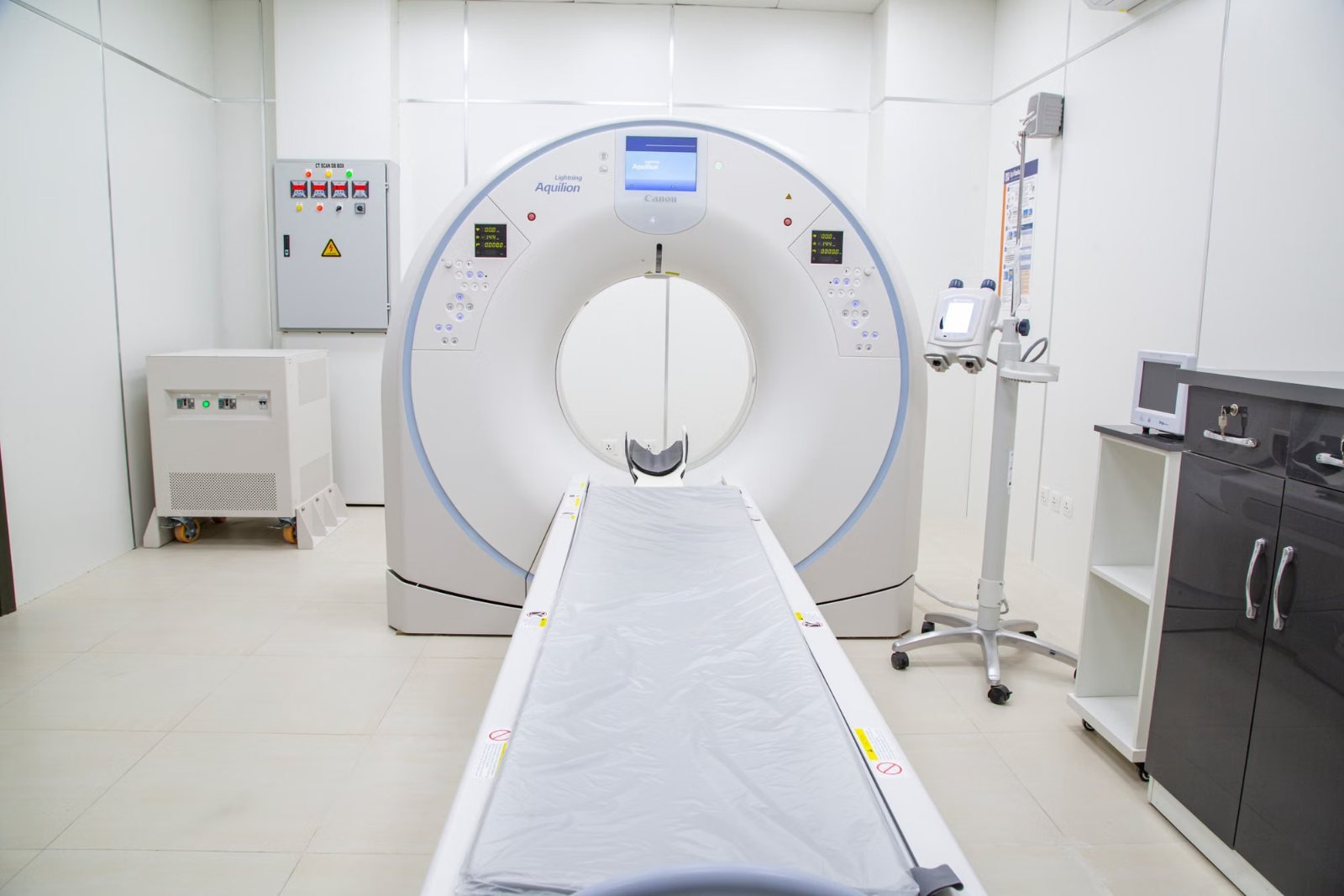
You lie on a flat bed that moves through a ring-shaped scanner. The NHS says the scan usually takes 10 to 20 minutes. Cancer Research UK says the whole appointment can take about an hour and a half, depending on the area being scanned, so allow for time to drink contrast beforehand. The radiographer operates the scanner from another room but can talk to you throughout.
Radiation dose
CT uses X-rays, and an abdomen and pelvis scan covers a large area. The UK Health Security Agency gives a typical effective dose of about 10 mSv for a CT of the abdomen or pelvis, roughly 4.5 years of natural background radiation on its figures, compared with about 2 mSv for a CT head. The NHS says that if you have lots of CT scans there is a very small chance the radiation can cause cancer. That is why each scan has to be justified before it goes ahead. See our guide to radiation safety for more context.
Referral for a private CT abdomen and pelvis
Under the Ionising Radiation (Medical Exposure) Regulations 2017, known as IR(ME)R, every CT scan must be requested by a referrer and justified. Private clinics often arrange this through their own doctor or a clinical review, but a referral and justification step will always be part of the process.
Your scan will be reported by an appropriately qualified clinician, and the clinic will tell you how long its report takes.
When not to wait for a scan
The NHS advises calling 999 or going to A&E if a stomach ache came on very suddenly or is severe, if it hurts when you touch your stomach, if you are vomiting blood, if your poo is bloody or black, or if you cannot pee, or cannot poo or fart. Ask for an urgent GP appointment or contact NHS 111 if the pain gets much worse or does not go away. A private scan is not a substitute for urgent care.
Comparing clinics
Prices vary by clinic, region, whether contrast is used and how many areas are scanned. Clinics on FindScan publish their own prices and we show them as set. Read our private CT scan page, then see CT clinics near you and send an enquiry to the clinic you choose.
Common questions
What does a CT scan of the abdomen show?
It shows cross-sections of the organs in your tummy, such as the liver, pancreas, kidneys and bowel, along with blood vessels and bone. The NHS mentions CT in investigating problems such as kidney stones and diverticulitis, and in finding out how far some cancers have spread.
Do I have to drink anything before a CT abdomen?
Often, yes. Cancer Research UK says you might need to drink a liquid contrast some time before the scan. The clinic will tell you exactly what to drink and when.
Can I eat before a CT abdomen and pelvis?
Follow the clinic's instructions. Cancer Research UK says you may be asked to stop eating and drinking for 2 to 4 hours before a scan with contrast.
How long does a CT abdomen and pelvis take?
The scan itself usually takes 10 to 20 minutes, according to the NHS. Allow longer for the whole appointment if you need to drink contrast first.
Do I need a referral for a private CT abdomen and pelvis?
Yes. CT uses ionising radiation, so under IR(ME)R each scan must be requested by a referrer and justified. Many private clinics arrange this through their own doctor.
References
- CT scan. NHS. Accessed 6 October 2026.
- CT scan. Cancer Research UK. Accessed 6 October 2026.
- Kidney stones: diagnosis. NHS. Accessed 6 October 2026.
- Diverticular disease and diverticulitis. NHS. Accessed 6 October 2026.
- Tests and next steps for bowel cancer. NHS. Accessed 6 October 2026.
- Stomach ache. NHS. Accessed 6 October 2026.
- Patient dose information: guidance. UK Health Security Agency. Accessed 6 October 2026.
- The Ionising Radiation (Medical Exposure) Regulations 2017, SI 2017/1322. legislation.gov.uk. Accessed 6 October 2026.
This article is general information, not medical advice, and it does not replace an assessment by a clinician. If you have symptoms that worry you, speak to your GP or call 111. In an emergency, call 999.