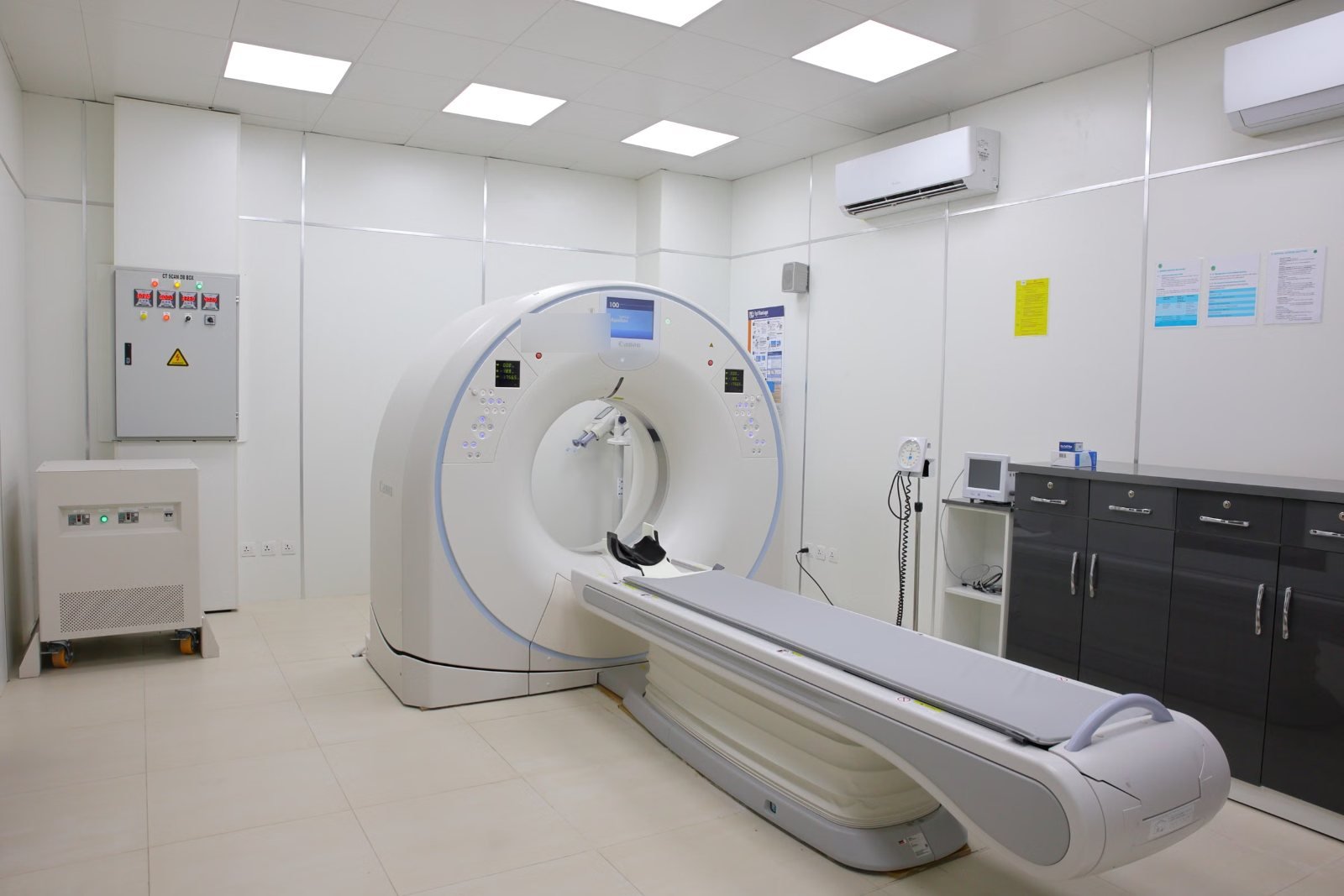
MRI vs CT (CAT) Scan: Which One Do You Need?
Two scans that look alike from the outside and do very different jobs. A CT scan is sometimes called a CAT scan, short for computerised axial tomography; it is the same test. Here is what each one is good at, where they overlap, and what actually decides which you have.
Written by the FindScan Editorial Team and reviewed by our Medical Advisor, Dr Mohamed Najjar
Reviewed
MRI and CT are the two scans people most often get offered, and the two most often confused. Both produce cross-sectional pictures of the inside of the body, both involve lying on a table that moves into a machine, and both are reported by an appropriately qualified clinician. Beyond that they are different technologies answering different questions. MRI uses a strong magnet and radio waves and is the better test for soft tissue: the brain, the spinal cord, ligaments, cartilage, tendons and most organs. CT uses X-rays and is faster, better for bone and the lungs, and the test of choice when time matters. The scan you need is set by the question being asked, not by which machine is newer or more expensive.
So if you are weighing up a CT scan versus MRI, or wondering whether you need an MRI or CT scan, the answer depends on what your doctor needs to see. For CT there must always be a referrer, because it uses ionising radiation and is covered by IR(ME)R 2017.
This page is general information, not medical advice. If you have symptoms that worry you, speak to your GP.
How each scan makes its picture
An MRI scanner is a large magnet. When you lie inside it, the hydrogen atoms in your body line up with the magnetic field; pulses of radio waves knock them briefly out of line, and the scanner listens to the signal they give off as they settle back. Different tissues settle at different rates, which is why MRI can tell a healthy disc from a bulging one or a torn ligament from an intact one. No ionising radiation is involved, so there is no radiation dose from an MRI at all.
A CT scanner is an X-ray tube that rotates around you while the table moves through the ring. A computer reconstructs hundreds of thin slices from the readings. Because it is built on X-rays, CT is very good at anything that stops X-rays: bone, calcium, metal, contrast dye in blood vessels, and the air-filled structure of the lungs. The trade-off is a radiation dose, which varies a great deal depending on which part of the body is scanned.
What MRI is better for
MRI is the stronger test for soft tissue detail. In practice that means:
- Brain and spinal cord: multiple sclerosis, tumours, the effects of stroke after the first hours, pituitary and inner-ear problems.
- Spine: disc prolapse, nerve root compression, the causes of sciatica and persistent back pain where imaging is actually indicated.
- Joints: cartilage, menisci, cruciate ligaments, rotator cuff tendons and labral tears, which CT shows poorly.
- Pelvis and prostate: multiparametric prostate MRI now comes before biopsy in the UK pathway.
- Liver, pancreas, bile ducts and the female pelvis, where tissue contrast matters more than speed.
The NHS lists finding the cause of symptoms, checking bones and organs, and monitoring how a treatment is working among the common reasons for an MRI. It also notes a scan usually takes between 15 minutes and an hour, which is the main practical cost of MRI: you have to lie still for longer, in a narrower and noisier space, than you would for CT.
What CT is better for
CT wins where speed, bone or the lungs are the point:
- Trauma and emergencies: a head CT after a serious injury or a suspected bleed takes minutes and shows fresh blood clearly.
- Chest: the lungs, airways, blood clots in the pulmonary arteries with contrast, and lung screening where it is appropriate.
- Bone: complex fractures, bone detail around joints before surgery, and anything involving calcium.
- Abdomen and pelvis for acute pain: appendicitis, kidney stones, bowel obstruction, and staging of many cancers.
- People who cannot have an MRI because of an incompatible implant, or who cannot tolerate the longer scan.
The NHS describes a CT scan as usually taking between 10 and 20 minutes. For a person in pain or distress, or a child, that difference alone can decide the test.
Radiation: the one difference that is not a matter of degree
MRI involves no ionising radiation. CT always does, and the amount depends on the region. The UK Health Security Agency publishes dose comparisons that put a head CT at about 1.4 millisieverts and a chest CT at about 6.6 millisieverts, against an average UK background exposure of roughly 2.6 millisieverts a year from natural sources. A single chest X-ray, for comparison, is about 0.014 millisieverts.
None of this makes CT dangerous when it is the right test; the NHS is clear that the risk from any one scan is very small and that doctors weigh it before referring. It does mean CT is not a scan to have on a whim, and it is the reason UK law requires a registered healthcare professional to refer you for any X-ray-based scan, CT included, under the Ionising Radiation (Medical Exposure) Regulations 2017. MRI and ultrasound carry no such legal requirement, which is why many private clinics accept self-referral for MRI but will arrange a referral on your behalf for CT. Our guide to having an MRI without a GP referral covers that in more detail.
Safety and who cannot have which scan
The main MRI question is metal. Pacemakers, some implanted devices, certain aneurysm clips and metal fragments in the eye can rule MRI out or need checking first. Modern implants are often MRI-conditional rather than forbidden, but the clinic has to confirm the make and model before you go in. The MHRA publishes the safety guidelines UK scanner units work to. If you have anything implanted, read our piece on MRI safety with metal implants and tell the clinic before you book.
For CT the main cautions are pregnancy, because of the radiation, and the contrast dye, which is checked against kidney function and any history of reaction. Both scans sometimes use contrast; MRI uses a gadolinium-based agent, CT an iodine-based one, and they are not interchangeable in terms of who can have them.
Where they overlap, and how the choice is made
Plenty of questions can be answered by either scan, and the choice then comes down to detail versus speed, radiation, availability, cost and what the referrer is trying to rule out. A good example is the abdomen: CT is the usual first test for acute pain, while MRI is preferred for characterising a liver lesion found on another scan. In the spine, CT shows the bones and MRI shows the discs and nerves, so the two are sometimes used together.
The Royal College of Radiologists publishes iRefer, the referral guidelines UK clinicians use to pick the appropriate test for a given presentation. If a clinic suggests a scan you were not expecting, that is the standard they should be able to point to. The honest answer to "MRI or CT?" is usually "it depends what we are looking for", and a clinician who asks about your symptoms before naming a scan is doing it properly.
What this means if you are paying privately
If you are self-referring, the first conversation with a clinic should be about the question, not the machine. Describe the symptom and where it is, and let them advise which scan fits. Expect a clinic to ask about implants before an MRI and to arrange a referrer before a CT. Expect the report to be written by an appropriately qualified clinician for that type of imaging, and ask when the report is included in the price and how it will reach you. Our guides to private MRI costs and private CT costs explain what moves the price of each.
Common questions
Is a CAT scan the same as a CT scan?
Yes. CAT stands for computerised axial tomography, the older name for computed tomography (CT). The scanner and the test are the same. Because CT uses X-rays, a private CT scan in the UK needs a referral from a doctor or another qualified referrer, while many private clinics accept self-referral for MRI.
Is MRI more accurate than CT?
Neither is more accurate in general. MRI gives better soft-tissue detail; CT gives better bone and lung detail and is faster. Accuracy depends on matching the scan to the question.
Can I choose a CT instead of an MRI to avoid the tunnel?
Sometimes, if CT can answer the same question, but often it cannot. Wide-bore and open MRI scanners exist for people who struggle with the standard tunnel; see our guide to claustrophobia and MRI options.
Does MRI use radiation?
No. MRI uses a magnetic field and radio waves. CT uses X-rays and carries a radiation dose that depends on the region scanned.
Do I need a referral for a CT scan?
Yes. UK law requires a registered healthcare professional to refer you for any scan that uses ionising radiation, including CT. Private clinics usually arrange this through their own clinicians. MRI has no such legal requirement.
References
- MRI scan: what it is, why it is done and what happens. NHS. Accessed 5 October 2026.
- CT scan: what it is, why it is done and what happens. NHS. Accessed 5 October 2026.
- Ionising radiation: dose comparisons (GOV.UK). UK Health Security Agency. Accessed 5 October 2026.
- The Ionising Radiation (Medical Exposure) Regulations 2017, SI 2017/1322 (legislation.gov.uk). legislation.gov.uk. Accessed 5 October 2026.
- Safety guidelines for magnetic resonance imaging equipment in clinical use (GOV.UK). MHRA. Accessed 5 October 2026.
- iRefer: making the best use of clinical radiology. Royal College of Radiologists. Accessed 5 October 2026.
This article is general information, not medical advice, and it does not replace an assessment by a clinician. If you have symptoms that worry you, speak to your GP or call 111. In an emergency, call 999.