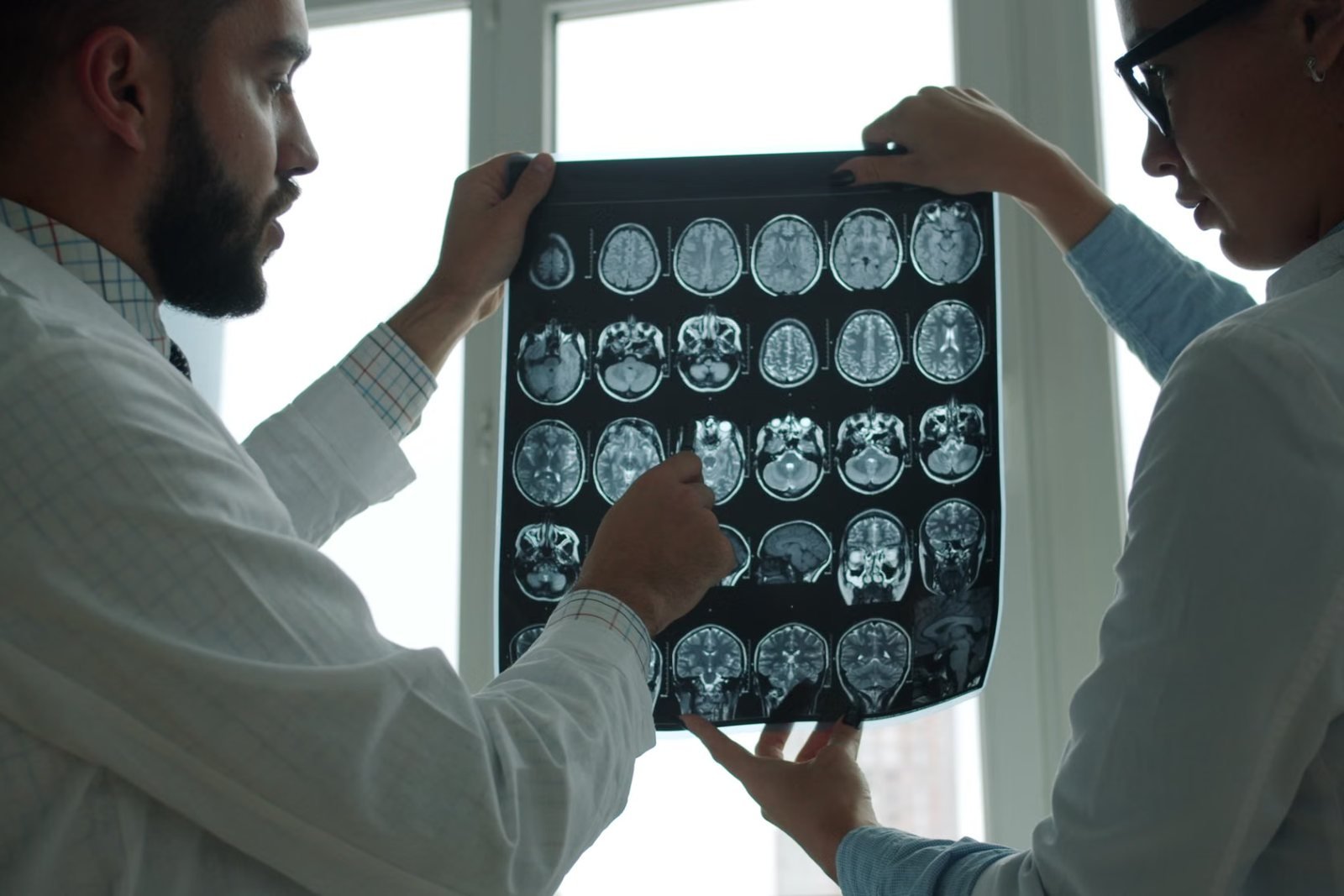
Lesions on a Brain MRI: What They Can Mean
Words like lesion or white matter hyperintensity on a brain MRI report can be unsettling. They describe how something looks on the scan, not a diagnosis, and the right person to explain them is the doctor who asked for the scan.
Brain MRI reports are written for doctors, and some of the terms sound more worrying than they often turn out to be. Lesion is a broad word for an area that looks different from the tissue around it. White matter hyperintensities are small areas that appear bright on certain MRI images, in the white matter that connects different parts of the brain.
This guide explains in general terms what these findings can be associated with, using NHS and NICE information and a UK study of brain MRI scans. It cannot tell you what your own scan means. Only a clinician who knows your history, your symptoms and the full set of images can do that, so please use it to prepare questions for that conversation rather than to reach your own conclusions.
A description, not a diagnosis
A radiology report describes what the images show. A phrase such as a few small white matter hyperintensities is a description of appearance, and the same appearance can have several different causes. Reports sometimes call a finding non-specific, which means the appearance on its own does not point to one cause.
Your referring doctor puts the report together with your symptoms, an examination and any other tests. That is why two people with similar wording on their reports can be given quite different advice.
These findings are common, especially with age
White matter hyperintensities are among the most frequent findings on brain MRI, and they are often found on scans done for another reason. A UK study published in BMC Neurology looked at 1,033 people referred urgently by their GP for a brain MRI. It found white matter hyperintensities in roughly 1 in 5 people under 50, and on 89.7% of scans in people over 80.
The study's authors note that white matter hyperintensities often indicate cerebral small vessel disease, but can also be associated with migraine and with demyelination, the kind of nerve damage seen in conditions such as multiple sclerosis. Finding them is not unusual, and on its own it does not tell you which of these applies.
Small vessel disease
The most common explanation, particularly in older adults, is change in the small blood vessels deep inside the brain. In the BMC Neurology study, almost all the white matter hyperintensities seen in people over 80 had an appearance consistent with small vessel disease.
The NHS describes narrowing of the small blood vessels deep inside the brain, known as small vessel disease, as one cause of vascular dementia. A report mentioning small vessel changes does not mean you have dementia, and that is something only your doctor can assess. The risk factors the NHS lists for vascular dementia include high blood pressure, smoking, high cholesterol, diabetes, being overweight, lack of exercise and drinking too much alcohol, and the study's authors point to blood pressure management as a key part of care. So your GP may want to check things such as your blood pressure, cholesterol and blood sugar.
Migraine
The BMC Neurology authors list migraine among the conditions associated with white matter hyperintensities. If you have migraine and a scan shows a few small bright spots, your doctor will weigh that alongside your history.
It is worth knowing that NICE headache guidance advises that people diagnosed with migraine should not be referred for brain imaging solely for reassurance. If migraine is your main concern, a GP appointment is usually the right place to start.
Multiple sclerosis
MRI is one of the tests used when doctors are investigating multiple sclerosis (MS). The NHS says there is no single test to diagnose MS. A neurologist makes the diagnosis, using a neurological examination, blood tests, an MRI scan to see if there is damage to the nerves in the brain or spinal cord, and sometimes a lumbar puncture or tests of how quickly messages travel from the eyes or ears to the brain.
So white matter spots on a report do not, by themselves, mean MS. If your doctor thinks MS needs to be considered, they will refer you to a neurologist, who will look at the whole picture.
Other possible causes
Lesion is a wide term. The BMC Neurology authors also list traumatic brain injury among the conditions linked with white matter hyperintensities, and the NHS lists MRI and CT among the scans used to diagnose a stroke and show what type it was. If any of these apply to you, your doctor will explain what the report means in your case.
What to do next
Discuss the report with the doctor who referred you. If you arranged a private scan and the report came to you directly, take it to your GP. Questions you might ask:
- What do these findings most likely mean for me?
- Do they explain my symptoms, or were they found by chance?
- Do I need further tests, a specialist opinion or a repeat scan?
- Is there anything I should do, such as having my blood pressure checked?
Call 999 if you or someone else shows signs of a stroke. The NHS uses FAST: face, arms, speech and time to call 999. The NHS also says to call 999 for a headache that came on suddenly and is extremely painful, or for weakness or being unable to move one side of the body or face.
Having a brain MRI privately
MRI does not use ionising radiation, so IR(ME)R does not apply. Many private clinics accept self-referral, usually after their own safety screening, but each clinic sets its own policy. Every scan is reported by an appropriately qualified clinician, and the clinic will tell you how long its report takes. Our guide to what a brain MRI shows and the brain MRI scan page explain more, and you can see clinics near you and send an enquiry. Before arranging a scan, it is worth speaking to your GP about whether one is needed.
Common questions
Are white matter lesions on an MRI serious?
They can mean different things. They are common, become more common with age, and are often found on scans done for another reason. They can be linked to small vessel changes, migraine, demyelination or other causes. Your referring doctor is the right person to explain what they mean for you.
Do white matter hyperintensities mean I have MS?
Not on their own. The NHS says there is no single test for MS. A neurologist diagnoses it using an examination, MRI and sometimes other tests such as a lumbar puncture. White matter spots have several possible causes.
Can migraine cause white spots on a brain MRI?
Migraine is one of the conditions associated with white matter hyperintensities, according to the authors of a UK study in BMC Neurology. NICE advises that people diagnosed with migraine should not be referred for brain imaging solely for reassurance.
Should I have another scan to check them?
That is a decision for your doctor, based on your symptoms and the full report. Some findings need follow-up and many do not. Ask your doctor directly whether a repeat scan or a specialist referral is needed.
Who can explain my brain MRI report?
The doctor who referred you for the scan. If you arranged a private scan and received the report yourself, book an appointment with your GP and take the report with you.
References
- Prevalence of white matter hyperintensities and radiological cerebral small vessel disease: an insight from routinely collected data. DOI 10.1186/s12883-025-04557-y. BMC Neurology (Maskery et al., 2025). Accessed 6 October 2026.
- Causes of vascular dementia. NHS. Accessed 6 October 2026.
- Multiple sclerosis. NHS. Accessed 6 October 2026.
- Headaches in over 12s: diagnosis and management (CG150), recommendations. NICE. Accessed 6 October 2026.
- Migraine. NHS. Accessed 6 October 2026.
- Diagnosing a stroke. NHS. Accessed 6 October 2026.
- Symptoms of a stroke. NHS. Accessed 6 October 2026.
This article is general information, not medical advice, and it does not replace an assessment by a clinician. If you have symptoms that worry you, speak to your GP or call 111. In an emergency, call 999.