Carotid Ultrasound: What the Neck Artery Scan Checks and Why It Is Not a Stroke Screening Test
World Stroke Day falls on 29 October, and every year it prompts searches for a scan that will check your stroke risk. A carotid ultrasound does look at the arteries that feed the brain, but it is a test with a specific job. Here is what it shows, when the NHS uses it and why it is not a screening test.
Written by the FindScan Editorial Team and reviewed by our Medical Advisor, Dr Mohamed Najjar
Reviewed
World Stroke Day is on 29 October, and the World Stroke Organization's message this year is that every minute counts: learn the signs of stroke today. Around the same date, searches for a scan that checks your stroke risk climb, and private clinics offer a carotid ultrasound, sometimes called a carotid doppler, as that check.
The scan is real and useful, but it answers one question: are the arteries in the neck narrowed? The NHS uses it quickly after a transient ischaemic attack or stroke, and GOV.UK and NHS policies say it should not be used to screen people with no symptoms.
First, the signs: FAST and 999
The NHS stroke page uses the word FAST for the main symptoms: face, arms, speech and time to call 999. The face may drop on one side, the person may not be able to lift both arms and keep them there, and their speech may be slurred or confused. The NHS adds that symptoms can sometimes stop after a short time, so you may think you are fine, and that even if this happens you should get medical help straight away.
A transient ischaemic attack, or TIA, is exactly that. The NHS says the symptoms fully resolve within 24 hours, that it is important to call 999 immediately if they are happening now, and that you still need to be assessed in hospital even if they disappear while you wait. If you had symptoms earlier and did not seek advice at the time, the NHS says to make an urgent appointment with a GP.
What a carotid ultrasound shows
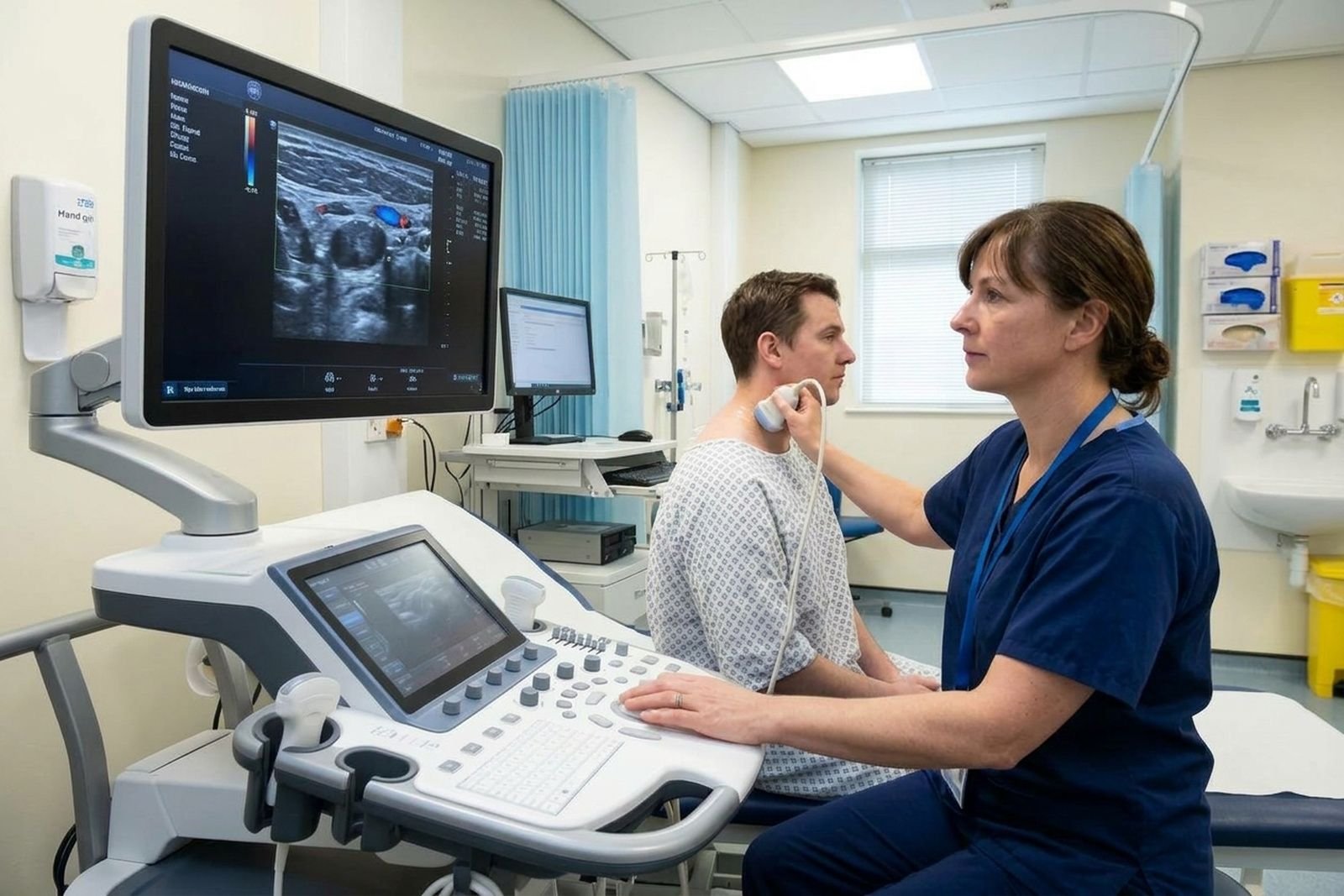
The NHS TIA diagnosis page describes the test simply: a carotid ultrasound scan uses sound waves to create images of the neck arteries leading to your brain and can show if there is any narrowing or blockage. The doppler part of the scan measures how fast blood is moving, which is how narrowing is estimated. The NHS says ultrasound scans do not use radiation and that a scan typically takes 10 to 45 minutes.
The narrowing it looks for is carotid artery disease. The NHS carotid endarterectomy page says this is where one or both carotid arteries in the neck is narrowed by a build-up of fatty material, which can reduce blood flow to the brain or eye and raises the risk of a stroke or TIA.
When the NHS uses it: after a TIA or stroke
In the NHS the carotid scan is part of a fast pathway. NICE's stroke and TIA guideline (NG128) says to refer people who have had a suspected TIA immediately for specialist assessment and investigation, to be seen within 24 hours of onset of symptoms, and that everyone with TIA who after specialist assessment is considered a candidate for carotid endarterectomy should have urgent carotid imaging. The NHS TIA page lists the other parts of that assessment, including a blood pressure check and an electrocardiogram, which can detect abnormal heart rhythms. It adds that brain scans are not always necessary after a TIA.
The point of scanning quickly is that the treatment is time-sensitive. The NHS says that if you have had symptoms and your carotid artery is more than 50% narrowed, you will need a carotid endarterectomy as soon as possible. A private scan arranged for next week would be slower than the NHS route and would not connect you to the surgeon who acts on the result.
Why it is not a screening test
Screening means testing people who have no symptoms. GOV.UK's page on private screening, published by Public Health England, says private companies offer screening for conditions not included on the NHS, and for carotid narrowing its verdict is that prevention methods are currently more effective than screening and that the available treatment carries a higher risk than benefit. Instead it points people aged 40 to 74 to the free NHS Health Check, which the NHS says is offered every 5 years, checks blood pressure, cholesterol, height, weight and waist, and gives you a score for your risk of problems including stroke.
NHS commissioning policies say the same. The Humber and North Yorkshire policy on carotid artery imaging, effective from December 2025, does not commission carotid imaging for people without symptoms of carotid artery disease, citing the 2021 US Preventive Services Task Force conclusion that the harms of screening outweigh the benefits.
There is also a simpler problem. The neck arteries are one cause of stroke among several, which is why the NHS lists heart rhythm and blood pressure checks alongside the carotid scan. A normal carotid ultrasound does not mean you will not have a stroke. Our guide to the limits of health scans covers why a normal result can be less reassuring than it feels.
When a private carotid ultrasound can make sense
The scan has a legitimate private use when a clinician has asked for it: a specialist who wants a repeat scan of a known narrowing, a surgeon planning an operation, or a GP who has examined you and wants the arteries looked at before deciding on a referral. Then the question has already been asked and the report has somewhere to go.
Ultrasound does not use ionising radiation, so the Ionising Radiation (Medical Exposure) Regulations do not apply and many clinics accept self-referral after their own screening questions, although some still ask for a referral for vascular scans. Our guide to seeing a GP before a scan explains why that conversation is worth having first.
The report, and comparing clinics
You lie back with your neck exposed, gel is applied and the probe is moved along each side of the neck. The report is written by a sonographer or radiologist and typically estimates any narrowing as a percentage, the measure the NHS uses for its 50% threshold.
Take the report to the clinician who asked for the scan, or to your GP, who can put it alongside your blood pressure, heart rhythm and other risk factors. A percentage on its own is not a plan.
If a clinician has recommended a carotid ultrasound, you can compare ultrasound clinics near you and send an enquiry; the clinic contacts you to confirm whether it needs a referral and the next steps.
FindScan is a directory of independent, regulated imaging clinics: you compare clinics and send an enquiry, and the clinic contacts you. We are not a healthcare provider, and nothing here replaces advice from your GP or specialist. If you or someone with you has any FAST symptom, call 999 now, even if it has passed.
Common questions
Can I have a carotid ultrasound to check my stroke risk?
You can find clinics that offer it, but GOV.UK's private screening page says prevention is currently more effective than screening for carotid narrowing, and NHS commissioning policies do not fund the scan for people without symptoms. For a stroke risk assessment, GOV.UK points people aged 40 to 74 to the NHS Health Check.
What does 50% narrowing mean?
It is the figure the NHS uses on its carotid endarterectomy page: if you have had symptoms and your carotid artery is more than 50% narrowed, you will need the operation as soon as possible. For someone without symptoms the NHS says surgery may still be needed, which is a specialist decision.
Does a normal carotid ultrasound mean I will not have a stroke?
No. The neck arteries are one cause among several, which is why the NHS TIA assessment also checks blood pressure and heart rhythm. A normal scan tells you about the arteries on the day.
I had stroke-like symptoms last week that went away. Should I get a scan?
Not by yourself. The NHS says to call 999 immediately for TIA or stroke symptoms that are happening now, and to make an urgent appointment with a GP if you had symptoms earlier and did not seek advice. NICE says suspected TIA should be assessed by a specialist within 24 hours, and that pathway includes the carotid scan if it is needed.
Do I need a referral for a private carotid ultrasound?
Not by law, because ultrasound does not use ionising radiation, but each clinic sets its own policy and vascular scans are an area where a referral is often requested. Ask when you enquire.
References
- World Stroke Day campaign (29 October 2026: Every M1nute Counts). World Stroke Organization. Accessed 27 October 2026.
- Stroke: symptoms. NHS. Accessed 27 October 2026.
- Transient ischaemic attack (TIA). NHS. Accessed 27 October 2026.
- Transient ischaemic attack (TIA): diagnosis. NHS. Accessed 27 October 2026.
- NG128 Stroke and transient ischaemic attack in over 16s: diagnosis and initial management (recommendations). NICE. Accessed 27 October 2026.
- Carotid endarterectomy: why it's done. NHS. Accessed 27 October 2026.
- Ultrasound scan. NHS. Accessed 27 October 2026.
- Private screening for health conditions: NHS recommendations. GOV.UK (Public Health England). Accessed 27 October 2026.
- NHS Health Check. NHS. Accessed 27 October 2026.
- Carotid artery imaging (screening) policy. NHS Humber and North Yorkshire Health and Care Partnership. Accessed 27 October 2026.
- The Ionising Radiation (Medical Exposure) Regulations 2017. legislation.gov.uk. Accessed 27 October 2026.
This article is general information, not medical advice, and it does not replace an assessment by a clinician. If you have symptoms that worry you, speak to your GP or call 111. In an emergency, call 999.