DEXA scan results explained: T-scores, Z-scores and what happens next
Your DEXA report gives your bone density as a T-score and a Z-score. Here is what those numbers mean, how doctors use them with tools like FRAX, and who decides what happens next.
Written by the FindScan Editorial Team and reviewed by our Medical Advisor, Dr Mohamed Najjar
Reviewed
A DEXA scan report can look like a page of codes and minus numbers. Once you know what the two main scores mean, it becomes much easier to follow. This guide explains DEXA scan results in plain English, so you can have a more useful conversation with your GP or specialist. If you are still at the stage of looking for a scan, our DEXA scan page explains how to compare clinics.
What a DEXA scan measures
A DEXA scan, also called a bone density scan, uses low dose X-rays to see how dense your bones are. The NHS says these scans are often used to diagnose osteoporosis or to assess your risk of it.
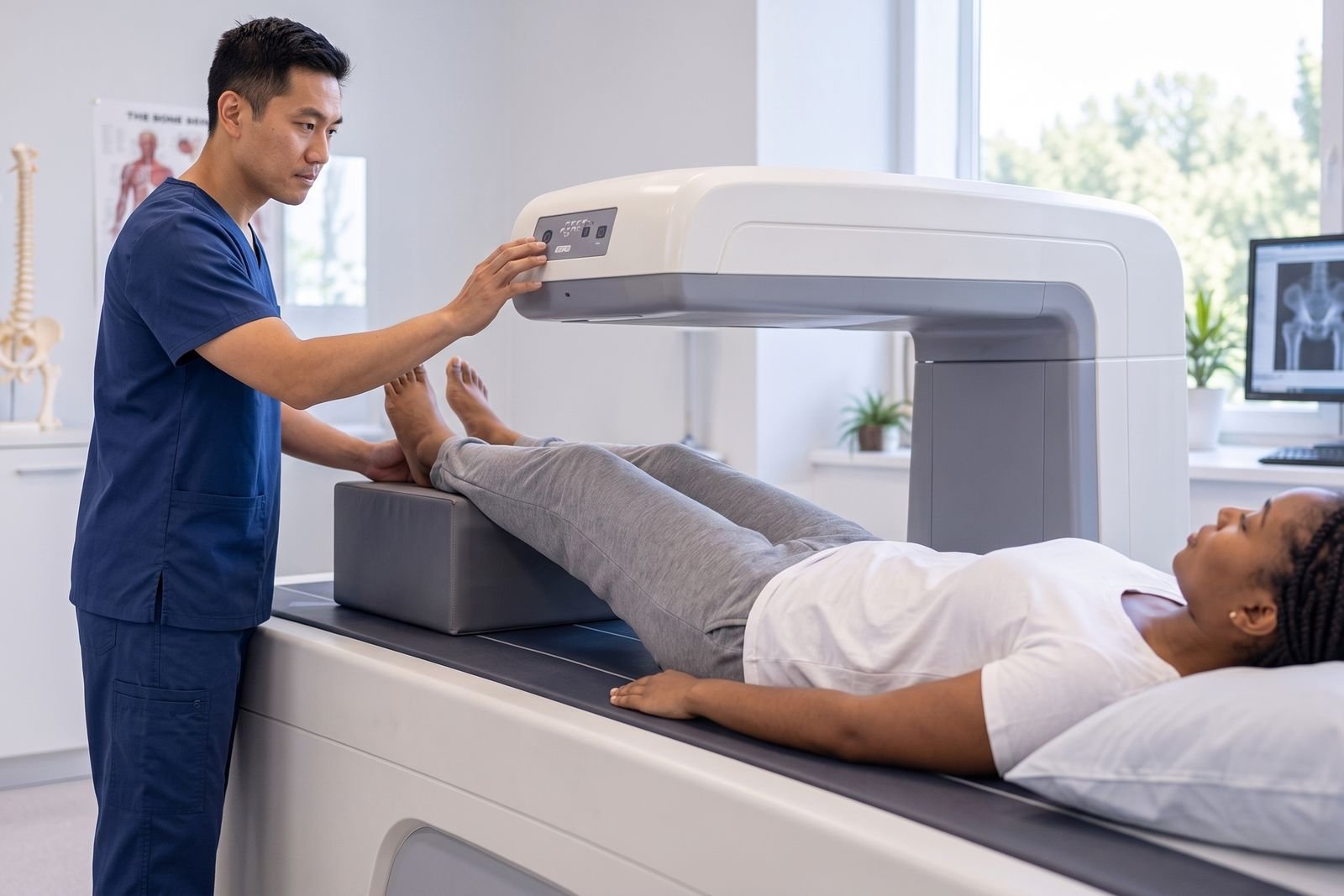
During the scan you lie on your back on an open table. The NHS explains that the areas scanned are usually your hip and lower spine. The forearm is sometimes scanned instead, for example when the hip or spine cannot be scanned. Because bone density varies around the skeleton, more than one area may be measured.
The machine works out your bone mineral density at each site. That number is then compared with reference values to give two scores: a T-score and a Z-score.
The T-score in plain English
The T-score compares your bone density with that of a young healthy adult. The Royal Osteoporosis Society describes it as comparing your result with the normal range found in young healthy adults.
The score is given in units called standard deviations, often shortened to SD. A standard deviation is simply a way of measuring how far a result sits from the expected value. So:
- A T-score of 0 means your bone density is about the same as the young adult average.
- A T-score of -1 means it is one standard deviation below that average.
- A T-score of -2.5 means it is two and a half standard deviations below.
Most adults lose some bone as they get older. The NHS notes that losing bone is a normal part of ageing, although some people lose it much faster than others.
The WHO categories: normal, osteopenia and osteoporosis
The World Health Organization (WHO) groups T-scores into three bands. The NHS sets these out on its guide to what happens during a DEXA scan:
- Normal: a T-score above -1.
- Osteopenia (low bone density): a T-score between -1 and -2.5. The NHS describes this as mildly reduced bone density compared with peak bone mass.
- Osteoporosis: a T-score of -2.5 or lower.
Hospital DEXA services use the same bands. For example, Hampshire Hospitals NHS Foundation Trust explains that a score between 1 and -1 is in the normal range, and that a score between -1 and -2.5 is called osteopenia.
As an example, a T-score of -1.8 would sit in the osteopenia band, and a T-score of -2.7 would sit in the osteoporosis band. If more than one area was scanned, your report may show a separate score for each one, and the scores do not always fall in the same band. Your doctor will explain how they apply to you.
Osteopenia can sound worrying, but it is not the same as osteoporosis. The NHS says osteopenia is an earlier stage of bone loss and that it does not always progress to osteoporosis.
The Z-score explained
The Z-score compares your bone density with what is expected for someone of the same age, rather than with a young adult. The Royal Osteoporosis Society puts it the same way: it compares you with people of the same age as you.
According to the NHS, a Z-score below -2 means your bone density is lower than expected for your age. The NHS also says Z-scores are mainly used for children and for people under 30 who are still growing.
Your report may show both scores for each site scanned. Which one matters most depends on your age and situation, so it is best to ask the person who requested the scan how they are reading it.
Why the scores are only part of the picture
A DEXA result is a measurement, not a full diagnosis on its own. The NHS says bone density is a good indicator of bone strength, but that the results will not necessarily predict whether you'll get a fracture. Things like age, sex and previous falls also affect your risk.
The Royal Osteoporosis Society makes a similar point. It explains that other risk factors are added to your scan result, and that the decision to offer a medicine is based on your overall chance of breaking a bone in the next 10 years, not on bone density alone.
The NHS lists a range of risk factors for osteoporosis. These include long-term use of high-dose steroid tablets, some medical conditions, a parent who broke a hip, a low body mass index, heavy drinking and smoking. Women are at higher risk, especially after an early menopause.
How FRAX fits in
FRAX is an online tool that estimates your chance of breaking a bone. The NHS explains that doctors may use tools such as FRAX or Q-Fracture to estimate future fracture risk, and that FRAX was developed by the University of Sheffield.
NICE guidance on assessing fracture risk (CG146) sets out how these tools are used in practice:
- Fracture risk assessment should be considered for all women aged 65 and over and all men aged 75 and over, and for younger people with risk factors such as a previous fragility fracture or regular steroid use.
- The tools estimate your 10-year risk of fracture as a percentage.
- Bone density should not be measured routinely before a FRAX or QFracture assessment.
- If your risk is close to the level where treatment would be considered, a DEXA scan can be added and the risk worked out again with your bone density included.
In other words, your DEXA scan result often feeds into a FRAX calculation. The combined picture helps your doctor decide what to do next.
Who explains your results
After the scan, a written report is produced. Our guide to the difference between a radiographer and a radiologist explains who does what. If you want to know when your report is likely to arrive, see how long scan results take.
The next steps come from your GP or specialist. The Royal Osteoporosis Society says your first port of call should always be your GP or specialist, who can explain the results alongside your overall health, age and family history.
The NHS says osteoporosis treatment is based on treating and preventing broken bones, and that whether you need treatment depends on your future fracture risk. Your doctor can recommend the most suitable plan.
Useful questions to ask
When you speak to your GP or specialist about your results, you might find it helpful to ask:
- Which areas were scanned, and which score are you using for me?
- What does my result mean alongside my other risk factors?
- What is my estimated 10-year fracture risk?
- Is there anything I should change, or any treatment you would suggest?
- Will I need another scan, and if so, when?
On repeat scans, NICE says that if your first result was close to the treatment threshold, your risk can be reassessed after a minimum of 2 years, or sooner if your risk factors change.
What a normal result does and does not mean
A T-score in the normal range is reassuring about your bone density on the day of the scan. It does not mean you cannot break a bone, and it does not rule out other conditions. As the NHS points out, other things such as falls also play a part in fracture risk.
Equally, a result in the osteopenia or osteoporosis range is not a reason to panic. It is information that helps your doctor plan the right support for you. To learn more about the condition itself, read our guide to osteoporosis signs and DEXA scans.
This article is general information, not medical advice. Please speak to your GP or the clinician who referred you about any symptoms or about your results, and if your symptoms are urgent, call NHS 111 or 999.
Finding a private scan
You can compare clinics offering DEXA scans on FindScan, where each clinic lists its own price, and send an enquiry to the clinic you choose. The clinic will then contact you to confirm details and the final price. DEXA uses ionising radiation, so under IR(ME)R 2017 every scan must be justified and needs a referrer; many private clinics can arrange this through their own doctor. Our guide on how to get a DEXA scan explains the steps.
Common questions
What is a normal T-score on a DEXA scan?
Under the World Health Organization bands used by the NHS, a T-score above -1 is in the normal range. A score between -1 and -2.5 is called osteopenia, or low bone density, and a score of -2.5 or lower is classed as osteoporosis. Your doctor will read the score alongside your age, health and other risk factors, because bone density alone does not predict whether you will break a bone.
What does a Z-score mean on a DEXA scan?
A Z-score compares your bone density with what is expected for someone of your own age, rather than with a young adult. The NHS says a Z-score below -2 means your bone density is lower than expected for your age. Z-scores are mainly used for children and for people under 30 who are still growing. Ask your GP or specialist which score they are using in your case.
Is osteopenia the same as osteoporosis?
No. Osteopenia means your bone density is lower than the young adult average, with a T-score between -1 and -2.5. The NHS describes it as an earlier stage of bone loss and says it does not always progress to osteoporosis. Your GP or specialist will look at your overall fracture risk to decide whether any action is needed.
Does a normal DEXA result mean I will not break a bone?
Not necessarily. The NHS says bone density is a good indicator of bone strength, but scan results will not necessarily predict whether you will have a fracture. Age, sex and previous falls also affect your risk. A normal result is reassuring about your bone density, but it does not rule out fractures or other conditions.
How does FRAX relate to my DEXA result?
FRAX is an online tool that estimates your 10-year risk of breaking a bone. NICE guidance says that when someone's risk is close to the level where treatment would be considered, a DEXA scan can be done and the risk recalculated with bone density included. Your doctor uses the combined result to help decide on next steps.
Do I need a referral for a private DEXA scan?
Yes. DEXA uses a low dose of ionising radiation, so under IR(ME)R 2017 every scan must be justified and needs a referrer. Many private clinics can arrange a referral through their own doctor. When you send an enquiry through FindScan, the clinic will contact you and explain how its referral process works.
References
- Bone density scan (DEXA scan). NHS. Accessed 12 October 2026.
- Bone density scan (DEXA scan): What happens. NHS. Accessed 12 October 2026.
- Osteoporosis: Overview. NHS. Accessed 12 October 2026.
- Osteoporosis: assessing the risk of fragility fracture (CG146): Recommendations. NICE. Accessed 12 October 2026.
- DXA scan results: the terminology explained. Royal Osteoporosis Society. Accessed 12 October 2026.
- DEXA bone density. Hampshire Hospitals NHS Foundation Trust. Accessed 12 October 2026.
- The Ionising Radiation (Medical Exposure) Regulations 2017, regulation 11. legislation.gov.uk. Accessed 12 October 2026.
This article is general information, not medical advice, and it does not replace an assessment by a clinician. If you have symptoms that worry you, speak to your GP or call 111. In an emergency, call 999.