Which scan is used for kidney stones?
If a doctor suspects kidney stones, the usual first scan for adults is a low-dose CT scan. Ultrasound is used instead for pregnant women and as the first scan for children, while a plain X-ray has a smaller role.
Written by the FindScan Editorial Team and reviewed by our Medical Advisor, Dr Mohamed Najjar
Reviewed
Get urgent help first if you need it
Kidney stones can cause severe pain, and some symptoms need medical help quickly. The NHS says to ask for an urgent GP appointment or get help from NHS 111 if you think you have kidney stones and you are in severe pain, or you have a high temperature or feel hot, cold or shivery.
An NHS hospital leaflet for people with kidney stones also advises going back to the emergency department if you are unable to pass urine, you develop a fever or feel unwell, or your pain gets worse or is not controlled by medication. These are not reasons to wait for a scan appointment. Get urgent care first.
The short answer: which scan is used for kidney stones?
For most adults with suspected kidney stone pain, the first scan is a low-dose CT scan without contrast dye. Ultrasound is used instead for pregnant women, and as the first scan for children and young people. A plain X-ray has a smaller role, mainly in follow-up.
The sections below explain why, based on the NICE guideline on kidney and ureteric stones. If you are looking into a private CT scan, it helps to understand where CT fits and why the referring clinician makes the choice.
CT scan for kidney stones: the usual first test for adults
Doctors call sudden, severe pain caused by a stone moving through the urinary tract renal colic. NICE guideline NG118 recommends that clinicians offer urgent (within 24 hours of presentation) low-dose non-contrast CT to adults with suspected renal colic. The NHS gives the same advice: if severe pain could be caused by kidney stones, adults should be offered a CT scan, and your GP should refer you to hospital for an urgent scan.
What is a CT KUB?
You may hear this scan called a CT KUB. KUB stands for kidneys, ureters and bladder, which are the parts of the urinary tract the scan covers. It is usually done without contrast dye. One NHS hospital describes the test as a non-contrast CT scan to find out the size and location of the stone.
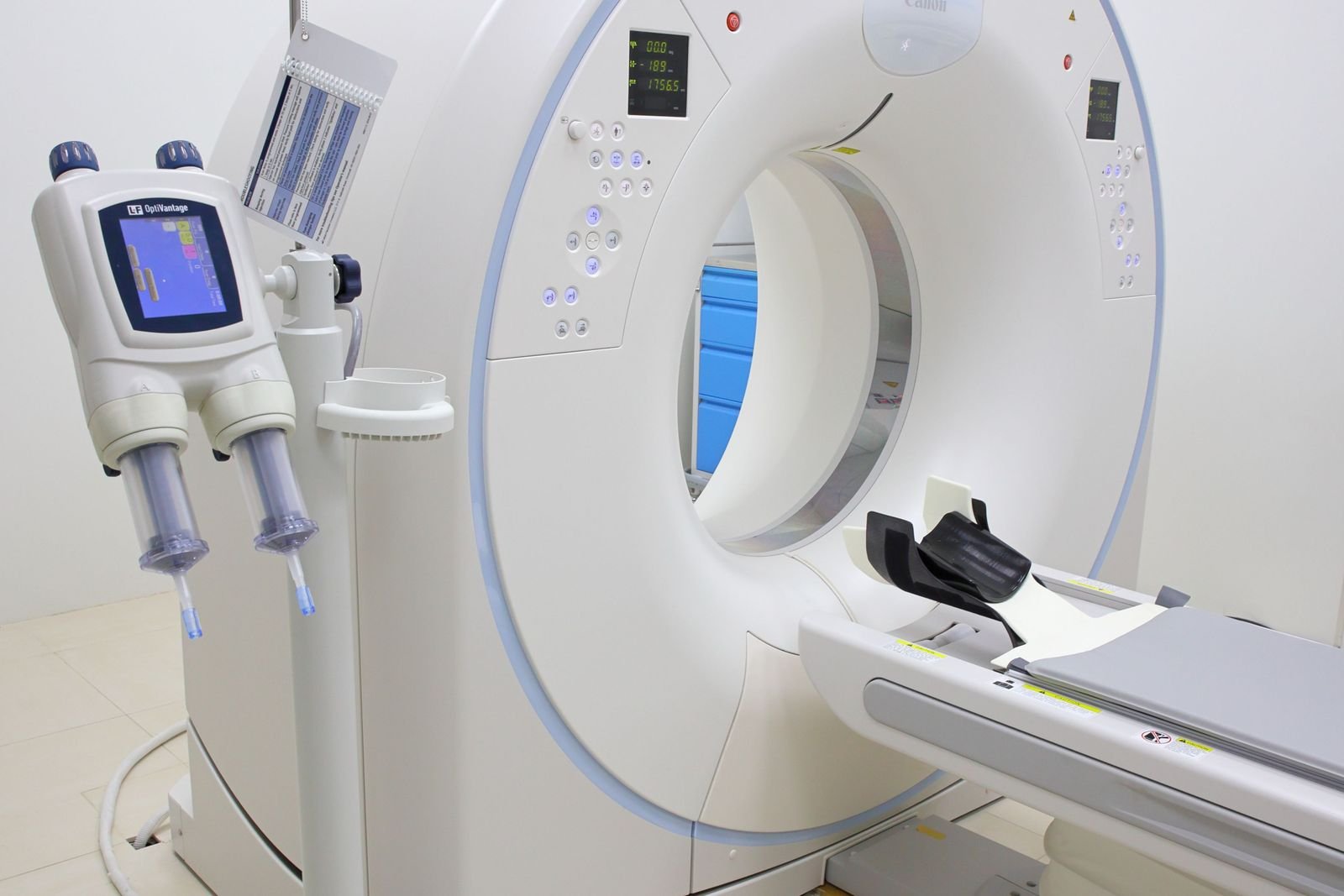
The NHS says a CT scan usually takes between 10 and 20 minutes. You lie on a flat bed that moves through a large ring while the pictures are taken.
Why CT is preferred
NICE explains its reasons in the rationale for the guideline. It found that limited evidence showed that MRI, ultrasound and plain abdominal radiograph were not as good as non-contrast CT for detecting renal and ureteric stones in adults. NICE also says CT should be done as soon as possible because kidney function can decline quickly, although a delay of up to 24 hours is acceptable when needed, for example out of hours.
CT does use X-rays, which is why NICE recommends a low-dose technique and why a CT scan must always be justified before it goes ahead.
Ultrasound for kidney stones
Ultrasound uses sound waves rather than radiation. The NHS says ultrasound scans do not use any radiation, unlike X-rays or CT scans, and that a scan can take around 10 to 45 minutes. This makes it the preferred choice in two groups.
Pregnant women
NICE says that if a woman is pregnant, offer ultrasound instead of CT. Its rationale explains that CT should not be used for pregnant women because of the radiation exposure.
Children and young people
For children and young people with suspected renal colic, NICE recommends urgent ultrasound, within 24 hours, as first-line imaging. If there is still uncertainty about the diagnosis after ultrasound, NICE says to consider low-dose non-contrast CT. The rationale notes serious concern about radiation exposure in children, and also that ultrasound is less accurate than CT and its quality can vary.
Ultrasound in other situations
Ultrasound is used to look at organs inside the body, and an abdominal ultrasound scan can look at the kidneys along with other organs in the abdomen, and our private ultrasound page explains the different types available. For suspected stones in adults who are not pregnant, though, NICE's evidence review found ultrasound less accurate than non-contrast CT, so your clinician may still recommend CT. Our guide to what ultrasound can detect explains more about its strengths and limits.
Where X-ray KUB fits in
A plain X-ray of the kidneys, ureters and bladder is called an X-ray KUB. It is not among NICE's recommended first tests for suspected renal colic, because the evidence NICE reviewed showed that plain abdominal X-rays were not as good as non-contrast CT for detecting stones in adults.
X-ray KUB is sometimes used to follow up stones that have already been found. A 2023 study published in the Journal of Medical Imaging and Radiation Oncology described X-ray as a lower dose alternative for follow-up. It also noted that X-ray only detects stones that show up on X-ray, and that in its patients, ultra-low-dose CT picked up more stones than X-ray. Your specialist will decide which follow-up test suits you, if one is needed.
CT, ultrasound and X-ray KUB compared
- Low-dose CT KUB: uses X-rays. NICE recommends it as the first test for adults with suspected renal colic, because it was the most accurate test for finding stones in the evidence NICE reviewed. Usually takes 10 to 20 minutes.
- Ultrasound: no radiation. Recommended instead of CT in pregnancy, and as the first test for children and young people. Less accurate than CT for finding stones in adults. Usually takes around 10 to 45 minutes.
- X-ray KUB: uses a lower dose of X-rays than CT, but only shows stones that are visible on X-ray. Not a recommended first test, and sometimes used to follow up a known stone.
What the scan result can tell you
A CT scan can show whether a stone is present, along with its size and position, which helps your clinician decide on treatment. A radiologist reports on the images and the report goes to the clinician who requested the scan.
If no stone is seen, that does not mean you have been given a clean bill of health. Your clinician will think about other possible causes of your symptoms and what to do next, so talk through the result with them.
Other tests you may have
A scan is usually only one part of the assessment. The NHS says you may also have urine tests to check for infections and pieces of stones, and blood tests to check that your kidneys are working properly.
NICE also covers pain relief, which is offered alongside imaging. A scan is never a substitute for being assessed by a clinician when you are in pain.
Private scans and kidney stones
If you have sudden severe pain that could be a kidney stone, the right route is urgent NHS care, not a planned private scan. NICE recommends imaging within 24 hours, and the NHS says your GP should refer you to hospital for an urgent scan.
A private scan may be relevant in other situations, for example when a clinician has asked for a non-urgent scan or for follow-up of a known stone. Before you enquire, it helps to know exactly which scan your clinician has asked for, such as a low-dose CT KUB or a kidney ultrasound, and who will receive and explain the report. In every case, CT and X-ray need a referral. Under the Ionising Radiation (Medical Exposure) Regulations 2017, an exposure must not be carried out unless it has been justified as showing a sufficient net benefit.
This article is general information, not medical advice. Please speak to your GP or the clinician who referred you about your symptoms or results, and if your symptoms are urgent, call NHS 111 or 999.
Finding a private scan
You can compare private CT, ultrasound and X-ray clinics on FindScan, see each clinic's own listed price and send an enquiry to the clinic you choose. The clinic will contact you to confirm the details and the final price. CT and X-ray always need a referral under IR(ME)R, and many private clinics can arrange this through their own doctor. Some clinics accept self-referral for ultrasound, depending on the clinic.
Common questions
What is the best scan for kidney stones?
For adults with suspected renal colic, NICE recommends an urgent low-dose CT scan without contrast, within 24 hours. NICE found that MRI, ultrasound and plain X-ray were not as good as non-contrast CT at detecting stones in adults. Pregnant women should be offered ultrasound instead, and ultrasound is the first test for children and young people.
What is a CT KUB?
CT KUB is a CT scan of the kidneys, ureters and bladder. For suspected kidney stones it is usually done at a low dose and without contrast dye, to find the size and position of any stone. The NHS says a CT scan usually takes 10 to 20 minutes. Like all CT scans, it needs a referral.
Can ultrasound detect kidney stones?
Ultrasound can be used to look for kidney stones and does not use radiation. NICE recommends it for pregnant women and as the first test for children and young people. However, the evidence NICE reviewed found ultrasound less accurate than non-contrast CT for adults, so CT is usually the first choice for adults who are not pregnant.
Will an X-ray show kidney stones?
Only some stones show up on a plain X-ray. NICE found plain abdominal X-rays were not as good as non-contrast CT at detecting stones in adults, so X-ray is not a recommended first test. X-ray KUB is sometimes used to follow up a stone that has already been found, because it gives a lower dose than CT.
When should I get urgent help for kidney stone pain?
The NHS says to ask for an urgent GP appointment or contact NHS 111 if you think you have kidney stones and are in severe pain, or have a high temperature or feel hot, cold or shivery. Hospital advice also says to seek urgent care if you cannot pass urine or your pain is not controlled. In an emergency, call 999.
Do I need a referral for a CT scan for kidney stones?
Yes. CT uses X-rays, so under the Ionising Radiation (Medical Exposure) Regulations 2017 it needs a referrer and must be justified before it goes ahead. This applies at private clinics too, and many can arrange a referral through their own doctor. If you have sudden severe pain, seek urgent NHS care rather than waiting for a private scan.
References
- Renal and ureteric stones: assessment and management (NG118), Recommendations. NICE. Accessed 12 October 2026.
- Renal and ureteric stones: assessment and management (NG118), full guideline PDF including rationale. NICE. Accessed 12 October 2026.
- Kidney stones. NHS (nhs.uk). Accessed 12 October 2026.
- Kidney stones: diagnosis. NHS (nhs.uk). Accessed 12 October 2026.
- Kidney Stones (Accident and Emergency patient information). University Hospitals Sussex NHS Foundation Trust. Accessed 12 October 2026.
- Ultrasound scan. NHS (nhs.uk). Accessed 12 October 2026.
- CT scan. NHS (nhs.uk). Accessed 12 October 2026.
- Comparison of diagnostic accuracy of ultra low-dose computed tomography and X-ray of the kidneys, ureters and bladder for urolithiasis in the follow-up setting (Kandasamy et al., Journal of Medical Imaging and Radiation Oncology, 2023). Journal of Medical Imaging and Radiation Oncology (peer-reviewed; abstract via OA.mg). Accessed 12 October 2026.
- The Ionising Radiation (Medical Exposure) Regulations 2017, regulation 11. legislation.gov.uk. Accessed 12 October 2026.
This article is general information, not medical advice, and it does not replace an assessment by a clinician. If you have symptoms that worry you, speak to your GP or call 111. In an emergency, call 999.