Private echocardiogram cost in the UK: what affects the price?
There is no single echocardiogram cost, because the price depends on the type of echo, who reports it and what is included. This guide explains what drives the cost, how the NHS route compares and what to ask a clinic before you go ahead.
Written by the FindScan Editorial Team and reviewed by our Medical Advisor, Dr Mohamed Najjar
Reviewed
If you are thinking about a private heart scan, one of the first questions is usually about echocardiogram cost. The honest answer is that there is no single figure. The price depends on which type of echo you need, who carries it out and reports it, whether a cardiologist reviews you, and where you have it done. This guide explains what drives the cost, how the NHS route compares, and what to ask a clinic. You can compare private echocardiogram clinics on FindScan, where each clinic lists its own price.
What is an echocardiogram?
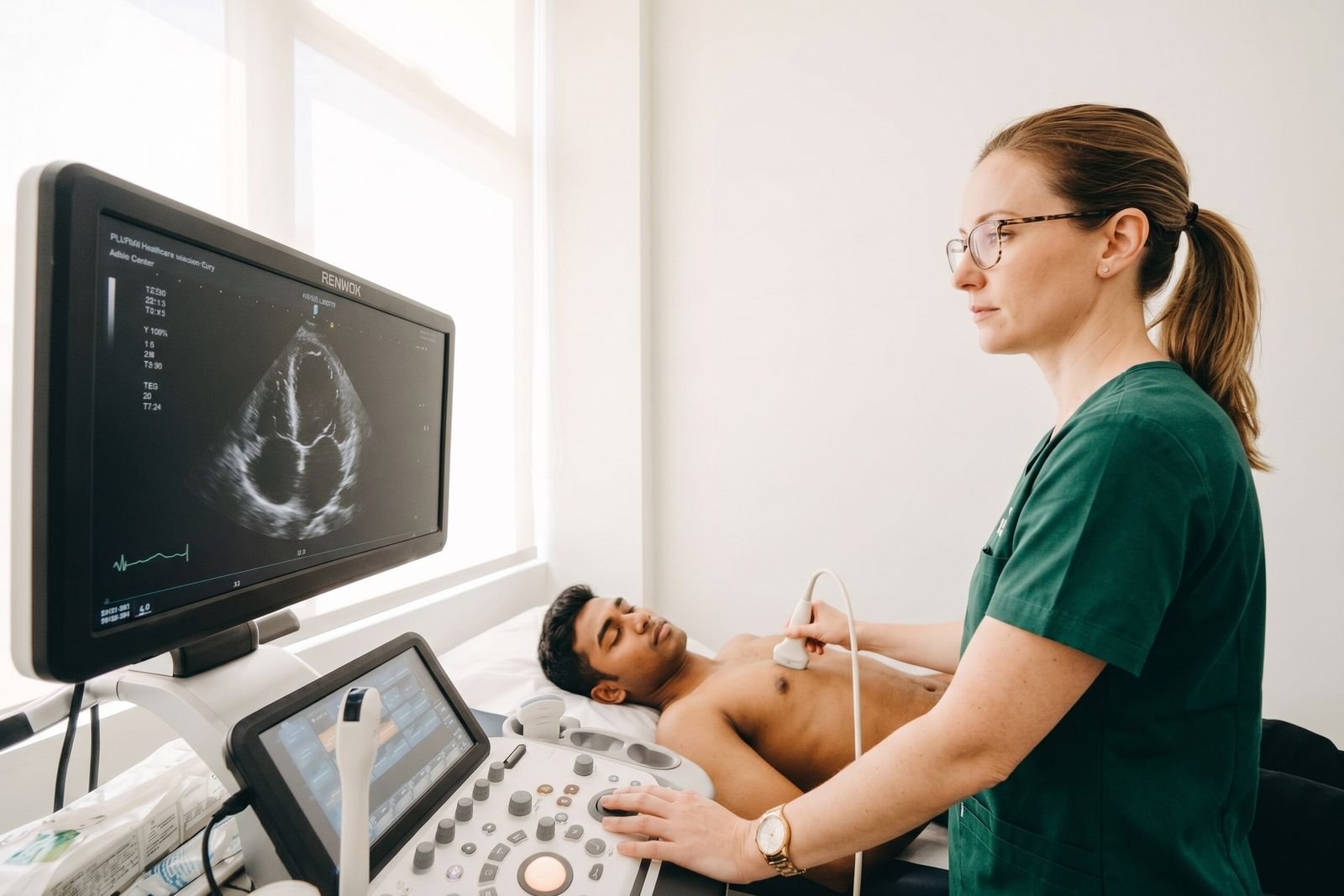
An echocardiogram, or echo, is an ultrasound scan of the heart. The NHS explains that it uses sound waves to build a picture of the heart and shows how well it is working. It can help diagnose conditions such as heart failure, heart valve disease and congenital heart disease, and is usually done by a sonographer.
Understanding the different types matters for cost, because they involve very different amounts of time, staff and equipment.
What affects the cost of a private echocardiogram?
1. The type of echo
This is often the biggest factor. The British Heart Foundation describes several types:
- Standard transthoracic echo (TTE): a probe is moved over your chest. It is the most common type and the simplest to arrange.
- Contrast echo: a dye is injected into a vein to improve the pictures. This needs a cannula and a trained person to give the injection.
- Bubble echo: salt water containing tiny bubbles is injected through a vein in the arm. It can help find a hole in the heart and may be used after a stroke or mini stroke (TIA).
- Stress echo: pictures are taken while your heart rate is raised, either by exercise or by medicine given through a vein. It can help diagnose coronary heart disease.
- Transoesophageal echo (TOE): a probe on a thin flexible tube is passed down the food pipe for closer pictures, usually with a throat spray and a sedative.
The more involved the test, the more it tends to cost. For example, the Royal Free London patient leaflet says a stress echo takes about 45 to 60 minutes and involves monitoring for side effects. A TOE needs a doctor, sedation, fasting beforehand and a period of recovery afterwards. The University Hospital Southampton TOE leaflet describes monitoring for around two hours until the sedation wears off. These extra staff, medicines and recovery space all add to the cost compared with a standard echo.
2. Who performs and who reports the scan
An echo is usually carried out by a trained sonographer or clinical scientist, and the images need to be interpreted and written up in a report. NICE guidance on heart failure says echocardiography should be performed on high resolution equipment by experienced operators trained to the relevant professional standards, and that those reporting echocardiography should be experienced in doing so (NICE guideline NG106).
Some clinics include a report written by the sonographer. Others have the report reviewed or written by a consultant cardiologist. A consultant review may add to the cost, but some people value it, especially if they want a specialist's opinion on what the findings mean.
3. Whether a consultation is included
Some private packages are scan only: you have the echo and receive a written report. Others include a consultation with a cardiologist before or after the scan to discuss your symptoms and results. A consultation can make a package more expensive, but it may save you arranging a separate appointment. Ask the clinic exactly what is included.
4. Extras added on the day
Sometimes the sonographer may find that the pictures are not clear enough. The NHS notes that a contrast agent is sometimes injected during a standard echo to make the heart clearer. If this happens privately, check in advance whether it would be charged as an extra.
5. Accreditation and quality
The British Society of Echocardiography offers formal accreditation for individuals in transthoracic, transoesophageal and stress echocardiography, and departmental accreditation described as a recognised benchmark of quality. Clinics with accredited staff or departments may price their services differently. It is reasonable to ask a clinic whether its sonographers or department are accredited.
6. Location and equipment
Prices vary between regions and between types of setting. A clinic in a city centre may have different costs from one in a smaller town, and newer equipment can affect pricing. You can browse options near you using scans by city.
7. Speed and convenience
Some clinics offer evening or weekend appointments, or faster turnaround of reports. These conveniences can affect the price. If timing matters to you, ask how long the report usually takes. Our guide on how long scan results take may also help.
NHS echo versus private echo
The NHS route
On the NHS, an echocardiogram is free at the point of use when your doctor refers you for it. The NHS says an echo is usually done in hospital, and that if you have not heard about your results after a few weeks you should contact the doctor who referred you.
How quickly you are seen depends on your symptoms and local services. For suspected heart failure, NICE recommends specialist assessment and a transthoracic echo within 2 weeks or 6 weeks, depending on the result of a blood test called NT-proBNP. For a heart murmur with no other symptoms, the NICE heart valve disease guideline suggests considering an echo if valve disease is suspected, based on things like the type of murmur, family history and age.
The private route
Going private may give you more choice over when and where you are scanned. The trade off is that you pay for the test yourself, unless you have private medical insurance that covers it.
It is worth knowing that NHS rules keep private care separate from NHS care. The NHS Kent and Medway guidance on mixing private and NHS treatment says additional private care must be delivered separately from NHS care, and that if you are diagnosed privately and need ongoing treatment, you may need to be referred into an NHS service. If you have a private echo, ask how the report will be shared with your GP, and speak to your GP about what happens next.
Is a private echo regulated?
In England, diagnostic procedures using ultrasound fall within the regulated activity "diagnostic and screening procedures" overseen by the Care Quality Commission. When comparing clinics, you can check that a provider is registered and look at its latest inspection report.
What to ask a clinic before you go ahead
- Which type of echo is this price for: standard, contrast, bubble, stress or TOE?
- Who will carry out the scan, and are they accredited?
- Who writes the report? Is it reviewed by a consultant cardiologist?
- Is a consultation included, before or after the scan?
- Could there be extra charges on the day, for example for contrast?
- How long will the report take, and how will I receive it?
- Will the report be sent to my GP, and can I get a copy of the images?
- Do I need a referral, or can I refer myself?
- What happens if the scan shows something that needs follow-up?
For more on getting copies of your results, see our guide on how to get your scan images and report.
Is a cheaper echo always the right choice?
Not necessarily. Comparing like with like is the key. A low headline price might be for a scan only with a brief report, while a higher price might include a consultant review and a follow-up appointment. Think about what you actually need. If your GP or a cardiologist has asked for a specific type of echo, make sure that is the test the clinic is quoting for.
It is also worth remembering that an echo is one test among several. A clear result does not on its own rule out every heart condition, so the value of a scan often depends on having someone to explain the findings in the context of your symptoms.
This article is general information, not medical advice. Please speak to your GP or the clinician who referred you about your symptoms or results, and if symptoms are urgent, call NHS 111, or 999 in an emergency.
Finding a private scan
You can compare private echocardiogram clinics on FindScan, where each clinic lists its own price, and send an enquiry to the one you choose. The clinic will contact you and confirm the final price for your scan. Because an echo uses ultrasound rather than radiation, some clinics accept self-referral for a standard echo, while others ask for a referral from your GP or their own doctor, depending on the clinic.
Common questions
How much is an echocardiogram privately?
There is no single price. The cost depends on the type of echo, such as a standard, bubble, stress or transoesophageal echo, who carries out and reports the scan, whether a consultant cardiologist reviews it, and where the clinic is. On FindScan, each clinic lists its own price, and the clinic confirms the final price when it contacts you.
Why does a stress echo or TOE usually cost more than a standard echo?
These tests take more time, staff and equipment. A stress echo raises your heart rate with exercise or medicine and needs monitoring, and NHS leaflets say it takes about 45 to 60 minutes. A TOE involves a doctor, a throat spray, usually sedation, fasting beforehand and a recovery period afterwards while the sedation wears off.
Is an echocardiogram free on the NHS?
Yes, an echo is free at the point of use on the NHS when your doctor refers you for one. How quickly you are seen depends on your symptoms and local services. For suspected heart failure, NICE recommends specialist assessment and an echo within 2 or 6 weeks, depending on a blood test result.
Does private medical insurance cover an echocardiogram?
Some policies may cover an echo, often when it is recommended by a GP or specialist, but cover varies between insurers and policies. Check with your insurer before going ahead, ask whether you need a referral or pre-authorisation, and confirm whether any excess applies. The clinic can tell you whether it works with your insurer.
What should be included in the price of a private echo?
It varies, so ask the clinic. Check which type of echo the price covers, who writes the report, whether a consultant reviews it, whether a consultation is included, how long the report takes, and whether any extras, such as a contrast injection, could be charged on the day. Comparing like with like helps you choose.
References
- Echocardiogram. NHS. Accessed 12 October 2026.
- Echocardiogram (echo). British Heart Foundation. Accessed 12 October 2026.
- Having a stress echocardiogram (echo). Royal Free London NHS Foundation Trust. Accessed 12 October 2026.
- Transoesophageal echocardiogram (TOE): patient information. University Hospital Southampton NHS Foundation Trust. Accessed 12 October 2026.
- Chronic heart failure in adults: diagnosis and management (NG106), Recommendations. NICE. Accessed 12 October 2026.
- Heart valve disease presenting in adults: investigation and management (NG208), Recommendations. NICE. Accessed 12 October 2026.
- About the British Society of Echocardiography. British Society of Echocardiography. Accessed 12 October 2026.
- Mixing private and NHS treatment. NHS Kent and Medway Integrated Care Board. Accessed 12 October 2026.
- Scope of registration: diagnostic and screening procedures. Care Quality Commission. Accessed 12 October 2026.
This article is general information, not medical advice, and it does not replace an assessment by a clinician. If you have symptoms that worry you, speak to your GP or call 111. In an emergency, call 999.