DEXA scan and body fat: how body composition DEXA differs from a bone density scan
The same DEXA machine can measure bone density or estimate fat, muscle and bone across the body. Here is how the two scans differ, what a body composition report shows, and what UK rules say.
Written by the FindScan Editorial Team and reviewed by our Medical Advisor, Dr Mohamed Najjar
Reviewed
Many people first hear about DEXA scans in connection with bone health. Others come across them as a way of measuring body fat. It is the same type of machine, but the two scans are used for different reasons, produce different reports, and are treated differently under UK rules. This guide explains how a DEXA scan and body fat measurement fit together, and what UK sources say. For bone density scans, see our main DEXA scan page.
One machine, two kinds of scan
DEXA stands for dual energy X-ray absorptiometry. It uses a low dose of X-rays to measure the body.
Leeds Teaching Hospitals NHS Trust explains that a DEXA scan is mainly used when someone has an increased risk of a bone condition such as osteoporosis. It adds that DEXA can also be used to measure body composition, meaning the amount of bone, fat and muscle in the body.
The UK government describes it in a similar way. It says DEXA can be used to assess body composition, providing information on the proportions of fat, bone and lean muscle within a medical pathway.
How a bone density DEXA scan works
A bone density scan looks at specific areas of the skeleton and compares your bone density with reference values. The result is given as a T-score, which compares you with a young healthy adult, and a Z-score, which compares you with someone of the same age. Leeds Teaching Hospitals says a scan usually takes around five minutes, depending on the part of the body scanned.
The UK government lists the established medical uses of DEXA as diagnosing osteoporosis and osteopenia, assessing fracture risk, evaluating certain fractures, monitoring how well treatment is working, and medical research.
How a body composition DEXA scan is different
A body composition scan usually covers the whole body rather than one or two areas. Instead of focusing on bone density scores, the report splits the body into different types of tissue.
As an example of what a report can include, a UK university body composition service at Leeds Beckett University describes measuring fat tissue mass, lean tissue mass and bone mineral density. It breaks these down by region, such as the trunk, arms, legs and pelvis. It also gives an estimate of visceral fat, which it describes as the fat carried around the organs.
A body composition report may therefore show:
- total fat mass and lean mass
- how fat and lean tissue are spread across the arms, legs and trunk
- bone mineral content or density for the whole body
- an estimate of visceral fat
The exact layout varies between machines and providers, so the report you see may look different.
What the scan itself involves
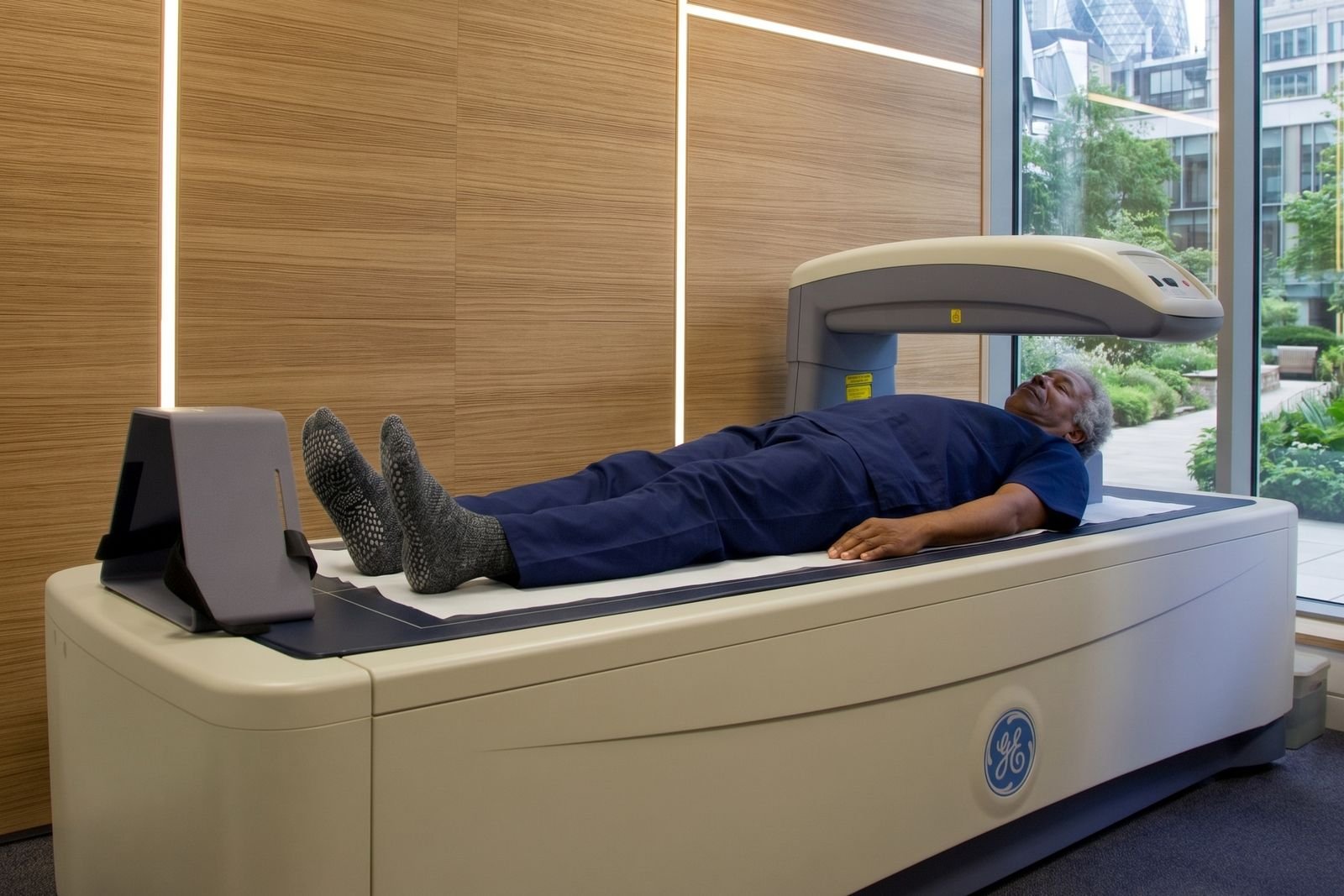
You lie still on a table while the scan is taken. Services usually give you instructions before you attend. Leeds Beckett University, for example, asks people to fast for at least four hours, stay normally hydrated, avoid heavy exercise beforehand, and wear clothing without metal zips or fastenings. Jewellery and other metal items are removed.
DEXA is not suitable during pregnancy. Leeds Teaching Hospitals explains that DEXA scans aren't recommended for pregnant women, as X-rays can harm an unborn baby. If there is any chance you could be pregnant, tell the clinic before your appointment.
Why BMI is not the same thing
People are often interested in body composition because they know that weight alone does not tell the whole story. The NHS points out that the BMI calculator cannot tell the difference between muscle and fat, so a very muscular person may be placed in the overweight range.
The NHS suggests other simple measures too. For example, it advises that you should try to keep your waist size to less than half your height. These checks do not involve any radiation, and your GP can talk you through them.
Radiation and the law: why justification matters
DEXA uses ionising radiation. The dose is very small: Leeds Teaching Hospitals says it is less than two days' exposure to natural background radiation. Even so, it is still an X-ray exposure, and UK law treats it that way.
The Ionising Radiation (Medical Exposure) Regulations 2017, known as IR(ME)R, apply to many kinds of exposure. These include patients having tests for their own diagnosis, health screening, research, asymptomatic individuals, and people having non-medical imaging on medical equipment.
Under regulation 11 of IR(ME)R, nobody may carry out an exposure unless it has been justified as showing a sufficient net benefit and has been authorised. The person justifying it must weigh the expected benefits against the possible harm, and consider other techniques that could do the job. Every DEXA scan therefore needs a referrer and must be justified, whether it is for bones or body composition.
What the UK government says about DEXA for fitness and wellness
In March 2026 the Department of Health and Social Care published its position on DEXA. It states that providing DEXA for non-medical sports and wellness purposes is prohibited, because this use has not been accepted as a justified practice under the Justification of Practices Involving Ionising Radiation Regulations 2004. It says any providers doing so are operating outside that framework.
The government also ran a public consultation on whether sports and wellness DEXA should become a justified practice. It closed on 1 June 2026. A consultation response was added on 7 October 2026, and it says a final decision has not yet been made. Further information on next steps will follow.
The consultation document sets out some of the concerns. It notes that repeated exposure may contribute to a small increased cancer risk over time. It also notes that if a scan picks up something unexpected without healthcare oversight, there is a risk that such findings may be missed. If the practice were ever allowed, the consultation suggests conditions such as limits on how often people could be scanned, age limits, not scanning during pregnancy, and passing images to a doctor.
So, at the time of writing, using DEXA simply to track body fat or fitness progress is not permitted in the UK. This may change, so it is worth checking the latest GOV.UK guidance.
When body composition DEXA is used medically
Body composition DEXA does have a place in healthcare, but it is a limited one. Leeds Teaching Hospitals says this type of scan is routinely used in children, but is still a research application in adults.
The government lists medical research among the permitted uses of DEXA. Any scan within a medical pathway still has to meet the IR(ME)R rules, with a referrer and a practitioner who decides that the benefit outweighs the risk.
If you are worried about your weight, muscle loss or a health condition, the best first step is to talk to your GP. They can decide whether any test is needed and, if so, which one.
Questions to ask a clinic
If a clinic offers you a DEXA scan, it is reasonable to ask:
- Is this a bone density scan or a body composition scan?
- What is the clinical reason for the scan, and who is the referrer?
- Who will report the images, and who will explain the results?
- What happens if the scan shows something unexpected?
You can read more about radiation in our guide to X-ray radiation safety, and about the limits of scanning people without symptoms in our article on full body health scans.
This article is general information, not medical advice. Please speak to your GP or the clinician who referred you about any symptoms or results, and if your symptoms are urgent, call NHS 111 or 999.
Finding a private scan
You can compare clinics offering DEXA bone density scans on FindScan, where each clinic lists its own price, and send an enquiry to the clinic you choose. The clinic will contact you and confirm the final price. DEXA uses ionising radiation, so every scan must be justified and needs a referrer under IR(ME)R; many private clinics can arrange this through their own doctor. Our guide on how to get a DEXA scan explains the process.
Common questions
Can a DEXA scan measure body fat?
Yes. As well as bone density, DEXA can be used to measure body composition, meaning the amount of bone, fat and muscle in the body. Leeds Teaching Hospitals NHS Trust says this type of scan is routinely used in children but is still a research application in adults. In the UK, the scan must be justified and needs a referrer, like any X-ray exposure.
Is a body composition DEXA scan the same as a bone density scan?
They use the same type of machine but are different scans. A bone density scan looks at specific areas of the skeleton and gives T-scores and Z-scores. A body composition scan usually covers the whole body and estimates fat mass, lean mass and bone, often broken down by region. They are used for different purposes.
Can I have a DEXA scan just to track my fitness?
Not at present. In March 2026 the Department of Health and Social Care said that providing DEXA for non-medical sports and wellness purposes is prohibited, because it has not been accepted as a justified practice. A government consultation on whether this should change closed in June 2026, and the response says a final decision has not yet been made. Check GOV.UK for the latest position.
How much radiation does a DEXA scan use?
Very little. Leeds Teaching Hospitals NHS Trust says the dose is less than two days' exposure to natural background radiation. However, it is still ionising radiation. The UK government consultation notes that repeated exposure may contribute to a small increased cancer risk over time, which is one reason every scan must be justified under IR(ME)R.
Do I need a referral for a DEXA scan?
Yes. Under IR(ME)R 2017, every exposure to ionising radiation must be justified as showing a sufficient net benefit, and a referrer is needed. Many private clinics can arrange a referral through their own doctor for a clinically appropriate scan. When you send an enquiry through FindScan, the clinic will contact you and explain its process.
References
- Bone density scan (DEXA). Leeds Teaching Hospitals NHS Trust. Accessed 12 October 2026.
- Use of dual energy x-ray absorptiometry (DEXA) scans: government position. GOV.UK (Department of Health and Social Care). Accessed 12 October 2026.
- Using dual energy x-ray absorptiometry (DEXA) scans for non-medical purposes as a justified practice (consultation page). GOV.UK (Department of Health and Social Care). Accessed 12 October 2026.
- Using dual energy x-ray absorptiometry (DEXA) scans for non-medical purposes as a justified practice (consultation document). GOV.UK (Department of Health and Social Care). Accessed 12 October 2026.
- The Ionising Radiation (Medical Exposure) Regulations 2017, regulation 3. legislation.gov.uk. Accessed 12 October 2026.
- The Ionising Radiation (Medical Exposure) Regulations 2017, regulation 11. legislation.gov.uk. Accessed 12 October 2026.
- Body Composition (DXA). Leeds Beckett University. Accessed 12 October 2026.
- Obesity: Diagnosis. NHS. Accessed 12 October 2026.
This article is general information, not medical advice, and it does not replace an assessment by a clinician. If you have symptoms that worry you, speak to your GP or call 111. In an emergency, call 999.