Coccyx MRI Scan: When Tailbone Pain Needs a Scan, and Having a Private Coccyx MRI Scan
Most tailbone pain gets better with time and simple self-care, and a scan is not usually the first step. This guide explains when a tailbone pain scan is considered, what a coccyx MRI can show, and how a private coccyx MRI scan works.
Written by the FindScan Editorial Team and reviewed by our Medical Advisor, Dr Mohamed Najjar
Reviewed
Tailbone pain, which doctors call coccydynia, is pain in the small bone at the very base of the spine. The NHS says it may improve after a few weeks, although it can sometimes last longer. A coccyx MRI is not usually the first step, but it can help when pain does not settle or a doctor wants to check for other causes. This guide explains when a tailbone pain scan is considered, what an MRI for coccydynia can show, and how a private coccyx MRI scan works.
We cover the self-care the NHS recommends, when to see a GP, the warning signs that need A&E, the difference between an X-ray and an MRI of the tailbone, and what to expect on the day. If you are looking at clinics, see our page on spine MRI scans.
Tailbone pain: what the NHS says
NHS Fife's pelvic health physiotherapy leaflet explains that the coccyx is made of several small fused bones attached to the sacrum, and that the pelvic floor muscles, part of the buttock muscles and several ligaments attach to it.
The NHS says tailbone pain is often a dull ache with occasional sharp pains. It tends to be worse when sitting, when sitting down or standing up, when bending forward and when opening your bowels. Causes it lists include pregnancy and childbirth, an injury such as a fall onto the coccyx, repeated or long periods of sitting such as driving or cycling, poor posture, being overweight or underweight, and a joint that moves too much or too little. Sometimes the cause is not known.
Most people improve. nidirect, the Northern Ireland government health site, says that for most people the pain improves over a few weeks or months, although for some it can last much longer.
Self-care the NHS suggests:
- sit with good posture and lower back support, and consider a coccyx cushion
- lie on your side to take pressure off
- try pelvic floor exercises
- use an ice pack wrapped in a towel for 20 to 30 minutes, or a heat pack
- consider an anti-inflammatory painkiller such as ibuprofen, and ask a pharmacist about a stool softener if opening your bowels hurts
- avoid sitting for long periods
The NHS Fife leaflet adds that leaning forward onto your thighs, or sitting on two rolled towels placed in a V shape under your seat bones, can take pressure off the coccyx.
When to see a GP, and when it is urgent
The NHS says to see a GP if tailbone pain has not improved after a few weeks of home treatment, if it is affecting your daily activities, or if you have a high temperature together with tailbone pain and pain somewhere else, such as your tummy or lower back. nidirect also lists very severe pain, bleeding, a fever, or pain away from the coccyx. In many areas you can refer yourself to NHS musculoskeletal (MSK) services, such as physiotherapy, without seeing a GP first.
If self-care and pelvic floor exercises have not helped, the NHS says the usual next options are physiotherapy and a steroid and local anaesthetic injection into the joint. If these do not reduce the pain, surgery to remove part or all of the coccyx may be recommended.
Go to A&E urgently if you have back or leg pain together with any of the warning signs listed in the King's College Hospital cauda equina syndrome leaflet, such as numbness in or around your back passage or bottom, loss of feeling or pins and needles between your inner thighs or genitals, new difficulty peeing or controlling your pee, leaking pee, or not being able to stop a poo. These can be signs of cauda equina syndrome, a problem with the nerves at the bottom of the spine, and need emergency help, not a routine scan.
When is a tailbone pain scan considered?
nidirect says a GP will first examine you to check for more serious causes, such as an infection or a fracture, and may refer you for an X-ray or MRI scan.
NHS guidance for clinicians in NHS Ayrshire and Arran's coccydynia pathway is clear that imaging is not recommended unless a doctor is checking for red flags, such as signs of infection. It also says to rule out the lower back as the source of the pain. It suggests MRI if a tumour or infection is suspected, or if pain is not responding to treatment or comes with numbness in the legs or bladder or bowel problems once a lower back cause has been ruled out. It says plain X-rays and dynamic imaging are used in specialist centres only, and that CT is kept for significant pelvic injury.
Dynamic imaging means X-rays taken from the side while you sit and while you stand. The MSD Manual professional chapter on coccyx disorders says this is the best method to check whether the coccyx moves more than it should. Normally the coccyx tips forward by less than 20 degrees when you sit, and more movement than that suggests instability. You can read more about private X-rays, and our guide to back pain and sciatica scans covers the lower back.
What a coccyx MRI shows (MRI for coccydynia)
The NHS MRI page says an MRI scan takes detailed pictures of the inside of your body. The MSD Manual says MRI is preferred over CT for the coccyx because it does not expose the pelvic organs to ionising radiation. It describes using MRI to look for serious or structural causes such as tumours, bone infection and abscesses, with images that show bone detail and signs of fluid or inflammation.
A coccyx MRI can therefore look at the bone, the joints and the soft tissue around the tailbone, and help rule out causes that are not coccydynia. Because NHS guidance says the lower back should be considered as a source of the pain, your clinician may ask for the lower back to be scanned instead of, or as well as, the coccyx. Clinics may list this under spine MRI or pelvis MRI, so ask the clinic which area its scan covers.
A report that finds nothing of concern does not mean your pain is not real. Your clinician uses the report alongside your symptoms and examination to plan what happens next.
Preparing for a coccyx MRI, how long it takes, and results
Before the scan you fill in a safety form. The NHS says it asks whether you have metal in your body, such as surgical clips, a pacemaker, or dental fillings or bridges, and whether you are or may be pregnant. Tell the clinic about any implant before the day.
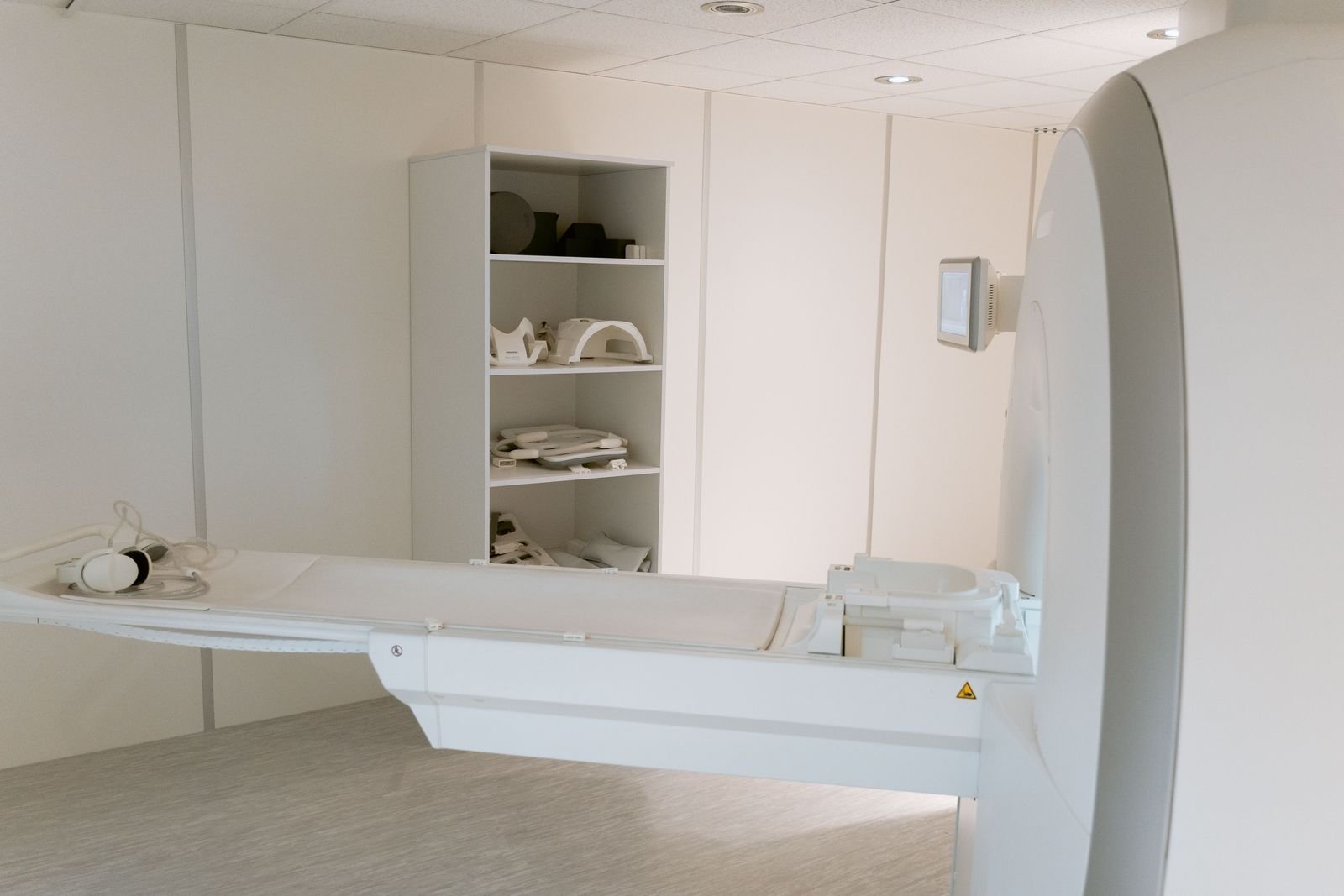
The NHS says an MRI usually takes between 15 minutes and 1 hour, and can take longer. You lie still while the scanner takes pictures, and it makes loud bangs and clicks, so you are given ear plugs or headphones. Some scans need an injection of contrast dye to show more detail. If lying on your back is uncomfortable because of your tailbone, tell the radiographer before the scan starts. Our guide on what to expect at an MRI scan walks through the day.
The NHS says it usually takes 1 to 2 weeks to get MRI results, and to contact the doctor who referred you if you have not heard after a few weeks.
Referral for a private coccyx MRI scan or X-ray
An X-ray uses ionising radiation, so it always needs a referrer. Under the Ionising Radiation (Medical Exposure) Regulations 2017, GOV.UK guidance says referrers refer people for exposures, and every exposure must be justified by a practitioner before it can take place. Many private clinics arrange this through their own doctor. Our guide to X-rays and referral explains more.
MRI does not use ionising radiation, so some clinics accept self-referral for MRI, depending on the clinic's own policy and its safety screening. Because NHS guidance says imaging is not usually needed unless a doctor is checking for red flags, it is worth seeing a GP or physiotherapist first, so a scan is only done when it will answer a clear question. See our guide to private MRI without a GP referral.
Finding a private scan
Each clinic on FindScan lists its own price and confirms the final price when it contacts you. When you send an enquiry, say that you need a coccyx MRI and whether you have a referral letter. MRI may be self-referral at some clinics, depending on the clinic, while a coccyx X-ray always needs a referrer.
Comparing clinics on FindScan
On FindScan you can compare MRI clinics near you, see what each clinic offers, and send an enquiry to the one you choose. The clinic contacts you to confirm which area it will scan, whether it needs a referral, and the next steps to arrange your scan.
FindScan is a directory of independent, regulated imaging clinics. We are not a healthcare provider and nothing here is medical advice, so please speak to your GP or the clinician who referred you about your symptoms or results. If symptoms are urgent, call NHS 111, or 999 in an emergency.
Common questions
What does a coccyx MRI show?
A coccyx MRI takes detailed pictures of the tailbone, the joints around it and the nearby soft tissue, without ionising radiation. Clinical references describe using it to look for causes such as tumours, bone infection and abscesses, and signs of fluid or inflammation. A report that finds nothing of concern does not mean your pain is not real; your clinician uses it alongside your examination.
Do I need a tailbone pain scan?
Usually not at first. The NHS says tailbone pain may improve after a few weeks with self-care. NHS guidance for clinicians says imaging is not recommended unless a doctor is checking for red flags such as infection. See a GP if pain has not improved after a few weeks, is affecting daily life, or comes with a high temperature and pain elsewhere.
Can I get a private coccyx MRI scan without a referral?
Some clinics accept self-referral for MRI, depending on the clinic's own policy and safety screening, because MRI does not use ionising radiation. Others ask for a GP or specialist referral. A coccyx X-ray always needs a referrer under IR(ME)R 2017, and many private clinics arrange this through their own doctor. Seeing a GP or physiotherapist first helps make sure a scan is needed.
Is MRI for coccydynia better than an X-ray?
They answer different questions. NHS Ayrshire and Arran guidance suggests MRI if infection or a tumour is suspected, or for pain that is not responding to treatment, and says plain and dynamic X-rays are used in specialist centres only. Dynamic X-rays, taken sitting and standing, check whether the coccyx moves too much. MRI uses no ionising radiation and shows soft tissue.
How long does tailbone pain last?
The NHS says tailbone pain may improve after a few weeks, but it can sometimes last longer. nidirect says that for most people it improves over a few weeks or months. If it has not improved after a few weeks of self-care, or it is affecting your daily activities, the NHS says to see a GP. Physiotherapy and injections are options if it persists.
How long does a coccyx MRI take?
The NHS says an MRI scan usually takes between 15 minutes and 1 hour, and can take longer. You need to lie still, and you are given ear plugs or headphones because the scanner is loud. Tell the radiographer if lying on your back is uncomfortable. MRI results usually take 1 to 2 weeks to reach you, according to the NHS.
References
- Tailbone (coccyx) pain (reviewed 20 November 2025). NHS. Accessed 29 October 2026.
- Tailbone pain (coccydynia). nidirect (Northern Ireland government). Accessed 29 October 2026.
- RefHelp: Coccydynia. NHS Ayrshire and Arran (Right Decision Service, NHS Scotland). Accessed 29 October 2026.
- Coccyx pain: service user information leaflet (September 2020). NHS Fife Pelvic Health Physiotherapy Service. Accessed 29 October 2026.
- Cauda equina syndrome: information for patients (September 2024). King's College Hospital NHS Foundation Trust. Accessed 29 October 2026.
- Coccyx disorders (Patrick M. Foye, updated December 2025). MSD Manual Professional Edition. Accessed 29 October 2026.
- MRI scan (reviewed 11 September 2025). NHS. Accessed 29 October 2026.
- Guidance to the Ionising Radiation (Medical Exposure) Regulations 2017 (updated 4 September 2024). GOV.UK (Department of Health and Social Care). Accessed 29 October 2026.
This article is general information, not medical advice, and it does not replace an assessment by a clinician. If you have symptoms that worry you, speak to your GP or call 111. In an emergency, call 999.