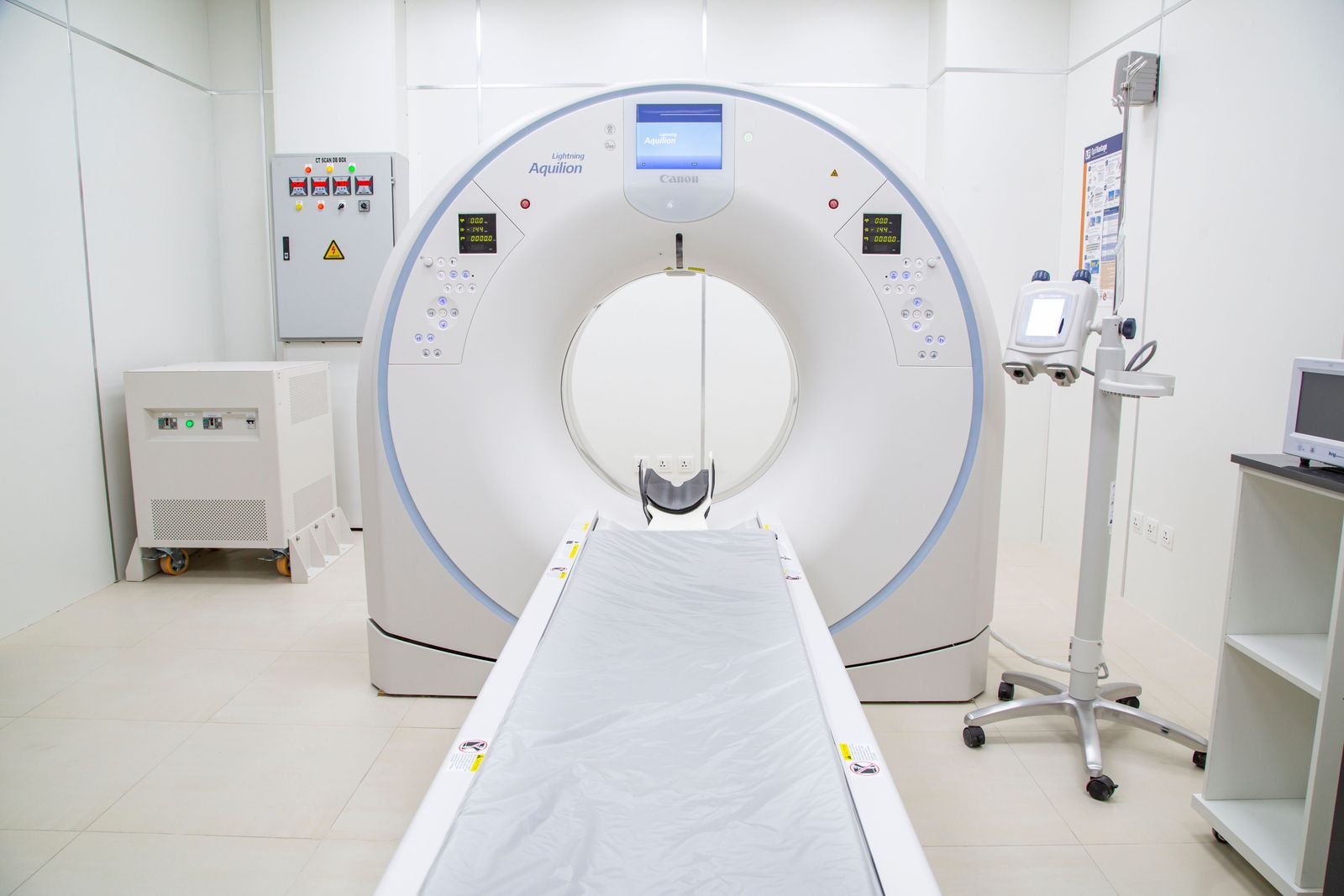
CT Coronary Angiogram and Calcium Score: What a Heart CT Scan Shows
A CT coronary angiogram and a coronary calcium score are both CT scans of the heart, but they answer different questions. Here is what each one shows, what NICE and the NHS say about when they are used, how much radiation is involved and what to expect on the day.
Written by the FindScan Editorial Team and reviewed by our Medical Advisor, Dr Mohamed Najjar
Reviewed
October is National Cholesterol Month, a campaign led by the charity HEART UK. The NHS says high cholesterol does not usually cause symptoms, and that too much cholesterol can block your blood vessels and make heart problems or a stroke more likely. A cholesterol reading cannot tell you what is actually happening inside the arteries that supply your heart. Two CT scans can.
A CT coronary angiogram and a coronary calcium score are often mentioned together and sometimes confused. Both look at the coronary arteries and both need a referral, but they are different tests used for different reasons. This guide explains what each one shows, what NICE and the NHS say about when they are used, and what the scan involves.
Two scans, two questions
The British Heart Foundation describes a CT coronary angiogram as a scan used to look at the heart, its arteries and any fatty deposits, or plaques, that can build up in them. It involves injecting contrast dye into your blood, and it produces detailed pictures of the vessels themselves. The question it answers is: is there a narrowing in the coronary arteries that could explain these symptoms?
A CT calcium score, according to the British Heart Foundation, measures the amount of calcified or hardened plaque in the heart arteries and does not give detailed pictures. It uses no dye, and the result is a number; the British Heart Foundation says a higher score means a higher risk of a heart attack. The question it answers is different: how much hardened plaque is there, and what does that say about future risk?
What NICE says about chest pain
NICE's guideline on recent-onset chest pain of suspected cardiac origin (CG95, published in 2010 and updated in 2016) is the reason CT coronary angiography has become the standard first test for stable chest pain in the UK. NICE's quality standard on stable angina (QS21) sets out the headline: people with features of typical or atypical angina are offered 64-slice (or above) CT coronary angiography, citing recommendation 1.3.4.3 of the guideline.
Those are decisions for a GP, cardiologist or chest pain clinic after an assessment of your symptoms, not tests to arrange first and explain later.
Where a calcium score fits
A calcium score is more often used in weighing up someone's future risk of heart disease than in working out the cause of chest pain. The NHS says that if a GP thinks you may be at risk of coronary heart disease they may do a risk assessment for cardiovascular disease and a test to check your cholesterol level.
If your GP or cardiologist suggests a calcium score, it is usually because it adds information to the picture built from your cholesterol, blood pressure, family history and other risk factors. What the number means for you is a conversation to have with the clinician who asked for it. Our guides to what an echocardiogram shows and echocardiogram versus ECG cover the other common heart tests.
What happens on the day
The NHS says a CT scan usually takes about 10 to 20 minutes, and that depending on why you are having it you may be given a dye to help show more detail, which passes out of your body in your urine. For a CT coronary angiogram, the British Heart Foundation adds that you may be given medicine to slow your heartbeat so that the scanner can capture clear pictures of the arteries, and that the whole appointment usually takes around 30 to 60 minutes including preparation.
A calcium score is simpler. Liverpool University Hospitals' patient leaflet says the CT calcium score takes approximately five minutes to perform and interpret. Our guide to CT scans with contrast explains the dye. The British Heart Foundation notes that people with advanced kidney problems, severe asthma or an allergy to the dye should avoid a CT coronary angiogram, and that CT scans are not suitable in pregnancy because of the radiation.
Radiation, in context
Both scans use X-rays. The British Heart Foundation says the radiation from CT coronary angiography and CT calcium scoring is low, similar to natural background radiation over a year, and that because of this the scans should be done only when necessary. For scale, the UK Health Security Agency's patient dose guidance on GOV.UK puts the UK average background dose at 2.1 millisieverts a year, a single chest X-ray at 0.02 millisieverts and a standard CT of the chest at around 8 millisieverts.
This is why the referral matters. The Ionising Radiation (Medical Exposure) Regulations 2017 require every X-ray-based scan in the UK to be justified, with a registered referrer behind each one, so a CT of the heart cannot be arranged on a walk-in basis. Our guide to X-ray and CT radiation safety goes into the numbers.
Having a heart CT privately
If a cardiologist or GP has advised a CT coronary angiogram or a calcium score and the NHS wait is long, private clinics with cardiac CT can carry out the scan and send the report back to your clinician. Because CT needs a referral under UK law, clinics will ask for one or arrange a consultation with their own clinician first. Not every CT scanner is set up for cardiac work, so check that the clinic offers the scan you have been asked to have.
You can compare CT clinics near you and send an enquiry; the clinic contacts you to confirm the referral it needs and whether it offers cardiac CT. FindScan is a directory of independent, regulated imaging clinics: you compare clinics and send an enquiry, and the clinic contacts you. We are not a healthcare provider, and whether a scan is right for you is a clinical decision for your GP or cardiologist. The NHS says to call 999 for chest pain that feels tight or like squeezing, chest pain spreading to the arms, neck or jaw, severe difficulty breathing, or pale, blue or grey lips or skin. That is an emergency, not a reason to look for a scan.
Common questions
What is the difference between a CT coronary angiogram and a calcium score?
The British Heart Foundation describes a CT coronary angiogram as a scan with contrast dye that gives detailed pictures of the heart's arteries and any plaques in them, while a calcium score measures the amount of calcified plaque, uses no dye and gives a number rather than detailed pictures.
Who should have a CT coronary angiogram?
NICE's quality standard on stable angina says people with features of typical or atypical angina are offered 64-slice or above CT coronary angiography, based on recommendation 1.3.4.3 of its chest pain guideline CG95. The decision follows an assessment of your symptoms by a clinician.
Can I have a heart CT without a referral?
No. CT uses ionising radiation, and the Ionising Radiation (Medical Exposure) Regulations 2017 require every exposure to be justified with a referral from a registered referrer. Private clinics ask for a referral or arrange one through their own clinician.
How much radiation is a cardiac CT?
The British Heart Foundation says the radiation from CT coronary angiography and CT calcium scoring is low, similar to natural background radiation over a year, which UKHSA puts at 2.1 millisieverts on average in the UK.
Does a low calcium score mean my heart is fine?
No single test rules out heart disease. The British Heart Foundation says a calcium score measures calcified plaque only and does not give detailed pictures, so your clinician reads the score alongside your cholesterol, blood pressure and other risk factors.
What should I do if I have chest pain now?
Call 999. The NHS says to call 999 for chest pain that feels tight or like squeezing, chest pain spreading to the arms, neck or jaw, severe difficulty breathing, or pale, blue or grey lips or skin. A scan is never the right response to chest pain that is happening now.
References
- Stable angina (QS21), quality statement 1: diagnostic investigation. NICE. Accessed 27 October 2026.
- Recent-onset chest pain of suspected cardiac origin: assessment and diagnosis (CG95). NICE. Accessed 27 October 2026.
- CT scan: CT coronary angiogram and CT calcium score. British Heart Foundation. Accessed 27 October 2026.
- CT scan. NHS. Accessed 27 October 2026.
- Coronary heart disease: diagnosis. NHS. Accessed 27 October 2026.
- Heart attack. NHS. Accessed 27 October 2026.
- High cholesterol. NHS. Accessed 27 October 2026.
- Coronary CT calcium score and CT coronary angiography (patient leaflet). Liverpool University Hospitals NHS Foundation Trust. Accessed 27 October 2026.
- Patient dose information: guidance. UKHSA (GOV.UK). Accessed 27 October 2026.
- The Ionising Radiation (Medical Exposure) Regulations 2017, SI 2017/1322. legislation.gov.uk. Accessed 27 October 2026.
- National Cholesterol Month (HEART UK), October 2026. Awareness Days. Accessed 27 October 2026.
This article is general information, not medical advice, and it does not replace an assessment by a clinician. If you have symptoms that worry you, speak to your GP or call 111. In an emergency, call 999.