Kidney MRI Scan: What an MRI of the Kidneys Shows, When It Is Used and How to Prepare
A kidney MRI is usually a second look, arranged when an ultrasound or another test has not given enough detail. This guide explains what the scan can show, where it fits alongside ultrasound and CT, what to know about contrast dye if your kidneys do not work well, and how to prepare.
Written by the FindScan Editorial Team and reviewed by our Medical Advisor, Dr Mohamed Najjar
Reviewed
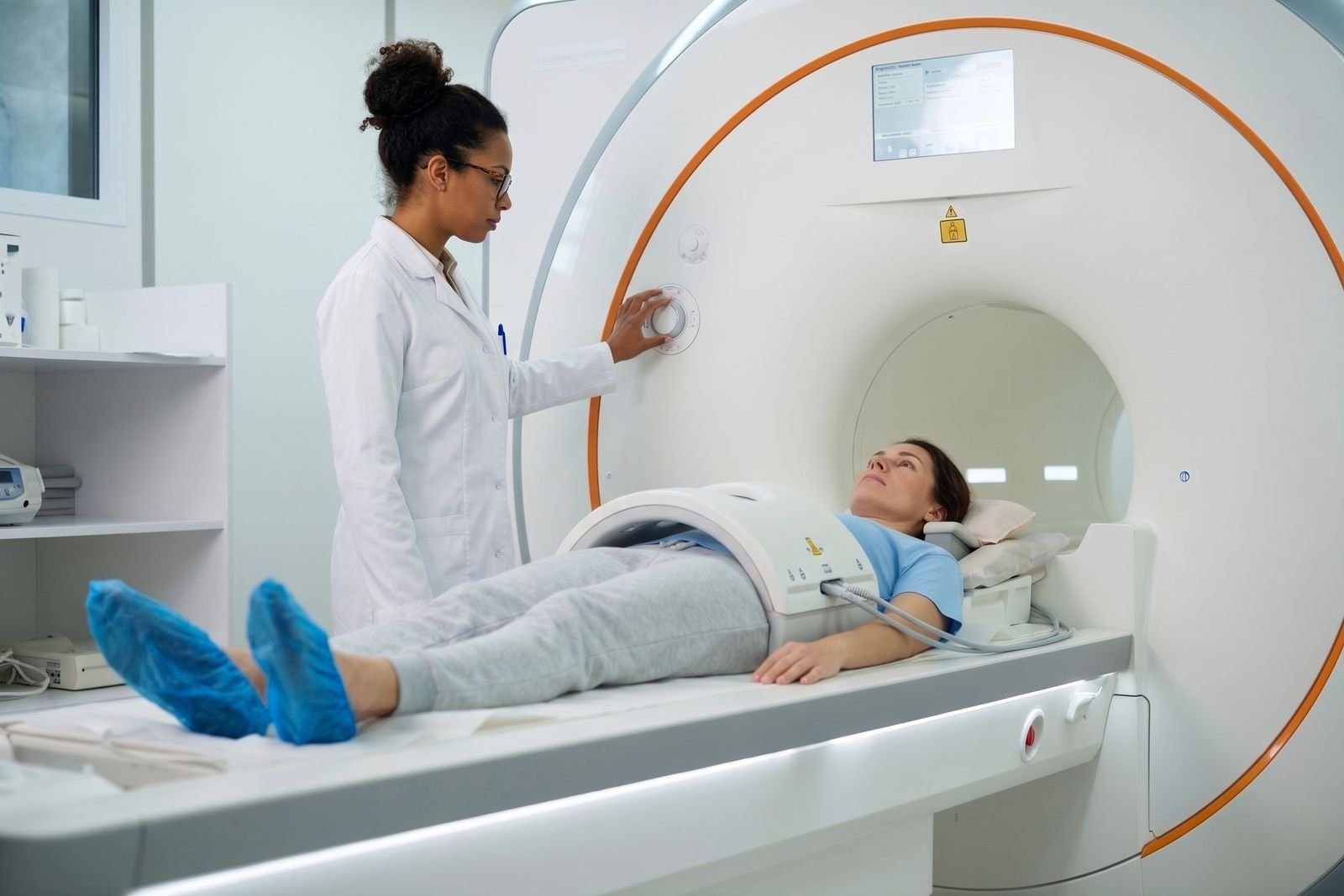
A kidney MRI scan takes detailed pictures of the kidneys and the tubes that drain them, using magnetism and radio waves. Doctors usually ask for a kidney MRI when an earlier test has not given enough detail, or when another scan is not suitable for you. An MRI of the kidneys is rarely the first test: most people start with an ultrasound, and suspected kidney stones are usually checked with CT.
This guide covers what the scan can show, how it compares with ultrasound and CT, MR urograms and MR angiograms, what to know about contrast dye and kidney function, how to prepare, how long it takes and how results reach you. If you are looking at private options, our abdomen MRI page lists clinics that scan the tummy area; ask the clinic to confirm it offers an MRI of the kidneys specifically. This is general information, not medical advice, and your clinic's own instructions always come first.
What a kidney MRI scan shows
Cancer Research UK explains that MRI uses magnetism and radio waves to take pictures of the inside of your body. The NHS says an MRI scan takes detailed pictures of the inside of your body and can be used to check bones and organs.
For people with kidney problems, Kidney Care UK says MRI can give your kidney doctor more information to help them make a diagnosis. It adds that you may already have had other tests, such as an ultrasound scan or X-ray, which may not have been detailed enough on their own.
A kidney MRI is a test that answers a specific question your doctor has, such as taking a closer look at something seen on another scan, or checking the urinary system or the blood vessels that supply the kidneys. It is not a general check-up.
Kidney MRI vs ultrasound and CT
Ultrasound usually comes first. Cancer Research UK says that when kidney cancer is a possibility, your GP may send you for an ultrasound scan of your tummy, and that a specialist may ask for one before a CT scan if you have not had one. It lists CT, MRI and a biopsy among the tests a specialist may then arrange. You can compare abdominal ultrasound clinics on FindScan if that is the scan you have been asked to have.
Kidney stones are a different question. NICE guidance recommends urgent low-dose non-contrast CT, within 24 hours, for adults with suspected renal colic (the pain of a kidney stone), ultrasound instead of CT if a woman is pregnant, and ultrasound first for children and young people. MRI is not among those first-line tests. Our guide on which scan is used for kidney stones explains the options in more detail.
So an MRI of the kidneys tends to come after these tests, when the team needs a closer or different look.
Kidney lumps and cysts: what an MRI of the kidneys can add
Cancer Research UK says you might have an MRI scan if you cannot have the contrast used in a CT scan, for example because your kidneys do not work very well or you are allergic to it. It also says MRI may be used if your doctor wants to know whether a cancer has reached the main blood vessels near the kidney.
Cysts are fluid-filled sacs. For polycystic kidney disease, the NHS says ultrasound is used to look for cysts, and that a CT or MRI scan may be needed in some cases because it shows the kidneys in more detail. The NHS also notes that imaging may miss very small cysts in younger people, so scans may need to be repeated later in life.
If an earlier scan mentioned a cyst or a lesion, the radiologist's report and your doctor are the best guide to whether more imaging is needed. A finding on one scan is the start of a conversation, not a diagnosis.
MR urogram and MR angiogram
Two kidney-specific types of MRI are worth knowing by name. When MRI is used to look at your urinary system, Kidney Care UK says this is sometimes called an MR urogram, and contrast dye helps the team see the urinary system in greater detail.
A magnetic resonance angiogram (MRA) is a type of MRI that takes pictures of arteries. Kidney Care UK says that when it is used for kidney conditions it looks at the renal arteries, the blood vessels that supply your kidneys, and can help identify diseased or malformed blood vessels. A contrast dye is injected so the arteries show up more clearly, and staff may ask you to stay for 30 minutes afterwards to check you do not react to it.
Contrast dye and your kidney function
Not every MRI uses contrast. The NHS says you may be given an injection of a contrast medium (dye) to help show more detail, and it asks everyone having an MRI whether they have any kidney problems. MRI contrast agents are often based on gadolinium. Oxford University Hospitals says that if you have a history of kidney disease you may be given a blood test to check how well your kidneys work, and that contrast agent can cause tissue and organ damage in people with severe kidney disease. Kidney Care UK says you may have a blood test to check clotting, blood count and kidney function.
The rare condition behind this caution is nephrogenic systemic fibrosis (NSF). The MHRA, the UK medicines regulator, describes NSF as a serious and life-threatening condition in which connective tissue forms in the skin, and it can affect other organs. Its advice says high-risk gadolinium agents must not be used in people with severe kidney impairment (a GFR below 30), that kidney function should be tested in everyone receiving a high-risk agent, and that screening is particularly important for people aged 65 or over. For people with moderate or severe kidney impairment, it advises a single lowest possible dose, not repeated for at least 7 days.
If you have chronic kidney disease, mention it when you send an enquiry and ask whether the clinic needs a recent kidney blood test. Our guide to MRI with contrast covers side effects and what the injection feels like.
Preparing for a kidney MRI scan, and how long it takes
The NHS says the hospital will tell you if there is anything you need to do before the scan. You will be asked about metal in your body, such as surgical clips or a pacemaker, and whether you are or may be pregnant, and you should not wear anything metal. Our guide to MRI safety with metal implants explains why this matters.
Oxford University Hospitals says you should be able to eat, drink and take your medicines as usual unless you are told otherwise. For kidney scans, Kidney Care UK says some medicines may need to be stopped, that you may be given fluid to drink, and that you will empty your bladder before the scan.
Kidney Care UK says the scan usually takes between 20 minutes and an hour. The NHS says you will be given ear plugs or headphones because the scanner is noisy, you need to lie still, and you may be asked to wait for up to 30 minutes after a contrast injection. If small spaces worry you, the NHS says to tell the team, as you may be able to have a medicine to help you relax. See what to expect during an MRI scan.
Results and referral
Kidney Care UK says a radiologist, a doctor who specialises in interpreting images, looks at the pictures and sends a report to the doctor who referred you, who then discusses it with you. The NHS says results usually take 1 to 2 weeks, and that if you have not heard after a few weeks you should contact the doctor who referred you. Our guides on how long scan results take and getting your images and report explain more.
A report that finds nothing abnormal answers the question that was asked, but it does not rule out every condition, so keep talking to your doctor if symptoms continue.
MRI may be self-referral at some private clinics, depending on the clinic's own policy and safety screening. A kidney MRI is most useful when a doctor has a clear question for it and can act on the report, so many people go through their GP or specialist. Our guide to private MRI without a GP referral explains how this works.
Comparing clinics on FindScan
You can compare abdomen MRI clinics near you on FindScan, see each clinic's own listed price and send an enquiry to the one you choose. The clinic contacts you to confirm whether it can scan the kidneys in the way your doctor has asked, whether contrast is needed, and how to arrange your scan.
FindScan is a directory of independent, regulated imaging clinics, not a healthcare provider, and nothing here replaces advice from your GP or kidney doctor. Speak to your GP or the clinician who referred you about symptoms or results. If you feel very unwell or have severe pain, call NHS 111, or 999 in an emergency.
Common questions
What does a kidney MRI show?
A kidney MRI gives detailed pictures of the kidneys and, depending on how it is set up, the urinary system or the arteries that supply the kidneys. Kidney Care UK says it can give your kidney doctor more information to help make a diagnosis, often after an ultrasound or X-ray was not detailed enough. It answers a specific question rather than acting as a general check-up.
How long does a kidney MRI scan take?
Kidney Care UK says the scan usually takes between 20 minutes and an hour. The NHS says an MRI generally takes 15 minutes to 1 hour but can take longer, and you may be asked to wait for up to 30 minutes after a contrast injection. Allow extra time for safety questions and getting changed.
Is an MRI of the kidneys better than an ultrasound?
They do different jobs. Ultrasound is usually the first scan: Cancer Research UK says a GP may send you for one when kidney cancer is a possibility. MRI tends to come later, when more detail is needed, when CT contrast is not suitable, or when doctors need to check the blood vessels near the kidney. Your doctor will choose the right test for your question.
Do you need contrast for a kidney MRI?
Sometimes. The NHS says you may have a contrast injection to show more detail. Because gadolinium contrast needs care in severe kidney disease, you may have a blood test to check kidney function first. The MHRA says high-risk gadolinium agents must not be used when kidney function is severely reduced, and the clinic will check what is safe for you.
Can you have a kidney MRI scan for kidney stones?
It is not the usual test. NICE recommends urgent low-dose non-contrast CT for adults with suspected kidney stone pain, ultrasound instead of CT during pregnancy, and ultrasound first for children and young people. MRI is not among those first-line tests. If you have stone symptoms, speak to your GP or NHS 111 about the right scan.
Can I get a private kidney MRI without a referral?
MRI may be self-referral at some private clinics, depending on the clinic's own policy and safety screening. A kidney MRI is most useful when a doctor has a clear question for it and can act on the report, so many people go through their GP or specialist. When you send an enquiry, the clinic will tell you what it needs.
References
- MRI scan. NHS. Accessed 29 October 2026.
- Magnetic resonance imaging (MRI) scan (last updated 9 June 2026). Kidney Care UK. Accessed 29 October 2026.
- Magnetic resonance angiogram (MRA) (last updated 9 June 2026). Kidney Care UK. Accessed 29 October 2026.
- Tests for kidney cancer: MRI scan (last reviewed 23 January 2024). Cancer Research UK. Accessed 29 October 2026.
- Tests for kidney cancer: tests to diagnose (last reviewed 23 January 2024). Cancer Research UK. Accessed 29 October 2026.
- Autosomal dominant polycystic kidney disease (ADPKD): diagnosis. NHS. Accessed 29 October 2026.
- Renal and ureteric stones: assessment and management (NG118), recommendations. NICE. Accessed 29 October 2026.
- Gadolinium-containing contrast agents: new advice to minimise the risk of nephrogenic systemic fibrosis (Drug Safety Update). GOV.UK (MHRA). Accessed 29 October 2026.
- Having an MRI scan: information for patients. Oxford University Hospitals NHS Foundation Trust. Accessed 29 October 2026.
This article is general information, not medical advice, and it does not replace an assessment by a clinician. If you have symptoms that worry you, speak to your GP or call 111. In an emergency, call 999.