MRI Weight Limit: What It Means, Wide Bore MRI for Larger Patients, and What to Tell the Clinic
If you are worried about whether you will fit in an MRI scanner, you are not alone, and there is usually a way forward. This guide explains MRI scan weight limits in the UK, why width matters as much as weight, and how wide bore and open scanners can help.
Written by the FindScan Editorial Team and reviewed by our Medical Advisor, Dr Mohamed Najjar
Reviewed
Every MRI scanner has a weight limit for its table and a fixed width for its tunnel, which is called the bore. If you have looked up the MRI weight limit before a scan, the honest answer is that it depends on the scanner. There is no single MRI scan weight limit in the UK: limits vary between machines and between clinics, so the figure that counts is the one the clinic gives you for the scanner you would use. The good news is that wide bore MRI for larger patients is widely available, and open and upright scanners offer other options.
This guide explains where the limits come from, what some NHS hospitals publish, why the position of the body part matters, what to tell a clinic when you send an enquiry, and how to make the scan more comfortable. The Society of Radiographers says that patients in larger bodies have a right to safe, dignified and respectful care, so these are fair questions to ask, and you should never feel embarrassed asking them.
Why every scanner has an MRI weight limit and a width limit
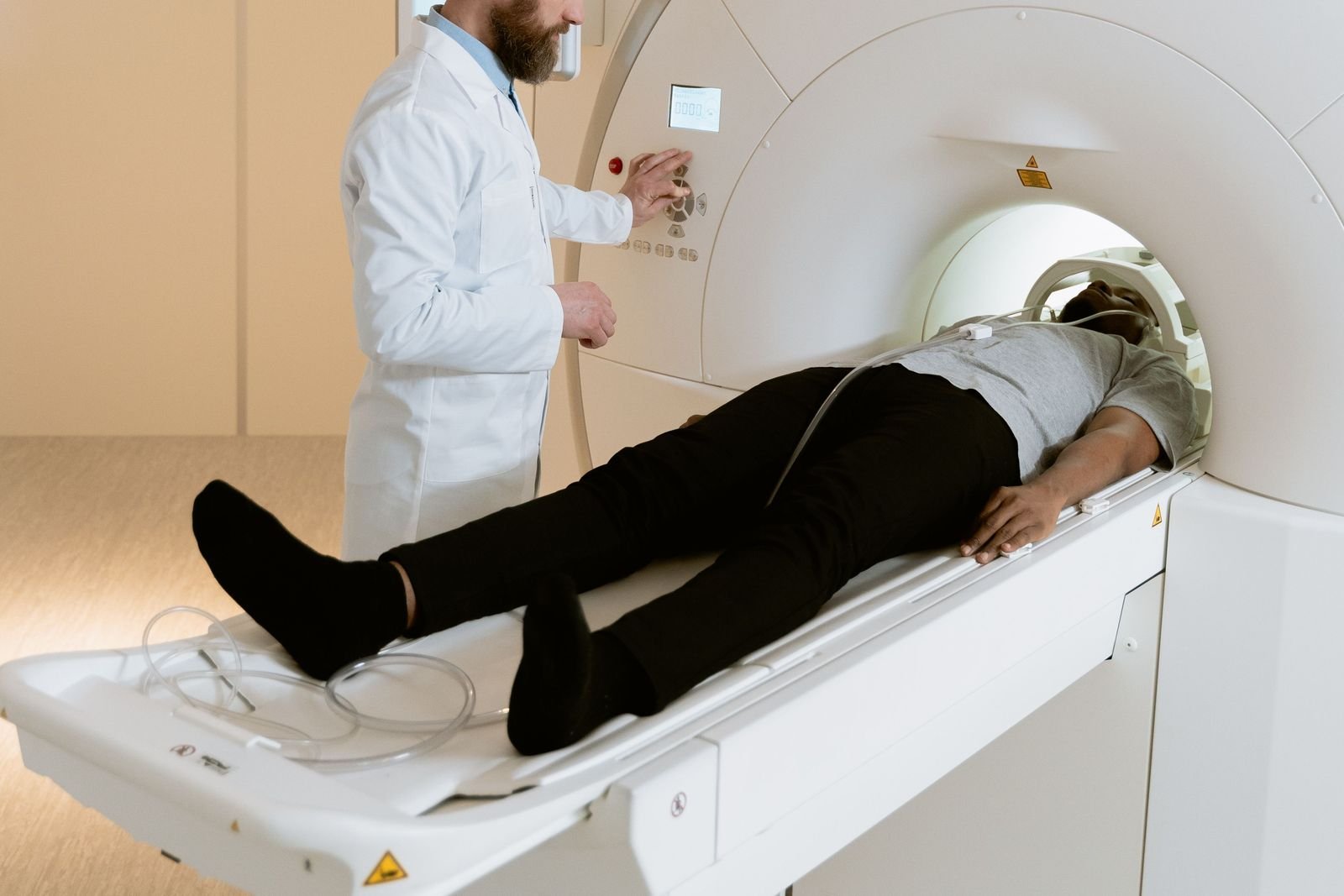
The NHS describes an MRI scanner as a large machine with a short tunnel through it and a flat bed that moves through the scanner. Two physical limits come from that design. The table, and the motor that moves it, is built to carry a set maximum weight. The tunnel has a fixed diameter, and the table itself takes up part of that space.
The Society of Radiographers' guidance on caring for larger patients in imaging says the table weight and opening size of all equipment should be clearly displayed. It also warns that a patient above a table's weight limit can damage the table or its motor. That is why a clinic asks about weight: it is a safety check, not a judgement.
Weight is often not the only factor. In a freedom of information response, University Hospitals Birmingham NHS Foundation Trust said that with its wide bore scanner, most patients were too wide rather than over the weight limit. It added that other factors can significantly limit the safe weight that can be scanned.
MRI scan weight limits in the UK: what NHS hospitals publish
A few NHS organisations publish figures. They are useful as examples, but they apply only to the scanners named:
- University Hospitals Birmingham said its wide bore scanners have a 70 cm opening and a maximum weight of 250 kg (UHB FOI response).
- Referral guidance for Bristol, North Somerset and South Gloucestershire says two named scanners in Bristol can take patients up to 250 kg, with a separate route for anyone above that (BNSSG MRI considerations).
- York and Scarborough Teaching Hospitals asks patients to get in touch with the MRI department if they weigh more than 22 stone (140 kg) (York and Scarborough MRI leaflet).
These figures are not a UK rule. Limits vary from scanner to scanner, and a figure from one hospital tells you nothing certain about a scanner somewhere else. Always ask the clinic for the limits of the specific scanner you would be scanned on.
Wide bore MRI for larger patients
A wide bore scanner is a closed, tunnel-style scanner with a larger opening, so there is more room around your body and shoulders. The UHB response describes wide bore scanners with a 70 cm opening, and the Bristol guidance calls newer wide bore scanners much more patient friendly than older scanners.
NHS commissioning policy treats wide bore scanning as an option when someone cannot fit comfortably in a conventional scanner because of their body size or another physical limitation, or when their weight is more than the conventional table can carry. That is how the Humber and North Yorkshire policy on open, wide bore and upright MRI describes it. Our guide to the types of MRI scanner explains how wide bore compares with a standard closed scanner.
Open and upright scanners: MRI for bigger people who need more space
Open scanners use a different magnet design, with open sides rather than a tunnel, and upright scanners scan you sitting or standing. The Humber and North Yorkshire policy says these non-closed scanners may be used when a conventional closed scanner cannot be used because of a physical limitation, including body size, or because of claustrophobia.
There is a trade-off. The MHRA safety guidelines for MRI equipment say open systems tend to use lower magnetic fields than closed bore systems. The Humber and North Yorkshire policy says image quality from these scanners is usually lower and the scan takes longer, and the Bristol guidance says images from open scanners are not as detailed as those from closed scanners. Whether that matters depends on the body part and the question being asked, so the choice is one for the clinic's radiology team and your referrer.
If you think an open or upright scanner might suit you, you can compare open and upright MRI clinics, and our guide to open vs closed MRI sets out the pros and cons.
What to tell the clinic when you enquire, and why the body part matters
The Society of Radiographers says good practice is an accurate assessment before a patient attends, looking at weight, size and girth. Sharing this early saves a wasted journey and lets the clinic plan the right scanner. It also helps to know that the scanner needs the area being scanned to sit in the middle of the tunnel. Royal Berkshire NHS Foundation Trust explains that you go in head first or feet first depending on the part of your body being scanned, and that the body part needs to be in the middle of the tunnel.
When you send an enquiry, it helps to include:
- your current weight, ideally a recent measurement;
- your height;
- your widest measurement, such as around your hips, tummy or shoulders, if the clinic asks for it;
- exactly which area is being scanned, for example your left shoulder or lower back;
- whether you can lie flat and still for the length of the scan, and whether lying flat makes you breathless or causes pain;
- any implants or metal in your body.
The NHS says an MRI scan usually takes between 15 minutes and 1 hour, and sometimes longer, so ask how long your scan is likely to take. If one clinic's scanner is not suitable, ask whether it has a wide bore or open scanner at another site. On referral, MRI may be self-referral at some clinics, depending on the clinic's own policy and safety screening, while others ask for a referral from a doctor or other clinician. Our guide to private MRI without a GP referral explains more.
Comfort, claustrophobia and positioning
Some people find the tunnel feels very enclosed, whatever their size. If you are worried, tell the clinic before the day. The NHS says you may be able to have a medicine to help you relax, and that you should not drive for 24 hours afterwards if you do. You can also ask whether someone can come with you, and the NHS says the radiographer will be able to hear and speak to you during the scan. Our guide to claustrophobia and MRI covers more options.
The MHRA lists burns caused by skin touching skin, or by arms or legs forming a loop, among the risks it describes, so the radiographer will think carefully about how your arms and legs are placed. If any area starts to feel uncomfortably warm during the scan, say so straight away.
Key points
- Every MRI table has a maximum weight and every bore has a fixed width; for many people, width matters as much as weight.
- Limits vary by scanner, so ask the clinic for the figures for the scanner you would use.
- Wide bore, open and upright scanners give more room, though open and upright scans may take longer and show less detail.
- Tell the clinic your weight, height, any body measurements it asks for and the area to be scanned when you enquire.
Comparing clinics on FindScan
You can compare private MRI clinics near you on FindScan, see each clinic's own listed price and send an enquiry to the clinic you choose. Mention your weight, height and the area to be scanned in your enquiry; the clinic contacts you to confirm whether its scanner suits you and to arrange your scan.
FindScan is a directory of independent, regulated imaging clinics, not a healthcare provider, and nothing here replaces advice from your GP or the clinician who asked for your scan. Speak to them about symptoms or results. If symptoms are urgent, call NHS 111, or 999 in an emergency.
Common questions
What is the MRI weight limit?
There is no single MRI weight limit. Each scanner table has its own maximum, and the bore has a fixed width. Some NHS hospitals publish figures for particular scanners, for example 250 kg for certain scanners in Birmingham and Bristol, but limits vary by scanner. Ask the clinic for the limit of the scanner you would use.
Is there an MRI scan weight limit in the UK?
There is no national UK limit. Each scanner has a table weight limit and a bore width set by its design. York and Scarborough Teaching Hospitals, for example, asks patients who weigh more than 22 stone (140 kg) to get in touch with the MRI department. Other hospitals and clinics will have different figures, so always check with the clinic first.
What is a wide bore MRI for larger patients?
A wide bore MRI is a closed, tunnel-style scanner with a larger opening, so there is more space around your body. University Hospitals Birmingham describes wide bore scanners with a 70 cm opening. NHS policy treats wide bore scanning as an option for people who cannot fit comfortably in a conventional scanner or whose weight is over the conventional table limit.
Is there MRI for bigger people?
Yes. Wide bore scanners give more room, and open or upright scanners may be considered when a closed scanner cannot be used because of body size or claustrophobia. NHS guidance says open and upright scanners usually produce lower quality images and take longer, so the clinic's radiology team will advise which scanner suits your scan.
Will the clinic ask for my weight before an MRI?
Very likely, and it is a safety check rather than a judgement. The Society of Radiographers says good practice is an accurate assessment before you attend, looking at weight, size and girth. Telling the clinic your weight, height and the area to be scanned when you enquire helps it check that its scanner suits you before you travel.
Do I need a referral for a wide bore MRI?
It depends on the clinic. MRI may be self-referral at some clinics, depending on the clinic's own policy and safety screening, while others ask for a referral from a doctor or other clinician. Whichever route you take, the clinic will ask safety questions about implants and metal in your body before your scan.
References
- MRI scan (page last reviewed 11 September 2025). NHS. Accessed 29 October 2026.
- FOI 0361: MRI scans and obesity. University Hospitals Birmingham NHS Foundation Trust. Accessed 29 October 2026.
- MRI considerations: open MRI scanner. NHS Bristol, North Somerset and South Gloucestershire ICB (Remedy). Accessed 29 October 2026.
- MRI Scanning, patient information leaflet PIL 447 v7 (July 2024). York and Scarborough Teaching Hospitals NHS Foundation Trust. Accessed 29 October 2026.
- Open, wide bore and upright magnetic resonance imaging (MRI) policy (effective 1 October 2024). Humber and North Yorkshire Health and Care Partnership. Accessed 29 October 2026.
- Bariatric Patients: Guidance and Advice for the Radiography Workforce (2013). Society and College of Radiographers. Accessed 29 October 2026.
- Having an MRI scan (adult), March 2023. Royal Berkshire NHS Foundation Trust. Accessed 29 October 2026.
- Safety guidelines for magnetic resonance imaging equipment in clinical use, fifth edition (updated 30 September 2026). GOV.UK (MHRA). Accessed 29 October 2026.
This article is general information, not medical advice, and it does not replace an assessment by a clinician. If you have symptoms that worry you, speak to your GP or call 111. In an emergency, call 999.