Neck MRI: What It Shows, and When Neck Pain or Whiplash Actually Needs a Scan
The clocks have gone back, the evenings are dark and wet, and the season of jolted necks has begun: rear-end shunts on the commute, slips on leaves, a bad night on an unfamiliar pillow. NHS guidance says most neck pain lasts only a few weeks and whiplash is diagnosed from your symptoms, not a scan. Here is how to tell the neck pain that needs an MRI from the neck pain that does not.
Written by the FindScan Editorial Team and reviewed by our Medical Advisor, Dr Mohamed Najjar
Reviewed
Neck pain has a season, and it starts about now. The NHS lists sleeping in an awkward position, poor posture, a pinched nerve and injuries such as whiplash among the common causes, and the weeks after the clocks go back bring more of all of them: long hours at screens in the dark, slips on wet leaves, and more collisions on the roads. RoSPA's road safety factsheet says that every autumn when the clocks go back, road casualties rise.
If your neck is sore, a scan may feel like the obvious way to find out what is wrong. This guide explains why NHS guidance usually points the other way, which symptoms do justify an MRI of the neck (the cervical spine), what the scan shows, and the warning signs that need urgent help rather than a scan.
Most neck pain settles without any scan
The NHS neck pain page says most neck pain only lasts a few weeks. Its advice is painkillers such as paracetamol or ibuprofen, a low, supportive pillow, heat or cold packs, gentle neck exercises, and keeping the neck moving rather than wearing a collar unless a doctor advises one.
The NHS says to see a GP if the pain or stiffness has not gone after a few weeks, if painkillers have not helped, if you are worried, or if you have other symptoms such as pins and needles or a cold arm, which it says could be a sign of something more serious. In many areas, it adds, you can refer yourself to NHS musculoskeletal (MSK) services such as physiotherapy without seeing a GP first. A scan does not feature in that route.
Whiplash: diagnosed by your story, not by a scan
NHS 111 Wales describes whiplash as a neck injury caused by sudden movement of the head, most often after a car accident or a slip or fall. It says whiplash usually gets better within 2 to 3 months, that you should keep doing everyday activities even if they hurt a little, and that a neck collar does not help.
The Royal Berkshire NHS Foundation Trust emergency department leaflet puts the imaging question plainly: tests and scans are not usually required in order to diagnose whiplash, which is diagnosed from your symptoms and how the injury happened; X-rays, CT or MRI may be recommended if another problem, such as a spinal injury, is suspected. It says that in about 60 per cent of cases the symptoms improve significantly or disappear within one to four weeks. After a collision, the right first step is an assessment by the emergency services, an urgent treatment centre or a GP, not a self-arranged scan.
The symptoms that need urgent help, not a private scan
NHS 111 Wales says to get an urgent GP appointment or call 111 if, after whiplash, you have severe pain that does not ease with painkillers, tingling or pins and needles, problems walking or sitting upright, sudden electric shock sensations in the neck and back, or weakness in the arms or legs, because these could be signs of nerve damage.
Berkshire Healthcare NHS Foundation Trust's whiplash advice adds difficulty walking or coordinating movement, loss of feeling or weakness in the arms or legs, and sudden or worsening severe headaches as reasons for urgent help through NHS 111, A&E or an emergency GP appointment, and says to call 999 for anything life-threatening. None of these should wait for a private scan.
When an MRI of the neck is the right test
The NHS cervical spondylosis page (age-related wear in the neck) says a health professional will examine your neck and shoulders, may test your reflexes and watch you walk, and that depending on your symptoms you may be sent for tests such as X-rays or scans. It describes two situations in which surgery may be considered: a nerve pressed on by a slipped disc or bone (cervical radiculopathy), and a problem affecting the spinal cord (cervical myelopathy).
NHS radiology departments spell this out for the clinicians who request scans. The Norfolk and Norwich University Hospitals criteria for musculoskeletal MRI requests say a cervical spine MRI is indicated for radiculopathy or for adverse features such as a focal neurological deficit, recent trauma, known or suspected cancer, infection or inflammation, or symptoms of myelopathy. They state that MRI is not indicated for acute or chronic neck pain without neurology or adverse features, and that generalised arm pain, altered sensation, pins and needles or numbness on their own are not an indication.
In plain terms: a sore, stiff neck is not an MRI question. Pain, weakness or altered feeling running down one arm in a recognisable pattern, or a problem affecting your walking, balance or hands, may be. A GP or physiotherapist can tell the two apart in the room.
What a neck MRI shows, and what the scan involves
MRI uses a magnetic field and radio waves rather than X-rays, and the NHS says it can be used to check bones and organs and find the cause of symptoms. In the neck that means the vertebrae, the discs, the spinal cord and the nerve roots; it is the test that shows whether a disc or bony spur is pressing on a nerve or the cord, which an X-ray cannot. A cervical spine MRI does not routinely include the brain, which is a separate scan, and it is not a scan of a lump in the neck; the NHS lumps page says a GP may refer you for an ultrasound scan to look at a lump. See whether MRI shows nerve damage and MRI shoulder scan, a common source of pain mistaken for the neck.
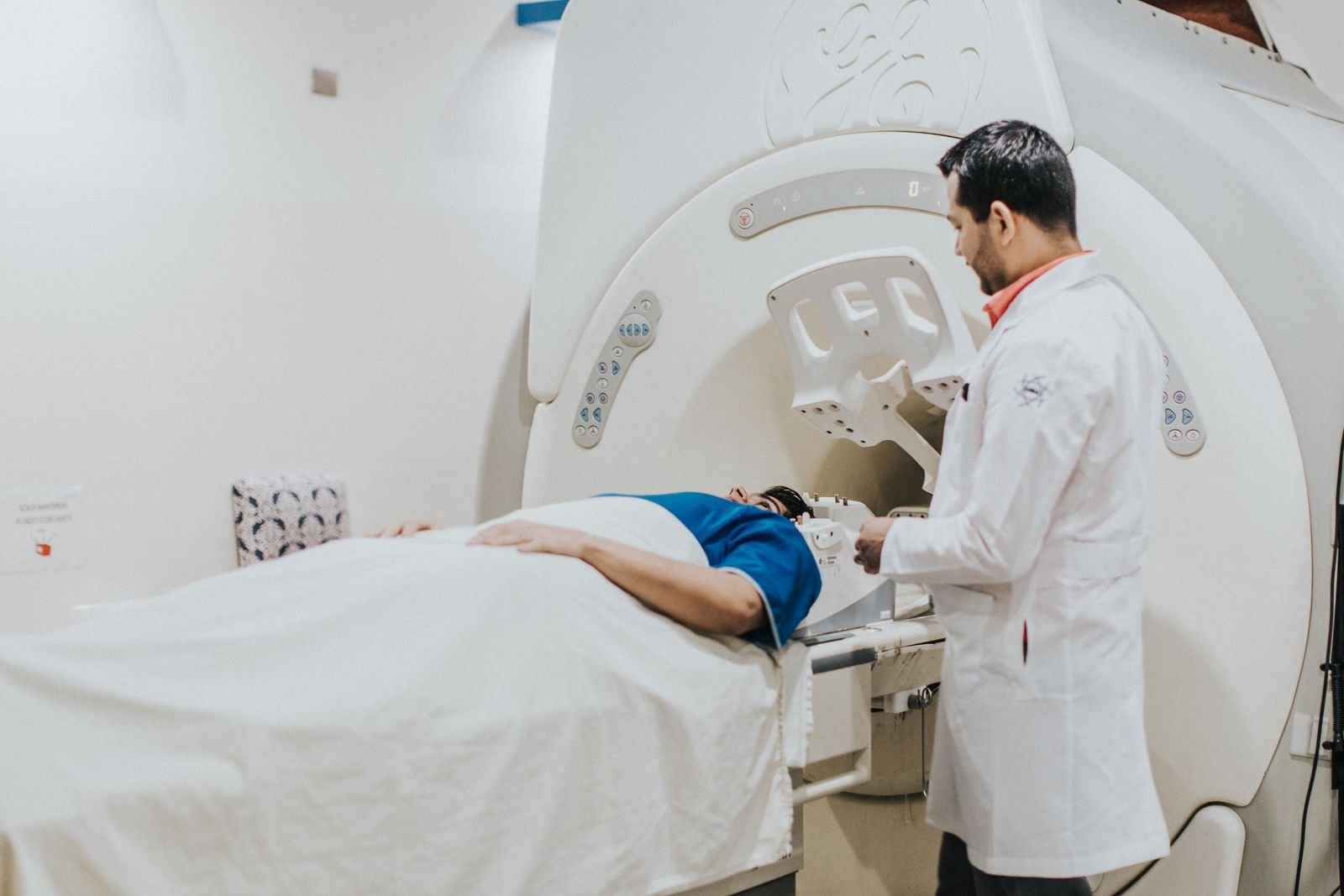
The NHS says an MRI usually takes between 15 minutes and 1 hour, that the scanner is loud so you are given earplugs or headphones, and that you will be asked about metal in your body. For a neck scan you lie on your back with a coil around your head and neck. See what to expect at an MRI scan and MRI safety and metal implants.
Having a private neck MRI
If a GP or physiotherapist has examined you and suggested a cervical spine MRI, and the NHS wait is long, a private scan is an option. MRI does not use ionising radiation, so many clinics accept self-referral, although every clinic screens you first and its radiographer or radiologist decides whether the scan suits your symptoms. You can compare neck MRI clinics near you on FindScan and send an enquiry; the clinic contacts you to confirm whether it needs a referral and the next steps. Ask who will receive the report, because it only helps if the clinician treating you can act on it.
FindScan is a directory of independent, regulated imaging clinics: you compare clinics and send an enquiry, and the clinic contacts you. We are not a healthcare provider, and nothing here replaces an examination by a GP or physiotherapist. If you have weakness in your arms or legs, problems walking, an electric shock feeling down your spine or severe pain that painkillers do not touch, contact NHS 111 or your GP urgently today, and call 999 for anything life-threatening.
Common questions
How long does a neck MRI take?
The NHS says an MRI scan usually takes between 15 minutes and 1 hour. The clinic will tell you how long your particular scan is expected to take.
Does a neck MRI show the brain?
Not routinely. A cervical spine MRI images the neck vertebrae, discs, spinal cord and nerve roots. A brain MRI is a separate scan that can be requested alongside it.
Do I need an X-ray or MRI for whiplash?
Usually neither. The Royal Berkshire NHS Foundation Trust emergency department leaflet says tests and scans are not usually required to diagnose whiplash, and that X-rays, CT or MRI may be recommended if another problem, such as a spinal injury, is suspected.
When does neck pain need an MRI?
NHS radiology referral criteria (Norfolk and Norwich University Hospitals) say cervical spine MRI is indicated for radiculopathy, meaning nerve root pain or weakness down the arm, or for adverse features such as a neurological deficit, trauma, suspected cancer or infection, or signs of spinal cord compression, and not for neck pain alone.
When is neck pain an emergency?
NHS 111 Wales says to get an urgent GP appointment or call 111 for severe pain despite painkillers, tingling or pins and needles, problems walking or sitting upright, an electric shock feeling in the neck and back, or weakness in the arms or legs. Call 999 if it is life-threatening.
References
- Neck pain and stiff neck. NHS. Accessed 27 October 2026.
- Cervical spondylosis. NHS. Accessed 27 October 2026.
- Whiplash. NHS 111 Wales. Accessed 27 October 2026.
- Neck injury (whiplash): emergency department patient information, December 2023. NHS (Royal Berkshire NHS Foundation Trust). Accessed 27 October 2026.
- Whiplash: advice and exercises. NHS (Berkshire Healthcare NHS Foundation Trust). Accessed 27 October 2026.
- Referral criteria for first contact practitioners in the community requesting musculoskeletal MRI (v2.0, 2024). NHS (Norfolk and Norwich University Hospitals NHS Foundation Trust). Accessed 27 October 2026.
- Road safety factsheet: Single/Double British Summertime (October 2020). RoSPA. Accessed 27 October 2026.
- MRI scan. NHS. Accessed 27 October 2026.
- Lumps. NHS. Accessed 27 October 2026.
This article is general information, not medical advice, and it does not replace an assessment by a clinician. If you have symptoms that worry you, speak to your GP or call 111. In an emergency, call 999.