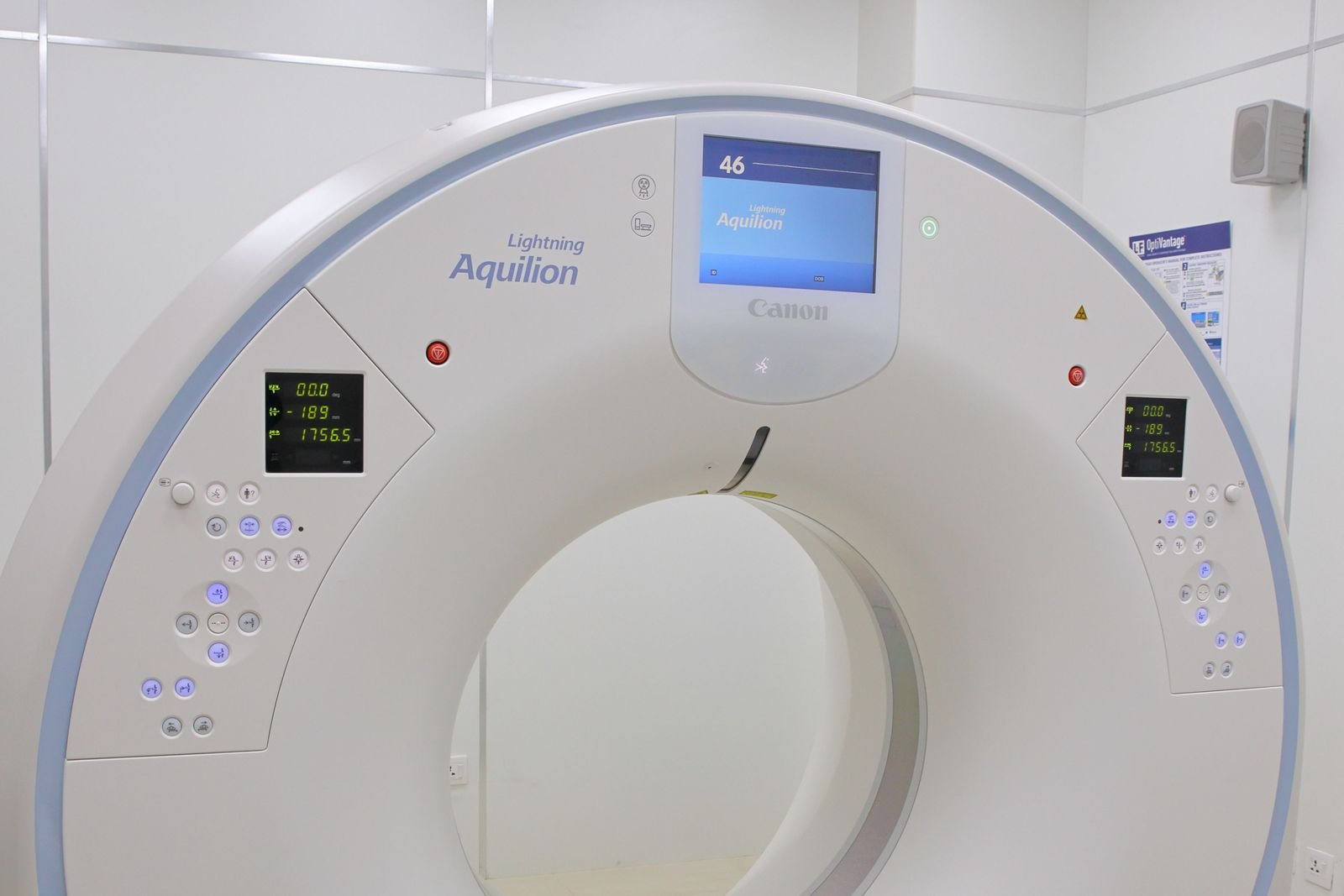
What Is a PET Scan? PET CT Scans Explained, and PET Scan vs CT Scan
A PET CT scan uses a small amount of radioactive tracer to show how active the body's tissues are, combined with a CT scan to show exactly where things are. This guide explains what happens, how to prepare, what to expect afterwards, and why it always needs a specialist referral.
Written by the FindScan Editorial Team and reviewed by our Medical Advisor, Dr Mohamed Najjar
Reviewed
If a specialist has asked for a PET scan, it is natural to want to know what is a PET scan, how it differs from a CT scan you may already have had, and what the day involves. In short, a PET CT scan combines two tests in one machine: the PET part shows how active cells are, using a small amount of radioactive tracer, and the CT part shows the body's structure. That is the heart of the PET scan vs CT scan question, and this guide explains it in plain language.
We cover what PET-CT is used for, how to prepare, how long it takes, the precautions afterwards and how referral works. Your hospital's own letter always comes first, because instructions differ between departments.
What is a PET scan?
The NHS describes a PET scan as a test that uses a small amount of radiation to scan inside your body, and says it can help diagnose conditions and plan treatment. PET stands for positron emission tomography. Before the scan, a small amount of radioactive liquid, called a tracer, is injected into a vein in your arm.
Cancer Research UK explains that the most common tracer is a radioactive sugar called FDG (fluorodeoxyglucose). Cancer cells need energy to grow, and Cancer Research UK says active cancer cells take up the FDG, which then shows up brighter on the scan. Other tracers are used for some specific questions.
PET scan vs CT scan: what each one shows
A CT scan uses X-rays and a computer to create detailed pictures of the inside of the body, which is how Cancer Research UK describes it. A PET scan shows something different: areas where cells are more active than normal. Cambridge University Hospitals puts it simply, describing PET-CT as a scanning method that lets the team see how organs are working.
The NHS says a PET scan can be combined with a CT scan (PET-CT) or an MRI scan (PET-MRI) when doctors need more detailed images. Combining them lets an active area on the PET pictures be matched to an exact place on the CT. Our guide to MRI vs CT scans compares two other common scans.
What a PET CT scan is used for
Most PET-CT scans are for cancer. Cancer Research UK says it can help find a cancer, show how big it is and whether it has spread (staging), show whether a lump is cancer, and help doctors choose treatment and check how well it is working. After treatment, a CT scan may still show some signs of the cancer, and a PET scan can help show whether that tissue is active cancer.
PET is also used outside cancer. The NHS says scans may be used to find out whether symptoms come from conditions such as cancer or dementia, and to plan treatment for cancer, epilepsy or after a heart attack. The evidence-based indications for the use of PET-CT in the UK from the Royal College of Radiologists and Royal College of Physicians list neurological and cardiological uses, vasculitis, and infection and inflammatory disorders, alongside a long list of cancers. The specialist who requests your scan will explain the question it is meant to answer.
How to prepare for a PET CT scan
Follow your appointment letter over anything here. The NHS says you typically should not eat for 6 hours beforehand, with only water allowed, and should avoid strenuous exercise for up to 24 hours before. Trust leaflets say much the same: Cambridge asks for nothing except plain water for six hours, and the Christie also asks patients not to drink alcohol for 24 hours before. See also eating and drinking before a scan.
If you have diabetes, contact the department well before the day. The NHS says to tell the hospital if you have diabetes or find it hard to go without food. Blood sugar needs to be within a target range, and the numbers vary: the Christie says between 4 and 10 mmol/l, while the Royal United Hospitals Bath says 4 to 12 mmol/l and that well-controlled diabetic patients can often manage with a shorter four-hour fast. Cambridge says the scan will need to be rearranged if high blood sugar levels are found. Do not change your diabetes medicines unless the department tells you to.
- Take your usual medicines on the day unless your letter says otherwise; Cambridge and the Christie both say this.
- Leave jewellery at home and wear loose, warm clothes without metal zips or underwiring. The NHS says metal items need to be removed.
- Tell the department in advance if you are or might be pregnant, or if you are breastfeeding.
- Do not bring children or pregnant companions. Guy's and St Thomas' and the Christie both ask patients not to.
On the day of your PET CT scan, and afterwards
After a few checks, the tracer is injected into a vein and you rest quietly while it spreads around the body. The NHS says the injection is given about an hour before the scan, and Cambridge says this uptake period is 60 to 90 minutes. The Christie says the tracer is ordered for you and has a very short shelf life, so if you are running late, phone the department.
The scan itself is shorter than the wait: anywhere from about 10 to 60 minutes, depending on the hospital and the scan, according to the NHS, Cancer Research UK and Cambridge. In total, expect around 2 to 3 hours in the department; Cambridge says about 2 hours, and the Christie and Guy's and St Thomas' say 2 to 3 hours. Guy's and St Thomas' adds that you cannot leave between the injection and the end of the scan, because of radiation exposure to others.
The NHS says you can usually go home soon after and eat and drink straight away. It says the tracer's radiation falls to a safe level quickly and is gone within a few hours, and that drinking plenty of fluids helps clear it.
Because the tracer is still leaving your body, departments ask you to limit close contact with others. Cancer Research UK says to avoid close contact with pregnant women, babies and young children for the rest of the day. Cambridge and Bath say to avoid close contact with young children and pregnant women for six hours, counting from the injection in Bath's case. If you are breastfeeding, the NHS says staff will advise you, for example expressing milk before the scan and not breastfeeding for a few hours afterwards. Bath also advises carrying your appointment letter if you travel within seven days, because of radiation detectors at some transport hubs and event venues.
Like any test using ionising radiation, PET-CT carries a small risk. The NHS says the tracer's radiation is usually safe but any radiation can slightly raise future cancer risk, that PET-CT adds a small dose from the CT part, and that allergic reactions to the tracer are very rare. Our guide to radiation safety explains how doctors weigh this up.
Results, referral, and why PET-CT is not a health check
You will not usually get results on the day. A radiologist reports the images and the results go to the doctor who referred you. The NHS and Cancer Research UK say results usually take 1 or 2 weeks, and some departments aim to be quicker. If you have not heard after a few weeks, the NHS says to contact that doctor. See how to get your scan images and report.
PET-CT uses ionising radiation, so it is covered by the Ionising Radiation (Medical Exposure) Regulations 2017, known as IR(ME)R. The GOV.UK guidance to IR(ME)R says any exposure must be justified before it can take place. A referrer, who must be a registered healthcare professional, refers you, and a practitioner takes responsibility for justifying the scan. The tracer adds another layer: under IR(ME)R, the practitioner needs a licence to give radioactive substances, and the employer needs one for each site, granted on the advice of ARSAC, the Administration of Radioactive Substances Advisory Committee.
In practice, this means you cannot self-refer for a PET CT scan, on the NHS or privately. It is usually requested by a hospital specialist or consultant, and the Christie and Guy's and St Thomas' both say results go back to the consultant or specialist who asked for the scan. The IR(ME)R guidance also says exposures of people without symptoms, including for individual health assessment, must be justified. PET-CT is a test to answer a specific clinical question, not a screening test or general check-up for healthy people. See our guide to the limits of health scans.
Key points
- A PET scan uses a radioactive tracer, usually FDG, to show how active cells are; PET-CT adds a CT scan to show exactly where.
- It is mostly used for cancer, including staging and checking treatment, with some heart and brain uses.
- Expect to fast for about 6 hours, avoid hard exercise for 24 hours, and call ahead if you have diabetes.
- Allow 2 to 3 hours in the department, and limit close contact with babies, young children and pregnant people for as long as your department advises.
- PET-CT always needs a referrer and justification under IR(ME)R 2017; it is not a check-up for healthy people.
Comparing clinics on FindScan
On FindScan you can compare private CT clinics near you, see each clinic's own listed price and send an enquiry; the clinic then contacts you to arrange your scan. Every CT or PET-CT scan needs a referrer under IR(ME)R, and many private clinics arrange this through their own doctor. Not every CT clinic offers PET-CT, because it needs a licensed nuclear medicine service, so if your consultant has asked for PET-CT, check with the clinic that it provides it.
FindScan is a directory of independent, regulated imaging clinics, not a healthcare provider, and nothing here is medical advice. Speak to your GP or the clinician who referred you about symptoms or results. If you need help urgently, call NHS 111, or 999 in an emergency.
Common questions
What is a PET scan?
A PET scan is a test that uses a small amount of radiation to scan inside your body, according to the NHS. A radioactive tracer, most often a sugar called FDG, is injected into a vein, and areas where cells are more active than normal show up brighter. It is often combined with a CT scan, which is then called a PET-CT scan.
What is a PET CT scan?
A PET CT scan combines a PET scan and a CT scan in one session. The PET part shows how active the body's tissues are, using a radioactive tracer, and the CT part uses X-rays to show detailed structure. Cancer Research UK says combining them produces more detailed images, so doctors can see both where something is and how active it is.
PET scan vs CT scan: what is the difference?
A CT scan uses X-rays and a computer to create detailed pictures of the body's structure. A PET scan uses a radioactive tracer to show where cells are more active than normal. They answer different questions, which is why they are often done together as PET-CT. Your specialist will decide which test, if any, suits your situation.
How long does a PET CT scan take?
The scan itself is fairly short, from about 10 to 60 minutes depending on the hospital and the scan, but you rest for about an hour after the tracer injection first. NHS trust leaflets say to expect around 2 to 3 hours in the department in total. Bring something to read, but do not bring children or pregnant companions.
Can I be around children after a PET scan?
Departments ask you to avoid close contact with babies, young children and pregnant people for a short time afterwards, because the tracer is still leaving your body. Cancer Research UK says for the rest of the day, while some NHS trusts say six hours. Follow the advice your department gives you. If you are breastfeeding, staff will explain what to do.
Can I get a PET CT scan privately without a referral?
No. PET-CT uses ionising radiation, so under IR(ME)R 2017 every scan needs a referrer and must be justified before it goes ahead. Privately, it is usually requested by a consultant or hospital specialist. PET-CT is a test for a specific clinical question, not a screening test or check-up for people without symptoms.
References
- PET scan. NHS. Accessed 29 October 2026.
- PET scan. Cancer Research UK. Accessed 29 October 2026.
- 18F-FDG PET-CT scan (patient information). Cambridge University Hospitals NHS Foundation Trust. Accessed 29 October 2026.
- Information about your PET-CT scan. The Christie NHS Foundation Trust. Accessed 29 October 2026.
- PET CT patient information sheet (NM 102, adult PET-CT scan). Royal United Hospitals Bath NHS Foundation Trust. Accessed 29 October 2026.
- PET-CT scan. Guy's and St Thomas' NHS Foundation Trust. Accessed 29 October 2026.
- Evidence-based indications for the use of PET-CT in the United Kingdom 2022. Royal College of Radiologists and Royal College of Physicians. Accessed 29 October 2026.
- Guidance to the Ionising Radiation (Medical Exposure) Regulations 2017. GOV.UK (DHSC). Accessed 29 October 2026.
- About us: Administration of Radioactive Substances Advisory Committee. GOV.UK (ARSAC). Accessed 29 October 2026.
This article is general information, not medical advice, and it does not replace an assessment by a clinician. If you have symptoms that worry you, speak to your GP or call 111. In an emergency, call 999.