Blocked Sinuses That Will Not Clear: Do You Need a CT Scan?
An early flu season means a long queue of blocked noses and aching faces. Almost none of them need a scan. This guide explains what the NHS says to do first, why a sinus X-ray is no longer routinely used, and the narrow set of situations in which a specialist arranges a CT.
Written by the FindScan Editorial Team and reviewed by our Medical Advisor, Dr Mohamed Najjar
Reviewed
Every autumn brings a wave of blocked noses, pressure behind the cheeks and headaches that will not shift, and this year the wave may have arrived early. The UK Health Security Agency said on 8 October that early signs suggest the flu season is starting earlier than usual, and the NHS says sinusitis is common after a cold or flu.
Somewhere in the third week of a miserable head, people start searching for a sinus scan. Very few of them need one. The NHS expects most sinusitis to clear on its own, a plain sinus X-ray is not routinely funded on the NHS, and a CT of the sinuses is a test a specialist arranges when treatment has failed or something unusual is going on. Here is the order of events.
What sinusitis is and how long it lasts
The NHS describes sinusitis as swelling of the sinuses, usually caused by an infection, and says it is common and usually clears up on its own within 4 weeks. NICE's guideline on acute sinusitis (NG79) says it is usually caused by a virus and lasts for about 2 to 3 weeks, which is why antibiotics are rarely the answer. The NHS says it is common after a cold or flu and that allergies can trigger it.
The NHS lists the main symptoms as pain, swelling and tenderness around the cheeks, eyes or forehead, a blocked or runny nose, a reduced sense of smell, green or yellow mucus from the nose, and a high temperature, with headache, toothache, bad breath, a cough and pressure in the ears as other symptoms.
Self-care and the pharmacy come first
The NHS advice for the first weeks is rest, plenty of fluids, and painkillers such as paracetamol or ibuprofen, without aspirin for children under 16. It suggests avoiding anything you are allergic to, not smoking, and rinsing the nose with a salt water solution up to 3 times a day. If you have a high temperature or do not feel well enough for your normal activities, the NHS says to stay at home and avoid contact with other people until you feel better.
The NHS says a pharmacist can help and can tell you if you need to see a GP. It says to see a GP if your symptoms have not improved after 7 days of treatment from a pharmacist or GP, after 3 weeks of looking after yourself, if you keep getting sinusitis, or if your child is 11 or under. A GP may prescribe a steroid nasal spray or drops, antihistamines if an allergy is involved and, rarely, antibiotics.
When an ear, nose and throat specialist gets involved
The NHS says a GP may refer you to an ear, nose and throat specialist if your sinusitis has not improved after 3 months of treatment, if it keeps coming back, or if you only have symptoms on one side of your face. The specialist can examine the nose directly and decide whether anything further is needed.
For chronic sinusitis the NHS describes an operation called functional endoscopic sinus surgery, carried out under general anaesthetic, which widens the sinuses by removing the tissue that is blocking them or by inflating a small balloon in the blocked sinus. Imaging sits on the road to that decision, not at the start of it.
Why a sinus X-ray is no longer routinely used
If you were told years ago that a sinus X-ray showed nothing, that test has largely gone. Cheshire and Merseyside Integrated Care Board's commissioning policy on sinus X-rays (April 2023) says plain X-rays for diagnosing rhinosinusitis are not routinely commissioned, citing the Royal College of Surgeons and the British Society for Allergy and Clinical Immunology, which say there is no role for a plain X-ray in assessing chronic rhinosinusitis because it underestimates the changes in the sinuses.
The same policy sets out where CT belongs. Quoting the allergy society's guidance, it says CT should be reserved for patients failing medical treatment or with atypical or severe disease. In plain terms: the sprays and rinses come first, and the scan follows only if they do not work.
What a CT of the sinuses involves
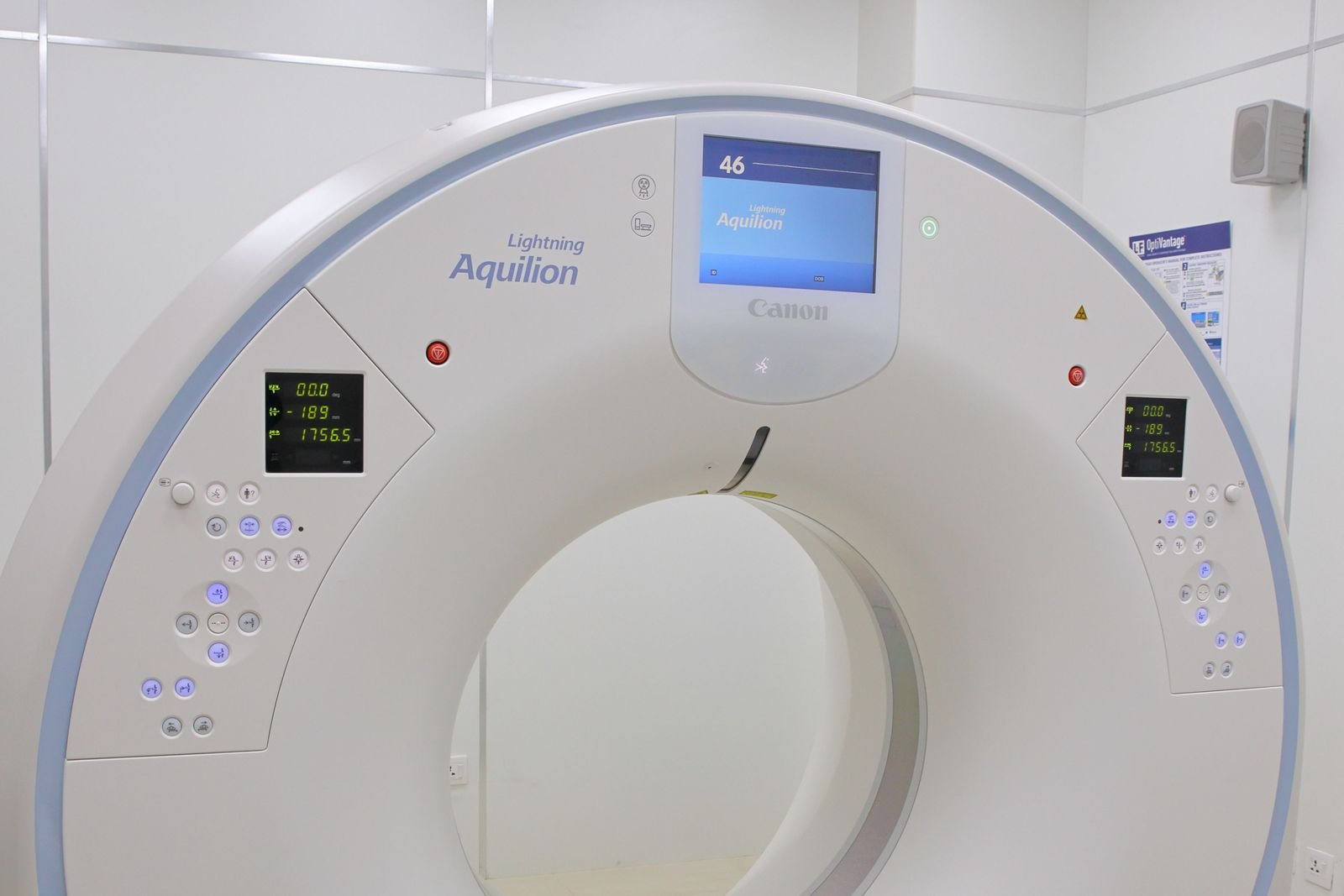
The NHS describes a CT scan as a test that takes detailed pictures of the inside of your body, usually lasting about 10 to 20 minutes. For the sinuses it maps the air spaces and the bone around them, which is what a specialist needs when deciding whether surgery would help. The NHS says to tell the hospital if you are or might be pregnant, have kidney or thyroid problems, have diabetes, or have ever reacted to contrast dye; the clinic will tell you whether your scan uses contrast.
Our guide to scan appointments with a cold or flu covers what to do if you are unwell on the day. Because CT uses X-rays, the Ionising Radiation (Medical Exposure) Regulations 2017 require every scan to be justified, with a referral from a registered referrer, so a private sinus CT needs a referral, usually from the specialist who wants the pictures. The NHS says having lots of CT scans carries a very small chance that the radiation could cause cancer, and that doctors weigh that up first; our guide to X-ray and CT radiation puts the doses in context. The NHS says results usually take 1 to 2 weeks.
Symptoms that need urgent care, not a scan
The NHS says to ask for an urgent GP appointment or get help from NHS 111 if you have sinusitis and are very unwell, if painkillers are not helping or your symptoms are getting worse, or if you have a weakened immune system, for example because of chemotherapy. For a child under 5 with sinusitis symptoms, the NHS says to call 111. If you have flu symptoms and feel very unwell or short of breath, the NHS flu page gives the same urgent GP or 111 advice, and says to call 999 for sudden chest pain, severe difficulty breathing or coughing up blood. None of those situations is helped by searching for a scan.
Where a private CT fits
If a specialist has recommended a CT of your sinuses and the wait is holding up a decision about treatment, a private scan can bring the pictures forward. Ask the specialist for the referral, then compare CT clinics near you and send an enquiry; the clinic contacts you to confirm the referral it needs and the next steps.
FindScan is a directory of independent, regulated imaging clinics: you compare clinics and send an enquiry, and the clinic contacts you. We are not a healthcare provider, and nothing here replaces an assessment by a clinician.
Common questions
Do I need a CT scan for sinusitis?
Almost always no. The NHS says sinusitis usually clears within 4 weeks and describes self-care, pharmacy treatment and a GP visit before any referral. Cheshire and Merseyside ICB's policy says CT is reserved for people whose sinusitis has not responded to treatment or who have atypical or severe disease.
Can I have a private sinus CT without a referral?
No. CT uses X-rays, and the Ionising Radiation (Medical Exposure) Regulations 2017 require every exposure to be justified with a referral from a registered referrer. A private clinic will ask for a referral from the clinician who wants the scan.
Why will the NHS not do a sinus X-ray?
Cheshire and Merseyside ICB's policy says plain sinus X-rays are not routinely commissioned, citing surgical and allergy guidance that there is no role for a plain X-ray in assessing chronic rhinosinusitis because it underestimates the changes in the sinuses. CT is the test used when imaging is needed.
When should I see a GP about sinusitis?
The NHS says to see a GP if your symptoms have not improved after 7 days of treatment from a pharmacist or GP, after 3 weeks of self-care, if you keep getting sinusitis, or if your child is 11 or under. A GP may refer you to an ear, nose and throat specialist after 3 months of treatment, if it keeps coming back, or if you only have symptoms on one side of your face.
Does a sinus CT use contrast dye?
It depends on the question the specialist is asking. The clinic will tell you whether your scan uses contrast and what to tell them beforehand, such as kidney problems, diabetes or a previous reaction to dye.
References
- Sinusitis (sinus infection). NHS. Accessed 27 October 2026.
- Sinusitis (acute): antimicrobial prescribing (NG79). NICE. Accessed 27 October 2026.
- Sinus X-ray commissioning policy, CMICB_Clin044, April 2023. NHS (Cheshire and Merseyside Integrated Care Board). Accessed 27 October 2026.
- CT scan. NHS. Accessed 27 October 2026.
- Flu. NHS. Accessed 27 October 2026.
- Are we seeing an early flu season? What we know so far about this year's strains (8 October 2026). UKHSA. Accessed 27 October 2026.
- The Ionising Radiation (Medical Exposure) Regulations 2017, SI 2017/1322. legislation.gov.uk. Accessed 27 October 2026.
This article is general information, not medical advice, and it does not replace an assessment by a clinician. If you have symptoms that worry you, speak to your GP or call 111. In an emergency, call 999.