Tennis Elbow: Do You Need an Ultrasound, MRI or X-ray?
Raking, lifting and screwdriver weekends are how many people get tennis elbow, and most of them do not play tennis. NHS orthopaedic and physiotherapy teams say the diagnosis is made by examining you, and that scans are rarely needed. Here is when a scan does help, which one is used, and how long the pain usually takes to go.
Written by the FindScan Editorial Team and reviewed by our Medical Advisor, Dr Mohamed Najjar
Reviewed
A weekend of raking leaves, cutting back the hedge and putting up shelves, and by Monday the outside of your elbow hurts every time you pick up the kettle. That is the classic story behind tennis elbow, and East Kent Hospitals makes the point plainly: most of the people affected are not tennis players. Gardening, bricklaying, heavy screwdriver use, hammering and typing are all on its list of triggers.
The natural next question is whether you need a scan. For most people the answer from NHS teams is no, at least not at the start. This guide explains how tennis elbow is diagnosed, when a scan does come into it, how long recovery takes, and the symptoms that should take you to NHS 111 rather than a scan.
What tennis elbow is
Tennis elbow, or lateral epicondylitis, is pain on the outside of the elbow where the tendons of the forearm muscles attach to the bone. The NHS says it is usually caused by repeated gripping and twisting of the wrist and forearm, from computer work, manual tasks or sports, and that it is more common in people aged 35 to 54.
East Kent Hospitals describes it as a tendinopathy: repeated or strenuous forearm activity causes small tears in the tendon that thicken, swell and become painful. NHS Lothian says it is thought to be due to overuse, often from repetitive hand and wrist tasks such as DIY, housework or computer work. The East Riding NHS musculoskeletal service puts it simply: the load on the tendon has been more than the tendon has been able to cope with.
How it is diagnosed, and why a scan is usually not needed
Tennis elbow is diagnosed by listening and examining, not by imaging. NHS Lothian says it is a clinical diagnosis based on your history and a physical examination. East Kent Hospitals says the diagnosis can usually be made with a simple examination by your GP, and the East Riding service says a good history and physical examination of your elbow alone provides enough information.
The NHS sources are just as consistent about scans. University Hospitals of Derby and Burton says tennis elbow does not routinely require X-rays or scans. NHS Lothian says further imaging, including X-rays, ultrasound and MRI, is rarely required, particularly if there has not been a fall or an injury. The East Riding service explains why: scans rarely change the treatment plan, because imaging findings are very poorly linked with pain and many people without any pain have similar results. A scan that shows a thickened tendon confirms what the examination already found, and the treatment, load management and exercise, is the same either way.
When ultrasound, MRI or an X-ray does help
Scans earn their place when the story does not fit or the pain does not settle. East Kent Hospitals says X-rays are not usually needed at first but may be requested later to rule out other problems, and that if a tendon tear is suspected an ultrasound scan can show signs of wear and tear. A fall or a sudden injury changes the picture, which is why NHS Lothian's advice carries that qualifier.
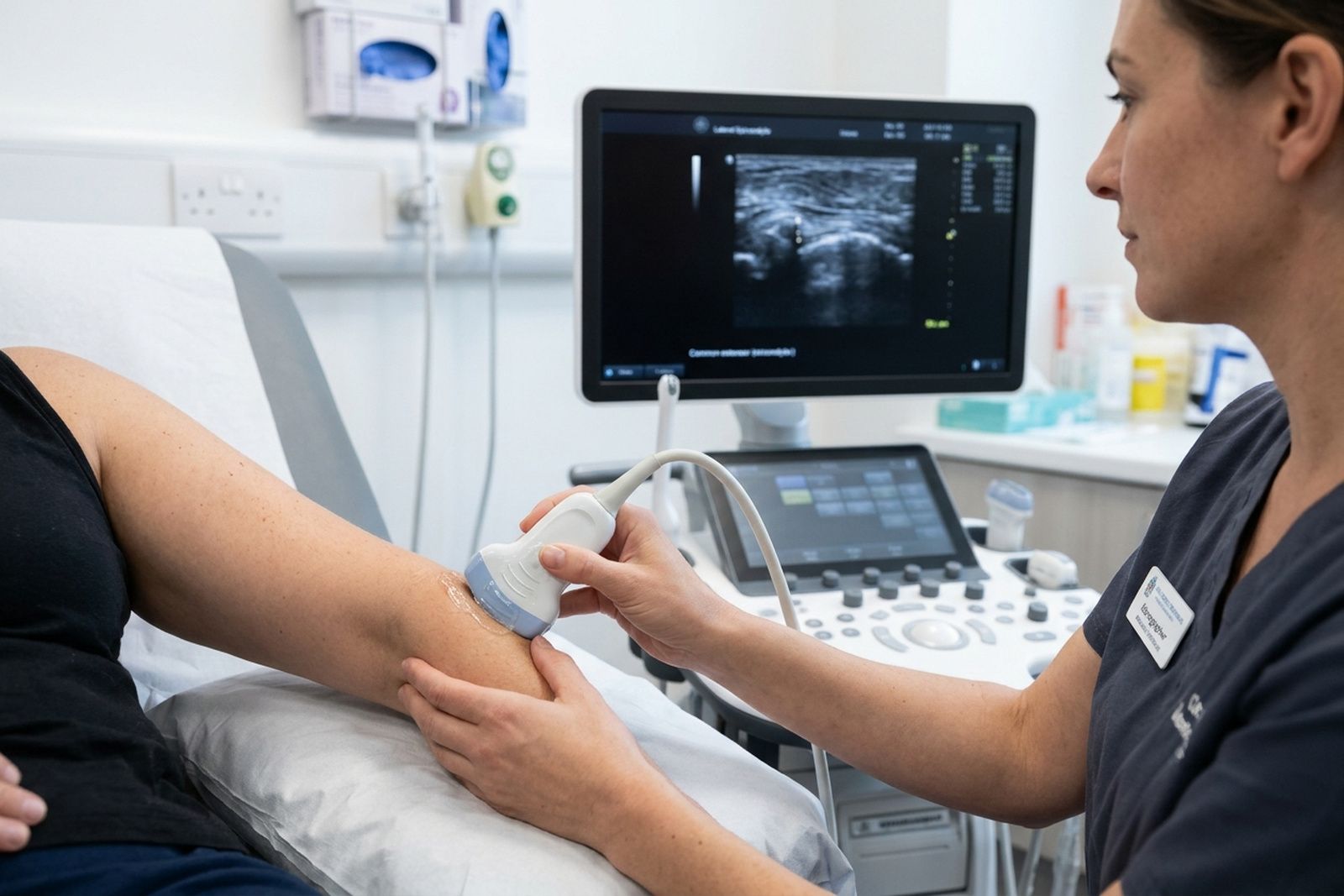
Ultrasound is usually the first choice because the tendon lies just under the skin. The NHS says an ultrasound scan is used to see images of the inside of your body, such as muscles and organs, and does not use radiation; the sonographer can check the tendon's thickness, compare it with the other arm and look for a tear. MRI, which the NHS says is used to help find the cause of symptoms and plan treatment, gives a wider view of the joint, ligaments and bone, so a clinician may choose it after a significant injury or when ultrasound has not answered the question. An X-ray, which the NHS says is used among other things to check bones, rules out a bony cause rather than showing the tendon. Our ultrasound vs MRI guide explains the trade-offs.
What to do first, and how long it takes
The NHS advice for the first few weeks is self-care: reduce the activities that bring the pain on, use a hot or cold pack wrapped in a towel for up to 20 minutes every 2 to 3 hours, do gentle bending and straightening exercises, and consider a forearm strap or elbow brace. The NHS says to see a GP if the pain continues after at least 2 weeks of rest and self-care, and that physiotherapy may help if symptoms have not improved after 6 weeks.
Be realistic about the timescale. The NHS says tennis elbow usually gets better with rest but can sometimes last over a year. NHS Lothian says it can take between 6 and 24 months to settle, and that after one year eight out of ten people will have significant improvement whether or not they receive treatment. East Kent Hospitals says about nine in ten people heal within a year without surgery, and the East Riding service says most people see improvement after roughly 6 to 12 weeks of lifestyle changes, advice and exercise. A physiotherapist can often help; our guide to physiotherapists and scan referrals explains what they can arrange.
Elbow symptoms that need NHS 111 instead
A few elbow problems are not tennis elbow and should not wait for a scan. The East Riding NHS musculoskeletal service says to contact NHS 111 if your arm or elbow hurts during exercise and eases with rest, comes with chest pain or tightness, is swollen with a high temperature, is extremely painful and hard to move, became severely painful after a fall or injury, has persistent pins and needles or numbness, or was injured with a snapping noise or has changed shape. The NHS says 999 is for life-threatening emergencies such as heart attacks, and arm pain with chest pain belongs there.
Having a private elbow scan
If a GP or physiotherapist has suggested an ultrasound or MRI of your elbow and the NHS wait is long, a private scan is an option. Ultrasound and MRI can be self-referred at many clinics because neither uses ionising radiation, although the clinic will ask what the scan is for and a sonographer or radiologist decides whether it is the right test. An X-ray uses radiation, so clinics ask for a referral; our guide to X-rays without a referral explains why. You can compare ultrasound clinics near you on FindScan and send an enquiry; the clinic contacts you to confirm whether it needs a referral and the next steps.
FindScan is a directory of independent, regulated imaging clinics: you compare clinics and send an enquiry, and the clinic contacts you. We are not a healthcare provider, and nothing here replaces an examination by a GP or physiotherapist. If your elbow pain came with chest pain, a snapping noise, a fever or numbness, contact NHS 111 today, or call 999 for chest pain, rather than arranging a scan.
Common questions
Do I need a scan to diagnose tennis elbow?
Usually not. NHS Lothian says tennis elbow is a clinical diagnosis based on your history and a physical examination, and University Hospitals of Derby and Burton says it does not routinely require X-rays or scans.
Which scan is best for tennis elbow, ultrasound or MRI?
When a scan is needed, ultrasound is usually used first because the tendon is close to the skin; East Kent Hospitals says an ultrasound can show wear and tear if a tendon tear is suspected. MRI gives a wider view of the joint and is chosen by the clinician when ultrasound has not answered the question.
How long does tennis elbow take to get better?
The NHS says it usually gets better with rest but can sometimes last over a year. NHS Lothian says it can take 6 to 24 months to settle, with eight out of ten people significantly improved after a year whether or not they have treatment.
Can I have a private elbow ultrasound without a GP referral?
Many clinics accept self-referral for ultrasound and MRI because they do not use ionising radiation, although the sonographer or radiologist decides whether the scan is appropriate. An X-ray needs a referral. The clinic confirms its own requirements when you enquire.
When should I see a GP about elbow pain?
The NHS says to see a GP if the pain continues after resting your elbow and trying self-care for at least 2 weeks. Contact NHS 111 if the pain followed a fall, or came with a snapping noise, a fever or numbness, and call 999 if it comes with chest pain.
References
- Tennis elbow. NHS. Accessed 27 October 2026.
- Tennis elbow (lateral epicondylitis): information for patients. NHS (East Kent Hospitals University NHS Foundation Trust). Accessed 27 October 2026.
- Tennis elbow: information for patients (v2.0, January 2024). NHS Lothian. Accessed 27 October 2026.
- Tennis elbow. NHS (University Hospitals of Derby and Burton NHS Foundation Trust). Accessed 27 October 2026.
- Tennis elbow. NHS (City Health Care Partnership, East Riding MSK Physiotherapy Service). Accessed 27 October 2026.
- Ultrasound scan. NHS. Accessed 27 October 2026.
- MRI scan. NHS. Accessed 27 October 2026.
- X-ray. NHS. Accessed 27 October 2026.
- When to call 999. NHS. Accessed 27 October 2026.
This article is general information, not medical advice, and it does not replace an assessment by a clinician. If you have symptoms that worry you, speak to your GP or call 111. In an emergency, call 999.