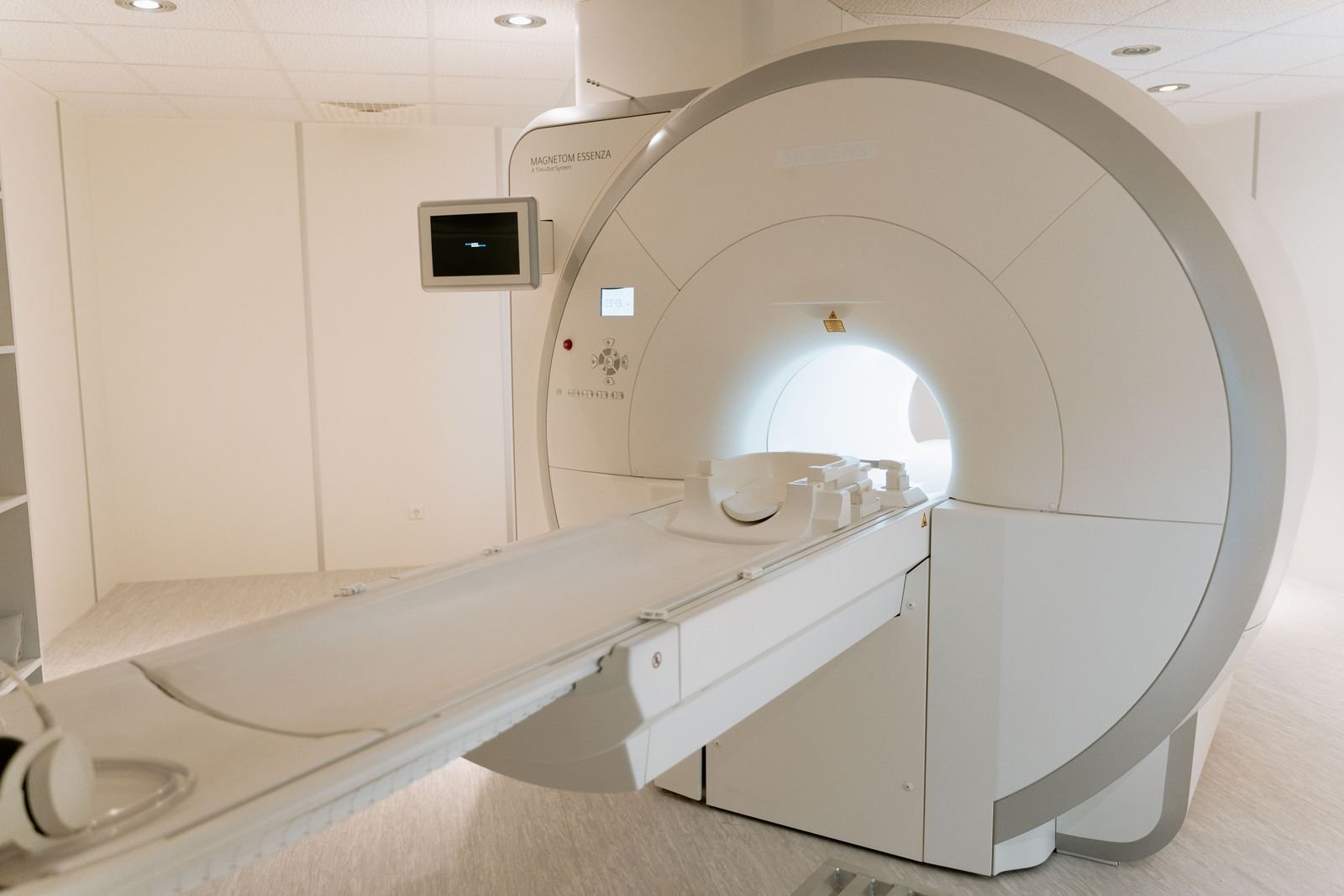
A prostate MRI scan uses magnets to create a detailed picture of the prostate and the surrounding tissues. In the UK it is part of the pathway for people who may have prostate cancer, usually after a raised PSA blood test has led to a referral to a specialist.
FindScan is a comparison service, not a healthcare provider. We do not carry out scans or give medical advice. We list private clinics that offer MRI, show each clinic's own listed price, and pass your enquiry to the clinic you choose.
mpMRI and bpMRI: what the names mean
Prostate Cancer UK describes a multi-parametric MRI (mpMRI) as a special type of MRI scan, and says that in many hospitals you may have one before having a biopsy. An mpMRI combines three types of image, called sequences: T2-weighted imaging, diffusion-weighted imaging, and dynamic contrast-enhanced imaging, which uses an injection of contrast dye.
A biparametric MRI (bpMRI) uses the T2-weighted and diffusion-weighted sequences without the contrast-enhanced part, so no dye injection is needed. Which type suits you is for the clinician requesting the scan to decide.
Where MRI fits in the prostate cancer pathway
The NHS says that if you are referred to a specialist because there is a chance you could have prostate cancer, you will have an MRI scan. This can give a clearer view of the prostate and show if you need any more tests. If the specialist needs to find out more, they may suggest a biopsy, where a small needle is put into the prostate to take a tissue sample so it can be checked for cancer cells.
NICE guideline NG131 on prostate cancer diagnosis and management says to offer multiparametric MRI as the first-line investigation to people with suspected clinically localised prostate cancer, and to report the results using a 5-point Likert scale. Its diagnosis and staging algorithm then sets out how the score guides the next step:
- Score of 3 or more. NICE says to offer an MRI-influenced prostate biopsy. Prostate Cancer UK says you will usually be offered a biopsy.
- Score of 1 or 2. NICE says to consider not doing a biopsy, but only after discussing the risks and benefits and reaching a shared decision. Prostate Cancer UK says your doctor may suggest regular PSA tests, or you may decide together to have a biopsy.
- Guiding a biopsy. Prostate Cancer UK says the doctor can use the scan images to decide which parts of the prostate to take samples from.
Prostate Cancer UK explains that the score, between 1 and 5, may be called a PI-RADS (Prostate Imaging Reporting and Data System) score or a Likert score, and tells your doctor how likely it is that you have cancer inside your prostate. It is not a diagnosis on its own, and the specialist team interprets it alongside your PSA level and other risk factors. Prostate Cancer UK also notes that MRI is less likely than a biopsy to pick up a slow-growing cancer. See prostate MRI explained.
Start with a PSA test and your GP
The NHS describes the PSA test as a blood test to help check for prostate conditions such as prostate cancer or an enlarged prostate, and says men and anyone with a prostate can ask a GP about it. A high PSA does not mean you have cancer; it may be raised for other reasons, such as an enlarged prostate. If your result is raised, you may be referred to a specialist for more tests, including an MRI scan and a biopsy.
Going through your GP first means your PSA result and any symptoms are looked at together, and if you need further tests you are already on the specialist pathway. A private MRI does not replace that assessment, and if a scan suggests a biopsy or treatment, a specialist will still need to arrange the next steps. See seeing a GP before a scan.
Urinary symptoms: see a GP
The NHS says an enlarged prostate is most common in men over 50, can affect anyone with a prostate, and is not usually serious. It can cause problems such as difficulty starting to pee, a weak flow, feeling that you cannot fully empty your bladder, and needing to pee more often or urgently, including at night. The NHS says it is important to get these symptoms checked by a GP because they can sometimes be caused by more serious conditions, such as prostate cancer. A GP may test a sample of your pee and offer a PSA blood test.
- See a GP if you have difficulty peeing or need to pee more often.
- Ask for an urgent GP appointment or get help from NHS 111 if you have blood in your pee (it may look pink, red or brown), pain when peeing, or you cannot pee at all.
Do you need a referral for a private prostate MRI?
MRI does not use ionising radiation, so the Ionising Radiation (Medical Exposure) Regulations 2017 (IR(ME)R), which apply to X-ray and CT, do not apply to it. Many private clinics accept self-referral for MRI, usually after their own safety screening, but each clinic sets its own policy. For prostate MRI in particular, some clinics ask for a recent PSA result or a referral letter, and some offer a review with their own doctor first.
See our guide to private MRI without a GP referral.
Preparing for the scan and safety
Prostate Cancer UK says the doctor or nurse will ask about your health before the scan, including whether you have any metal in your body such as implants or fragments, and you will need to take off any jewellery or metal items. If your scan uses contrast dye, it says the dye is usually safe but can sometimes cause problems if you have kidney problems, have asthma, or are allergic to the dye or have other allergies, so tell the clinic about any of these.
Some people cannot have an MRI, or need extra checks first, and the clinic's safety screening decides this. See MRI safety and metal implants and how to prepare for your scan.
During the scan, and your results
Prostate Cancer UK says the scan takes 30 to 40 minutes. You lie still on a table that moves into the scanner, which is very noisy, and you might feel warm. If you have contrast dye, it is given as an injection during the scan. If you feel anxious in enclosed spaces, tell the clinic beforehand. See claustrophobia and MRI.
Your images are reported by an appropriately qualified clinician, and the report is sent to you or your referrer, depending on how the clinic works. The clinic will tell you how long its report takes. Plan to discuss the result with a GP or urology specialist who can put the score in context. See scan results.
What affects the price of a prostate MRI
Each clinic sets its own price, and prices vary. The main factors are whether the scan is an mpMRI with contrast or a bpMRI without it, the type of scanner, whether a consultation or doctor review is included, and where the clinic is. FindScan shows each clinic's own listed price as the clinic sets it, without mark-up.
Check what is included, such as the report, before you send an enquiry. See our private MRI cost guide.
How to compare prostate MRI clinics on FindScan
Use FindScan search to see clinics near you that offer MRI. Compare locations, listed prices and clinic details, then send an enquiry to the clinic you choose. We pass your details to that clinic, and the clinic contacts you to discuss which prostate scan it offers, its referral policy, safety screening and availability.
For other scans of the lower body, see pelvis MRI.
FindScan is a comparison service, not a healthcare provider, and nothing here is medical advice. Speak to a GP or another clinician about your symptoms.