AAA Screening: The Free NHS Ultrasound Offered to Men at 65, What It Checks, and What If You Are Not Eligible
Movember runs through November, and one of the simplest things a man can do for his health takes a quarter of an hour and costs nothing. The NHS abdominal aortic aneurysm screening programme invites men across the UK for an ultrasound of the main blood vessel in the tummy in the year they turn 65. This guide explains what the scan checks, what the results mean, how to get it if you were never invited, and what the NHS says about aortic scans for people outside the programme.
Written by the FindScan Editorial Team and reviewed by our Medical Advisor, Dr Mohamed Najjar
Reviewed
The NHS says an abdominal aortic aneurysm, usually shortened to AAA, is a bulge or swelling in the aorta, the main blood vessel that carries blood from the heart down through the tummy. Most cause no symptoms, but a large one can burst, and the NHS says a rupture is a life-threatening emergency.
Because the condition is often silent and the test is simple, the NHS runs a screening programme. This guide explains who is invited, what happens, what the results mean, and the honest position on scans for people the programme does not cover.
Who is invited, in all four nations
The NHS says men living in England are invited for AAA screening in the year they turn 65, with the letter usually arriving 3 to 6 weeks before the appointment. The GOV.UK programme overview, updated on 9 October 2026, says screening is offered to men during the screening year (1 April to 31 March) in which they turn 65, and that men over 65 who were not invited can contact their local AAA screening service for an appointment.
The other nations run the same offer. Public Health Wales says men aged 65 are invited if they are registered as living in Wales, and men over 65 who have not been screened can ask for a scan through their local screening office. NHS National Services Scotland says the Scottish programme offers screening to all men in their 65th year, and that older men can opt in through their local screening centre. The Public Health Agency says the Northern Ireland programme offers the test to men in the year they turn 65, and men over 65 who have not been screened can phone the screening office.
The NHS says screening is recommended for anyone assigned male at birth, including trans women and non-binary people assigned male at birth; anyone registered as female with their GP should contact the surgery or local screening service to ask about an appointment.
What the scan involves
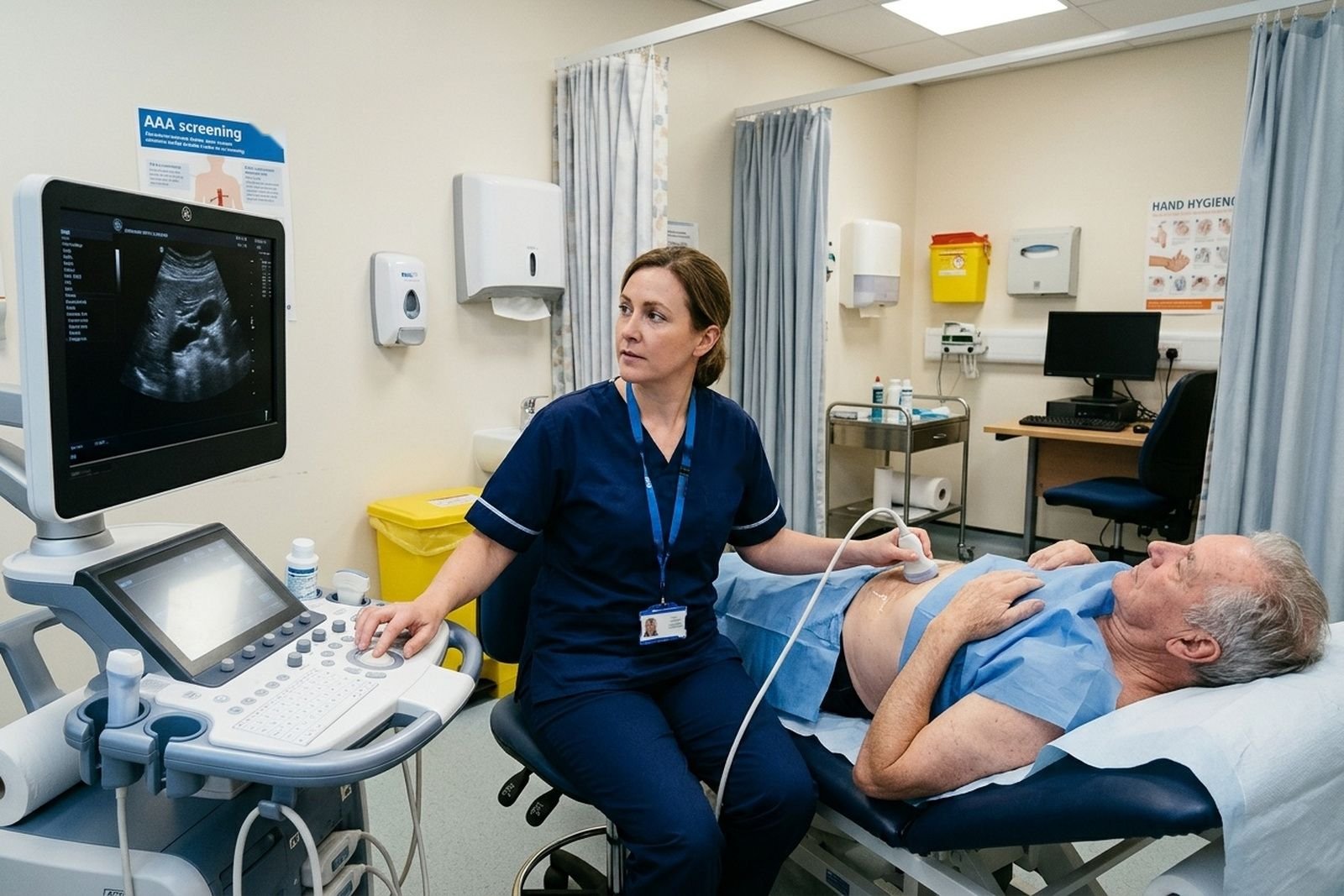
The test is an ultrasound of the tummy. The NHS says it is painless and takes around 10 to 15 minutes, and that it is usually done at GP surgeries or health centres. The result is given at the end of the appointment and sent to your GP. If the aorta cannot be seen clearly, the NHS says another scan may be needed. No needles or radiation are involved; our guide to abdominal ultrasound describes the same kind of scan used for other tummy organs.
What the four results mean
The NHS groups results by the width of the aorta. If no aneurysm is found, you need no further scans. A small aneurysm, 3 cm to 4.4 cm, means a yearly scan and advice from a specialist nurse; a medium one, 4.5 cm to 5.4 cm, a scan every 3 months; a large one, 5.5 cm or bigger, referral to a vascular surgeon for more tests and possible treatment.
For small and medium aneurysms the NHS says the nurse can discuss medicines, more frequent blood pressure checks and lifestyle changes such as stopping smoking. The NHS condition page adds that aneurysms often grow over time, which is why follow-up scans matter, and that surgery is generally considered for aneurysms that are 5.5 cm or larger, growing quickly or causing pain.
Why it is worth attending
The NHS says most aneurysms cause no symptoms, so screening is the main way to find one, and that finding one early lowers the risk of it bursting. The UK National Screening Committee's 10-year effectiveness review of the four UK programmes, covering 2013/14 to 2022/23, reported uptake of 79.6 per cent in England, 77.8 per cent in Wales, 84.5 per cent in Scotland and 82.8 per cent in Northern Ireland, 7,777 men with a large aneurysm referred for vascular treatment, a roughly halving of hospital treatment for ruptured aneurysms over the decade, and a fall of more than two thirds in the rate of ruptured aneurysms in men aged 65 to 74.
The NHS Constitution for England commits the NHS to providing the screening programmes recommended by the UK National Screening Committee, and this is one of them. Fifteen minutes in the year you turn 65 is a small ask.
Women, younger men and family history
The NHS says screening is not usually offered to men under 65, to people assigned female at birth, or to people already treated for an aneurysm. GOV.UK's private screening page, updated on 16 July 2026, is firmer: there is no evidence showing that screening men younger than 65 would deliver any major benefits.
Family history is the exception. The NHS screening page says that if you are not eligible but think you are at higher risk, you can talk to a GP about a scan, and it lists a family history of aneurysm, high blood pressure, diabetes, COPD and smoking as factors that raise risk. GOV.UK says men and women with a close relative who has had the condition can request screening. The route in each case is the GP, because the GP can arrange the scan in a way that connects the result to follow-up.
A private aortic ultrasound: when it can make sense
For men turning 65, the NHS scan is free, local and connected to follow-up, and there is no reason to go private for it. A private aortic ultrasound has a narrower place: a GP has agreed that a scan is reasonable for someone outside the programme, typically because of a close relative with an aneurysm, and the NHS route locally is slow or unclear. Our guide to the limits of health scans explains why a scan without a question behind it is rarely worthwhile.
If that is your situation, ultrasound does not use ionising radiation, so many clinics accept self-referral. Ask whether the aorta will be measured and reported specifically, who reports the scan, and that a copy goes to your GP. You can compare abdominal ultrasound clinics near you on FindScan and send an enquiry; the clinic contacts you to confirm whether it needs a referral and the next steps.
FindScan is a directory of independent, regulated imaging clinics: you compare clinics and send an enquiry, and the clinic contacts you. We are not a healthcare provider and nothing here replaces advice from your GP. The NHS says to call 999 if someone has sudden, severe pain in the tummy or back, is struggling to breathe, has pale or grey skin, or loses consciousness, because these could be signs of an aneurysm bursting. That is an emergency, not a reason to look for a scan.
Common questions
What is AAA screening?
An NHS ultrasound of the tummy that checks the width of the aorta for a swelling called an abdominal aortic aneurysm. The NHS says it is painless, takes around 10 to 15 minutes and gives the result at the end of the appointment.
Who gets invited for AAA screening?
Men in the year they turn 65, in all four UK nations, according to the NHS, Public Health Wales, NHS National Services Scotland and the Public Health Agency. Men over 65 who were never screened can contact their local screening service.
What happens if a small aneurysm is found?
The NHS says a small aneurysm, 3 cm to 4.4 cm, is followed with a yearly scan and advice from a specialist nurse. A medium one is scanned every 3 months, and a large one, 5.5 cm or more, is referred to a vascular surgeon.
Why are women not offered AAA screening?
The NHS says screening is not usually offered to people assigned female at birth or men under 65. The UK National Screening Committee's 10-year review raises screening women only as a possible future question. If you have a close relative who had an aneurysm, the NHS says to talk to your GP about a scan.
Can I have an aortic ultrasound privately?
Yes, but for a man turning 65 the NHS scan is free and connected to follow-up, so there is no reason to go private for it. A private scan makes most sense when a GP has agreed it is reasonable for someone outside the programme. Ask that the aorta is measured and reported and that the report goes to your GP.
References
- Abdominal aortic aneurysm screening. NHS. Accessed 27 October 2026.
- Abdominal aortic aneurysm. NHS. Accessed 27 October 2026.
- Abdominal aortic aneurysm screening: programme overview (updated 9 October 2026). GOV.UK (NHS England). Accessed 27 October 2026.
- Private screening for health conditions: NHS recommendations (updated 16 July 2026). GOV.UK. Accessed 27 October 2026.
- UK AAA Screening Programmes: 10 Year Effectiveness Review (UK NSC slides, January 2026). UK National Screening Committee. Accessed 27 October 2026.
- Abdominal Aortic Aneurysm (AAA) screening. Public Health Wales. Accessed 27 October 2026.
- Abdominal aortic aneurysm (AAA) screening (20 February 2026). NHS National Services Scotland. Accessed 27 October 2026.
- AAA screening event reminds men to attend for potentially life-saving test (24 March 2025). Public Health Agency (Northern Ireland). Accessed 27 October 2026.
- The NHS Constitution for England (updated 17 August 2023). GOV.UK. Accessed 27 October 2026.
This article is general information, not medical advice, and it does not replace an assessment by a clinician. If you have symptoms that worry you, speak to your GP or call 111. In an emergency, call 999.