Hernia Ultrasound: When a Groin or Tummy Lump Needs a Scan, and When It Does Not
A lump in the groin that appears when you lift, cough or stand and disappears when you lie down is the classic hernia. NHS guidance says a GP can usually identify one by examining you, and surgeons reserve imaging for the cases where the diagnosis is not clear. Here is how that decision is made, what a groin scan involves, and the warning signs that are an emergency.
Written by the FindScan Editorial Team and reviewed by our Medical Advisor, Dr Mohamed Najjar
Reviewed
You lifted something heavy at the weekend, or coughed your way through a cold, and now there is a soft lump in your groin or near your belly button that comes and goes, more obvious when you stand or strain and often gone when you lie down. That is the classic hernia, which the NHS describes as part of an internal organ, such as the bowel, pushing through a gap or weak area in the muscle that holds it in place.
Many people assume the next step is a scan. Usually it is not. This guide explains how a hernia is actually diagnosed, when an ultrasound is used, what a groin scan involves, and the symptoms that mean a hernia has become an emergency.
The common types, and who gets them
The NHS lists hernias by where they appear: an inguinal hernia in the groin, a femoral hernia in the upper thigh near the groin, an umbilical hernia near the belly button, a hiatus hernia in the chest, and hernias near the spine or beside a stoma. NHS 111 Wales says the inguinal hernia is the most common type and mainly affects men, and is often associated with ageing and repeated strain on the tummy.
Femoral hernias are different: the NHS says they mainly happen in women over 50, and it lists straining to poo, lifting heavy weights, being overweight, coughing, pregnancy and losing weight very quickly among the risk factors. In many cases, NHS 111 Wales says, a hernia causes no or very few symptoms: a lump that can often be pushed back in or disappears when you lie down, and which coughing or straining may make appear.
How a hernia is diagnosed: usually by examination, not by scan
The NHS says that if you think you have a hernia you should see a GP, who may refer you for tests or treatment if needed. NHS 111 Wales is more specific: a GP will usually be able to identify a hernia by examining the affected area, and may refer you for an ultrasound scan to confirm the diagnosis.
That order, examination first and imaging only if needed, is how NHS surgeons are asked to work. The Royal College of Surgeons of England and British Hernia Society commissioning guide for groin hernia (revised 2016) says medical imaging should be considered where there is diagnostic uncertainty or to exclude other pathology, recommends a dynamic ultrasound scan as the first-line investigation in that case, and says diagnostic imaging should not be arranged at primary care level.
NHS North Yorkshire's hernia policy (2021) takes a similar line: a visible hernia on examination, with the patient standing or coughing, is the basis for referral, and where no hernia can be seen but groin pain persists, the options may include referral to musculoskeletal services or an ultrasound of the groin if available locally. If the lump is there to be felt, a scan rarely adds anything; if there is pain with no lump, a scan may be what settles the question.
When ultrasound does help, and when MRI follows
Ultrasound comes into its own when there is groin or tummy pain with no definite lump, a lump the GP is not sure about, or a swelling that could be something other than a hernia. The Whittington Health NHS Trust groin ultrasound leaflet says the scan is particularly useful at detecting conditions such as hernias, groin lumps, swelling and abnormal lymph nodes, and the NHS says ultrasound does not use radiation.
If the scan is negative and the groin pain continues, the Royal College of Surgeons guide says MRI should be considered, to look for causes of groin pain other than a hernia. That is a specialist decision, and it shows why a self-arranged scan can be the wrong starting point. Our guides to abdominal ultrasound and ultrasound vs MRI explain what each scan is good at.
What a groin or abdominal wall ultrasound involves
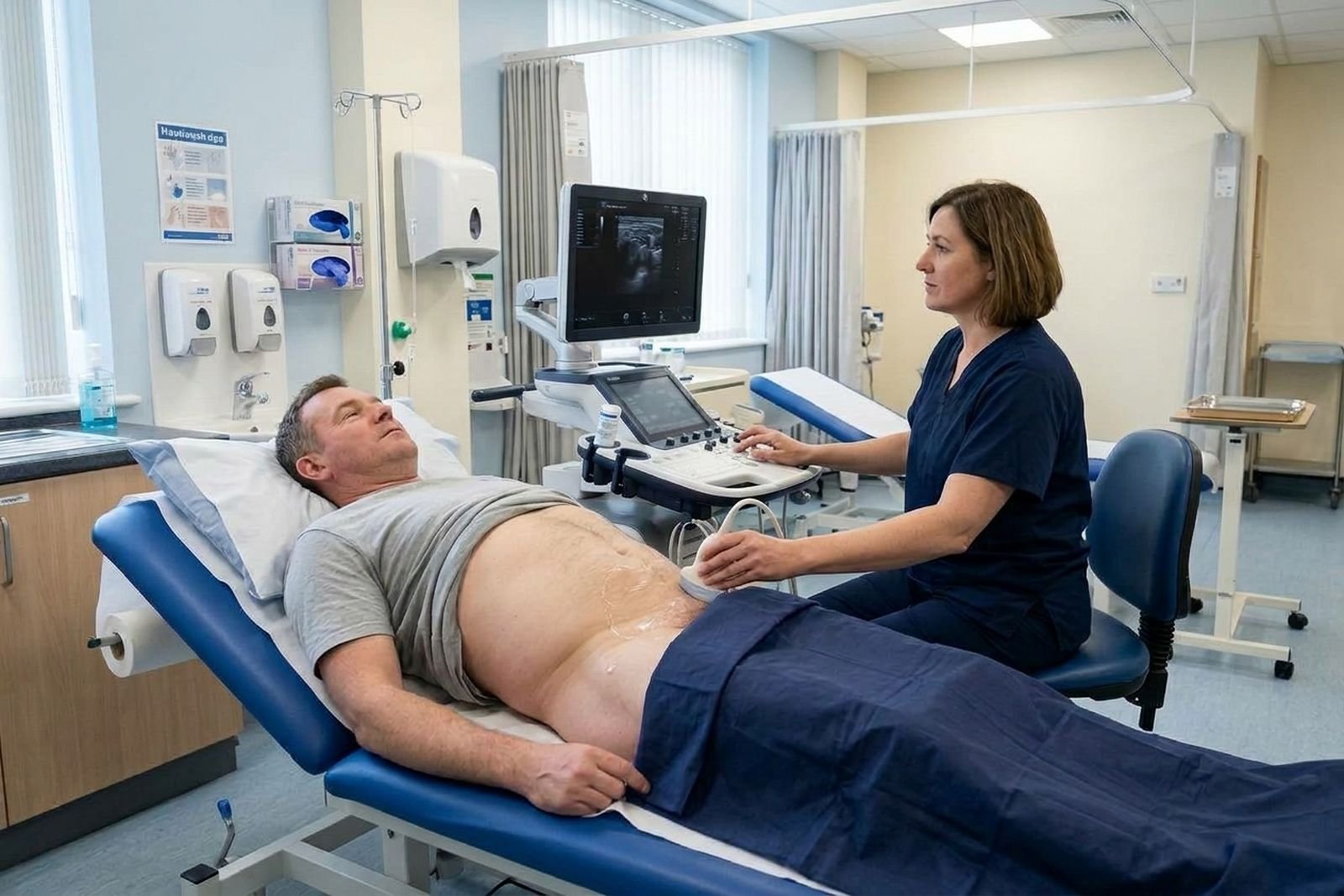
A hernia scan is a dynamic examination. The Whittington leaflet says that for hernia investigations you may be asked to stand or strain to better display the hernia, because a hernia that slips back when you lie down can be invisible until you push. The Belfast Trust groin scan leaflet says gel is applied, a small probe is moved over the area, and you may be asked to change position so it can be looked at from different angles.
Whittington says the scan usually takes 10 to 20 minutes and should not hurt; Belfast says no preparation is necessary. Results are not usually given on the day: Whittington says your doctor should receive a written report within about a week.
The symptoms that mean A&E or 999, not a scan
Most hernias are not urgent. The NHS says an inguinal hernia may not need treatment if it is not causing symptoms, and the Royal College of Surgeons guide says asymptomatic hernias can be managed with a watch and wait approach after discussion with a surgeon. But a hernia can become trapped.
The NHS says to get help from NHS 111 if you have a hernia and pain in or around it, a bloated tummy, nausea or vomiting, constipation, a high temperature or sudden confusion, because pain can be a sign of strangulation, when the muscle tightens around the internal organ. NHS 111 Wales says to go to A&E straight away if you have a hernia and develop sudden severe pain, are being sick, have difficulty pooing or passing wind, or the hernia becomes firm or tender or cannot be pushed back in. For a femoral hernia, the NHS says to call 999 or go to A&E for very bad tummy pain, vomiting, being unable to pass wind or poo, a high temperature or sudden confusion, and not to drive yourself. None of those symptoms should wait for a scan appointment, NHS or private.
Having a private ultrasound for a suspected hernia
If a GP or surgeon has suggested an ultrasound to confirm or rule out a hernia and the NHS wait is long, a private scan is an option. Ultrasound can be self-referred at many clinics because it does not use ionising radiation, although the clinic will ask what the scan is for and the sonographer or radiologist decides whether it is the right test. Ask whether the clinic performs a dynamic scan with you standing or straining, and who will receive the report. You can compare ultrasound clinics near you on FindScan and send an enquiry; the clinic contacts you to confirm whether it needs a referral and the next steps.
FindScan is a directory of independent, regulated imaging clinics: you compare clinics and send an enquiry, and the clinic contacts you. We are not a healthcare provider, and nothing here replaces an examination by a GP or surgeon. If a hernia has become painful, firm or tender, cannot be pushed back in, or you are being sick, go to A&E or call 999 today rather than arranging a scan.
Common questions
Do you need an ultrasound to diagnose a hernia?
Usually not. NHS 111 Wales says a GP will usually be able to identify a hernia by examining the affected area, and may refer you for an ultrasound scan to confirm the diagnosis.
What is a dynamic hernia ultrasound?
A scan in which you may be asked to stand or strain so that a hernia that slips back when you lie down can be seen. Whittington Health describes it, and the Royal College of Surgeons guide names dynamic ultrasound as the first-line investigation when imaging is needed.
Can a hernia be missed on ultrasound?
It can. Whittington Health says the scan cannot detect every condition, and the Royal College of Surgeons guide says MRI should be considered if the ultrasound is negative and groin pain persists.
Does a hernia always need surgery?
No. The NHS says an inguinal hernia may not need treatment if it is not causing symptoms. The NHS does recommend surgery for femoral hernias because they do not usually get better by themselves.
When is a hernia an emergency?
The NHS says to contact NHS 111 if a hernia becomes painful or you have a bloated tummy, vomiting, constipation or a high temperature; NHS 111 Wales says to go to A&E straight away for sudden severe pain, being sick, or a hernia that is firm, tender or cannot be pushed back in.
References
- Hernia. NHS. Accessed 27 October 2026.
- Hernia. NHS 111 Wales. Accessed 27 October 2026.
- Femoral hernia repair. NHS. Accessed 27 October 2026.
- Inguinal hernia repair. NHS. Accessed 27 October 2026.
- Commissioning guide: groin hernia (revised 2016). Royal College of Surgeons of England and British Hernia Society. Accessed 27 October 2026.
- Hernia: clinical policy (2021). NHS North Yorkshire CCG. Accessed 27 October 2026.
- Having a groin ultrasound. NHS (Whittington Health NHS Trust). Accessed 27 October 2026.
- Groin scan: patient information. NHS (Belfast Health and Social Care Trust). Accessed 27 October 2026.
- Ultrasound scan. NHS. Accessed 27 October 2026.
- When to call 999. NHS. Accessed 27 October 2026.
This article is general information, not medical advice, and it does not replace an assessment by a clinician. If you have symptoms that worry you, speak to your GP or call 111. In an emergency, call 999.