Broken a Bone After 50? Why a Minor Fall Can Lead to a DEXA Scan
Osteoporosis is often only found when a bone breaks. Here is what should happen after a fracture from a minor fall, who NICE's updated guideline says should be assessed, and where a DEXA scan fits.
Written by the FindScan Editorial Team and reviewed by our Medical Advisor, Dr Mohamed Najjar
Reviewed
A broken wrist from a stumble on the pavement, a cracked rib from a fall against the bath, a hip fracture from a trip on the stairs. If you are over 50, a bone that breaks in a fall from standing height or less is worth more than a cast and a few weeks of patience. The NHS says osteoporosis is often only diagnosed when a fall or sudden impact causes a bone to break, which means the fracture itself can be the first and only warning.
The practical question is whether a broken bone after a minor fall means you need a bone density scan. This guide sets out what the NHS and NICE's updated guideline on osteoporosis risk assessment say, where a DEXA scan fits, what a fracture liaison service does, and how to compare clinics if a scan has been advised.
The fracture that reveals the problem
Clinicians call a break caused by a minor fall or injury a fragility fracture. NICE defines it as a fracture typically caused by a low-impact injury that would not normally cause a fracture, such as a fall from standing height, and says fragility fractures most commonly affect the spine, hip, shoulder and wrist. The NHS lists having had a broken bone after a minor fall or injury among the reasons a bone density scan may be recommended, alongside taking steroid tablets (oral glucocorticoids) for 3 months or more, an early menopause, a family history of hip fractures, a low body mass index and conditions such as arthritis.
The important thing is the mechanism rather than the bone: if the fall was not one that should have broken anything, that is the detail to tell your GP.
Who NICE says should be assessed
In July 2026 NICE published a new guideline, Osteoporosis: risk assessment (NG259), which updates and replaces its 2012 guideline (CG146). It says to assess fragility fracture risk in all people aged 50 and over, and in women who have been through the menopause, if they have had a previous fragility fracture or are taking, or often take, steroid tablets or injections that act on the whole body (systemic glucocorticoids).
NICE also says to consider assessing risk in all men aged 75 and over, all women aged 65 and over, and people aged 50 to 74 (and women under 65 who have been through the menopause) with risk factors such as 2 or more falls in the last year, a parent or sibling who had a hip fracture, a body mass index below 18.5, current smoking or drinking more than 14 units of alcohol a week. For men and women under 50 who have not been through the menopause, it says to assess risk after a previous hip or spine fragility fracture or 2 or more major osteoporotic fractures.
So a fracture from a minor fall at 55 is, on its own, a reason to have your fracture risk assessed under NICE's guidance. Our guide to the signs of osteoporosis covers the other risk factors in more detail.
When NICE says to go straight to a DEXA scan
The new guideline makes a recent break a more direct route to a scan. NICE says to offer a DEXA scan to measure bone density, with or without first completing a risk calculator, when assessing people aged 30 and over who have had a previous hip or spine fragility fracture, a single major osteoporotic fragility fracture in the last 2 years, or 2 or more fragility fractures. NICE defines major osteoporotic fractures as fragility fractures of the spine, hip, shoulder and wrist, so a wrist broken in a fall from standing height in the past 2 years falls within that recommendation.
For other people, the risk calculation comes first. The NHS says a doctor can work out your future risk of breaking a bone using an online programme such as FRAX or QFracture, and NICE says to consider a DEXA scan to help guide treatment decisions when the 10-year risk of a major osteoporotic fracture is 10 per cent or more. The NHS adds that all of the risk factors need to be considered before you have a scan or start treatment, and NICE says a scan may not be needed before starting treatment for some people, for example older people living with frailty.
Fracture liaison services
Many hospitals run a fracture liaison service whose job is to pick up exactly this situation. The NHS says that if you are over 50 and have broken your hip, a fracture liaison service can help you prevent further broken bones. If you were treated for any fracture from a minor fall and nobody has mentioned bone health, it is reasonable to ask the fracture clinic or your GP whether a fracture liaison service covers your area.
The NHS falls page adds that a GP may refer you to a specialist falls service, which may include checking for problems such as muscle weakness, weak bones (osteoporosis) or problems with your eyesight. The NHS advises seeing a GP if you have had a fall or you are worried about your balance or mobility, and getting help from NHS 111 if you or someone else has fallen and may be in pain, injured or unwell.
What a DEXA scan involves
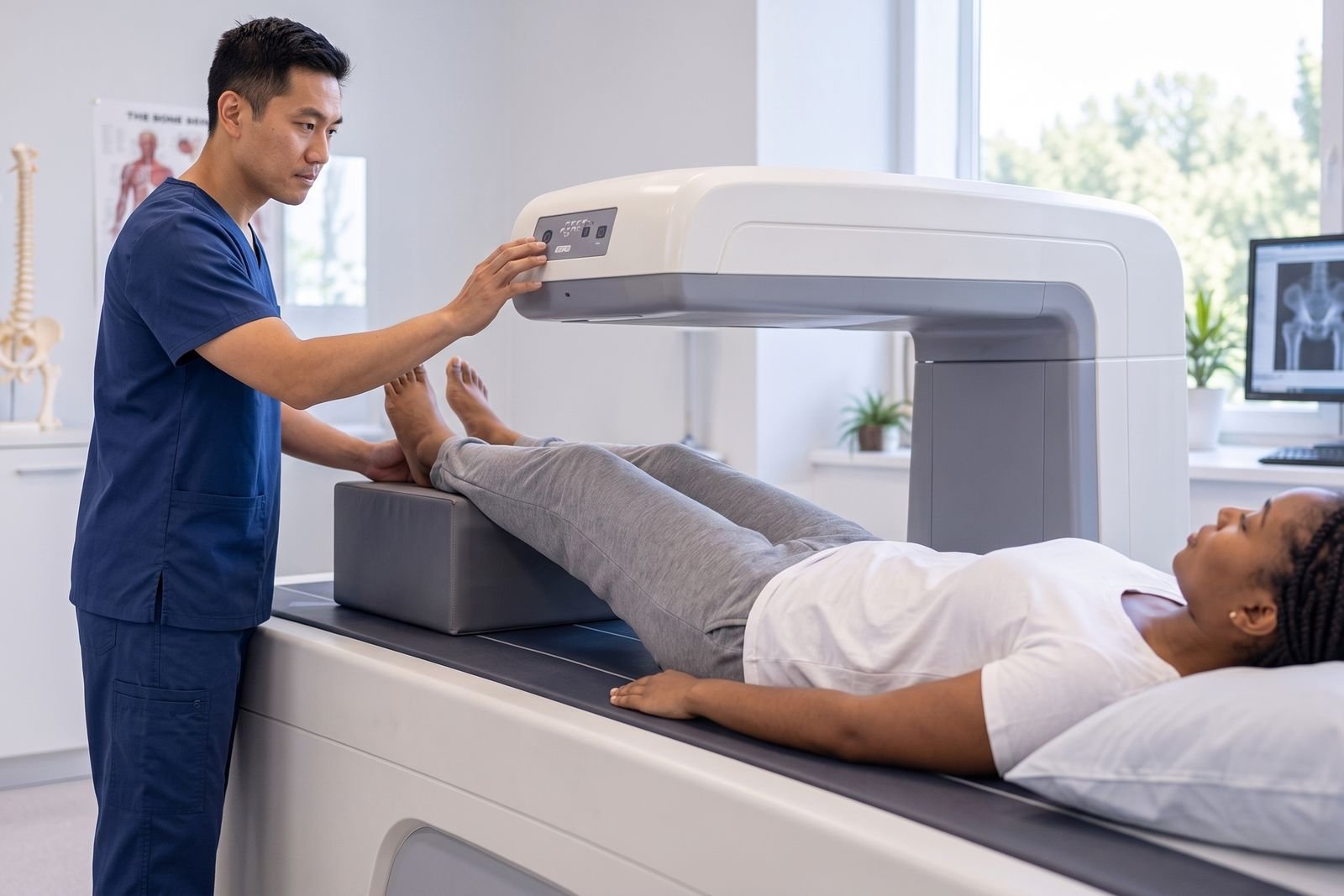
The NHS describes a bone density scan as quick and painless, using low dose X-rays to see how dense, or strong, your bones are, with a much lower level of radiation than standard X-rays. It says the scan usually takes 10 to 20 minutes and usually covers the hip and lower spine. The result is given as a T-score, the difference between your measurement and that of a young healthy adult, and is read alongside your other risk factors. Our guides to what a DEXA scan involves and DEXA results explained cover the scan and the scores.
Will you need another one?
Not necessarily, and not soon. NICE's new guideline says not to routinely repeat a DEXA scan within 2 years of the most recent one unless there are exceptional circumstances. For people who had a scan but did not meet the criteria for treatment, it says to consider a repeat scan within 2 to 3 years if they were close to meeting those criteria, sooner if their circumstances change (for example, another fragility fracture) and at 5 years if nothing has changed. Whether you need a repeat, and when, is a decision for the clinician looking after you.
Having a DEXA scan privately
If a clinician has suggested a bone density scan and the NHS wait is long, a private DEXA scan is an option. Because DEXA uses ionising radiation, UK law requires each scan to be justified by a registered referrer, so private clinics ask for a referral or arrange one through their own clinician. The report goes to whoever referred you, to be read together with your risk assessment.
You can compare DEXA clinics near you and send an enquiry; the clinic contacts you to confirm the referral it needs and the next steps. Our guide to how to get a DEXA scan covers the NHS and private routes. FindScan is a directory of independent, regulated imaging clinics: you compare clinics and send an enquiry, and the clinic contacts you. We are not a healthcare provider, and whether a scan is right for you is a clinical decision for your GP or clinician. If you have fallen and may be badly hurt, call 999 or get help from NHS 111.
Common questions
Does a broken bone after a minor fall mean I have osteoporosis?
Not on its own, but the NHS says osteoporosis is often only diagnosed when a fall or sudden impact causes a bone to break, and it lists a broken bone after a minor fall or injury among the reasons a bone density scan may be recommended. NICE's 2026 guideline says anyone aged 50 or over with a previous fragility fracture should have their fracture risk assessed.
At what age does NICE recommend a fracture risk assessment?
NICE's 2026 guideline (NG259) says to assess risk in everyone aged 50 and over, and women after the menopause, who have had a fragility fracture or take steroid tablets regularly. It says to consider assessment for all men aged 75 and over, all women aged 65 and over, and people aged 50 to 74 with risk factors such as repeated falls, a parent or sibling with a hip fracture or a low body mass index.
Do I go straight for a DEXA scan after a fracture?
Sometimes. NICE says to offer a DEXA scan, with or without a risk calculator, to people aged 30 and over who have had a hip or spine fragility fracture, a single major osteoporotic fracture (spine, hip, shoulder or wrist) in the last 2 years, or 2 or more fragility fractures. Otherwise a risk calculation such as FRAX or QFracture usually comes first.
What is a fracture liaison service?
A hospital service that follows up people who have had a fragility fracture. The NHS says that if you are over 50 and have broken your hip, a fracture liaison service can help you prevent further broken bones. If nobody has mentioned bone health after a fracture from a minor fall, ask your GP or the fracture clinic.
Can I have a private DEXA scan without a referral?
No. DEXA uses ionising radiation, so UK law requires a registered referrer to justify each scan. Private clinics ask for a referral or arrange one through their own clinician, and the clinic will tell you what it needs when you send an enquiry.
How often is a DEXA scan repeated?
NICE's 2026 guideline says not to routinely repeat a DEXA scan within 2 years of the last one unless there are exceptional circumstances. If you did not need treatment but were close to it, NICE says to consider a repeat within 2 to 3 years, or at 5 years if nothing changes. Your clinician decides.
References
- Osteoporosis. NHS. Accessed 27 October 2026.
- Bone density scan (DEXA scan): why it's done. NHS. Accessed 27 October 2026.
- Bone density scan (DEXA scan). NHS. Accessed 27 October 2026.
- Bone density scan (DEXA scan): how it is performed. NHS. Accessed 27 October 2026.
- Osteoporosis: risk assessment (NG259, 29 July 2026): fragility fracture risk assessment. NICE. Accessed 27 October 2026.
- Osteoporosis: risk assessment (NG259): deciding whether pharmacological treatment is appropriate. NICE. Accessed 27 October 2026.
- Osteoporosis: risk assessment (NG259): follow-up for people not having treatment. NICE. Accessed 27 October 2026.
- Osteoporosis: risk assessment (NG259): terms used in this guideline. NICE. Accessed 27 October 2026.
- Broken hip. NHS. Accessed 27 October 2026.
- Falls. NHS. Accessed 27 October 2026.
- The Ionising Radiation (Medical Exposure) Regulations 2017, SI 2017/1322. legislation.gov.uk. Accessed 27 October 2026.
This article is general information, not medical advice, and it does not replace an assessment by a clinician. If you have symptoms that worry you, speak to your GP or call 111. In an emergency, call 999.