Can a DEXA Scan Show a Spine Fracture? The New Spine Check Explained
Around seven in ten spine fractures caused by osteoporosis are never diagnosed, according to NICE. Its 2026 guideline says a short spine check on the same scanner should be considered alongside a DEXA scan for many people. Here is what that check is, who it is for and what to ask.
Written by the FindScan Editorial Team and reviewed by our Medical Advisor, Dr Mohamed Najjar
Reviewed
Spine fractures caused by osteoporosis are often not the sudden, painful event people imagine. When NICE consulted on its draft guideline in January 2026, it said around 70% of spine fractures caused by osteoporosis currently go undiagnosed. A vertebra can partially collapse during something as ordinary as a cough or a sneeze, which the NHS lists among the ways these fractures happen, and NICE notes that most spine fragility fractures are not caused by falls but happen after lifting, twisting or bending. The person may put the ache down to a bad back or getting older.
That is why NICE's guideline on assessing fracture risk, published on 29 July 2026, matters for anyone sent for a bone density scan. Alongside the usual DEXA measurement, it says clinicians should consider a vertebral fracture assessment, a spine check done on the same scanner. This guide explains what the check is, who NICE says should be offered it, and what it means if you are comparing clinics for a DEXA scan.
What a standard DEXA scan measures
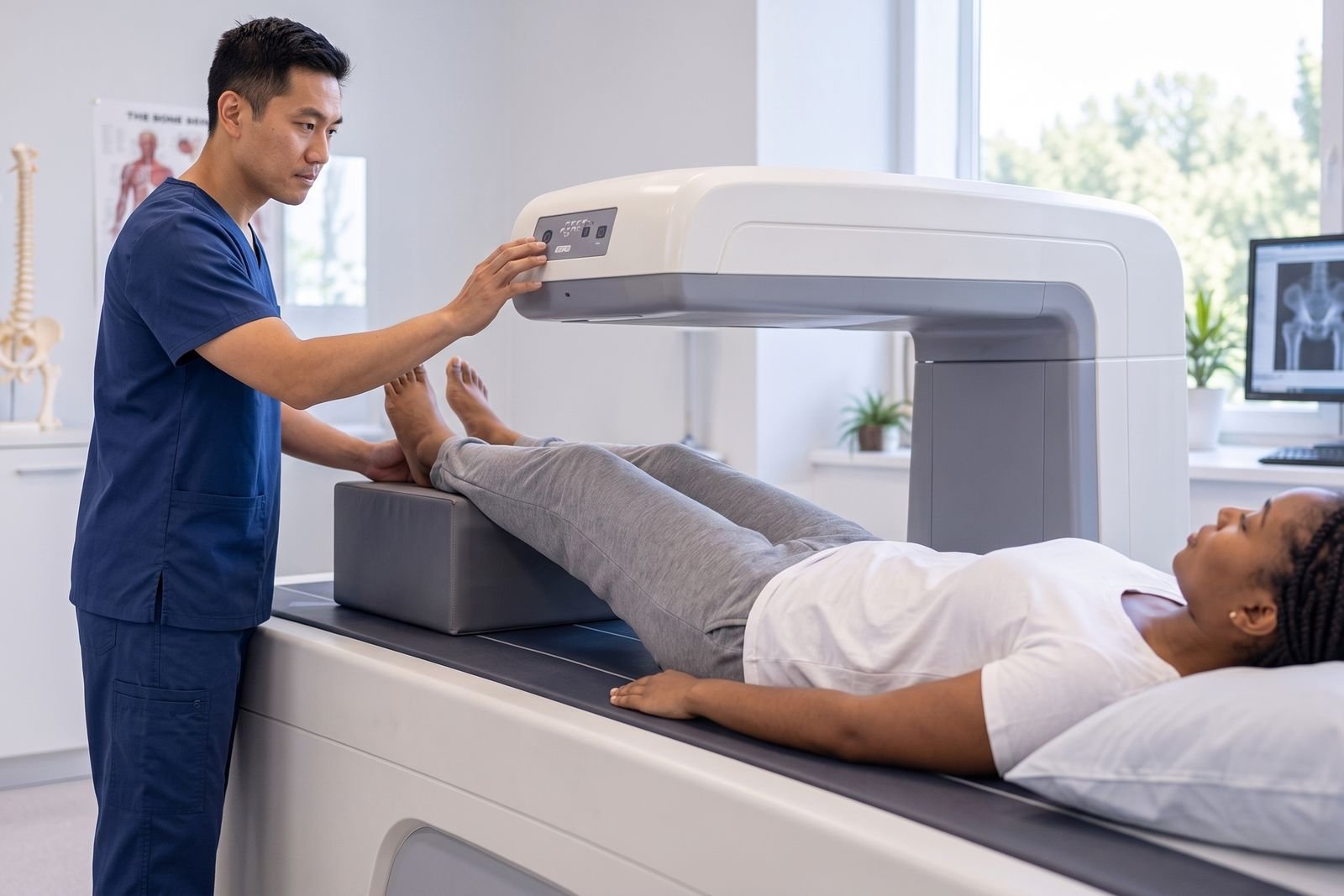
The NHS says a bone density scan uses low dose X-rays to see how dense, or strong, your bones are, with a much lower level of radiation than standard X-rays. It says the scan usually takes 10 to 20 minutes, and that the result is a T-score, the difference between your measurement and that of a young healthy adult; a T-score at or below minus 2.5 is defined as osteoporosis.
A standard DEXA scan is a measurement of density. It tells you how much mineral is in the bone, not whether a bone has already broken. Our guides to what a DEXA scan involves and DEXA results explained cover the scores in detail.
What the spine check adds
A vertebral fracture assessment, usually shortened to VFA, uses the DEXA scanner to take a side-on, low-dose image of the spine so that the shape of each vertebra can be checked for the wedging or collapse that marks a fracture. The Royal Osteoporosis Society describes it as a quick, low-dose X-ray of the spine that takes just a few minutes, done at the same time as a bone density scan. When NICE announced the draft recommendation, it said the check can be done on the same scanner during the same visit and is cost-effective.
Finding a vertebral fracture changes the picture. The NHS lists broken spinal bones among the most common injuries in people with osteoporosis and says they are a common cause of long-term pain, as well as the characteristic stooped, bent-forward posture.
Who NICE says should be offered it
NICE's guideline (NG259) says to consider doing a VFA when doing a DEXA scan for men aged 70 and over and women aged 60 and over. For younger people it says to consider a VFA if they have had a previous major osteoporotic fracture, have signs or symptoms of a spine fracture (such as back pain or rib pain with no identified cause, height loss of more than 4 cm or a rounded, stooped posture), if the DEXA scan itself suggests a fracture, if they take steroid tablets regularly, or if their bone density is exceptionally low for their age. The decision sits with the clinician who requests the scan.
NICE also lists times when a VFA should not be done, for example if you have had spinal imaging in the past 3 months and have no symptoms of a spine fracture, or if scoliosis may affect how the image is read.
The same guideline changes who goes straight to a DEXA scan. NICE says to offer a DEXA scan, with or without a FRAX or QFracture risk calculation, to people aged 30 and over who have had a previous hip or spine fragility fracture, a single major osteoporotic fragility fracture in the last 2 years, or 2 or more fragility fractures. Our guide to broken bones after 50 covers that route.
Why so many spine fractures are missed
NICE's explanation is simple: these fractures often cause no obvious symptoms at first. In its January 2026 announcement NICE put the scale in context: about 3.5 million people in the UK have osteoporosis, and around 549,000 new fragility fractures happen each year, including 86,000 vertebral and 105,000 hip fractures. The Society of Radiographers, whose DXA radiographers contributed to the guideline, notes that it covers identifying vertebral fragility fractures. Our guide to the signs of osteoporosis covers the risk factors.
What to ask before a DEXA scan
If you have been referred for a DEXA scan, it is reasonable to ask the referring clinician, or the clinic, whether a vertebral fracture assessment will be included. If you are a woman aged 60 or over or a man aged 70 or over, or you have lost height, developed a stooped posture or had unexplained back pain, mention it.
Two things are worth knowing. NICE says not to routinely do further spine imaging after a VFA has found a fracture, unless there is uncertainty about whether a fracture is present or concern about another diagnosis, so the VFA result is usually acted on directly. And a VFA does not replace the density measurement: both results go back to the referring clinician to be read with your risk assessment. NICE also says not to routinely repeat a DEXA scan within 2 years of the last one unless there are exceptional circumstances.
Having a DEXA scan with VFA privately
If a clinician has advised a bone density scan and the NHS wait is long, a private DEXA scan is an option, and some private scanners can perform a vertebral fracture assessment in the same appointment. DEXA uses ionising radiation, so UK law requires each scan to be justified by a registered referrer, and private clinics ask for a referral or arrange one through their own clinician.
You can compare DEXA clinics near you and send an enquiry; the clinic contacts you to confirm the referral it needs and whether its scanner can do a VFA. Our guide to how to get a DEXA scan covers the NHS and private routes. FindScan is a directory of independent, regulated imaging clinics: you compare clinics and send an enquiry, and the clinic contacts you. We are not a healthcare provider, and whether a scan is right for you is a clinical decision for your GP or clinician. Sudden severe back pain after a fall, back pain with numbness or weakness in the legs, or new problems controlling your bladder or bowels need urgent medical attention: contact your GP or NHS 111 straight away, or call 999 in an emergency.
Common questions
Can a normal DEXA scan show a spine fracture?
Not reliably. A standard DEXA scan measures bone density and reports a T-score; it is not designed to show whether a bone has broken. The vertebral fracture assessment is an extra side-on image of the spine taken on the same scanner to look for fractures, which NICE now says should be considered alongside the density scan for many people.
What is a vertebral fracture assessment?
A VFA is a quick, low-dose spine image taken on a DEXA scanner during the same visit as the bone density scan. The Royal Osteoporosis Society says it takes just a few minutes.
Who should have a VFA according to NICE?
NICE's 2026 guideline (NG259) says to consider a VFA when doing a DEXA scan for women aged 60 and over and men aged 70 and over, and for younger people with risk factors such as a previous major osteoporotic fracture, unexplained back pain, height loss of more than 4 cm or regular steroid tablets. The referring clinician decides.
How many spine fractures go undiagnosed?
When NICE consulted on its draft guideline in January 2026, it said around 70% of spine fractures caused by osteoporosis currently go undiagnosed, because they often cause no obvious symptoms at first.
Who can go straight to a DEXA scan without a risk calculator?
NICE's 2026 guideline says to offer a DEXA scan, with or without a FRAX or QFracture assessment, to people aged 30 and over who have had a hip or spine fragility fracture, a single major osteoporotic fracture (spine, hip, shoulder or wrist) in the last 2 years, or 2 or more fragility fractures.
Can I have a private DEXA scan with VFA without a referral?
No. DEXA uses ionising radiation, so UK law requires a registered referrer to justify each scan. Private clinics ask for a referral or arrange one through their own clinician. Ask when you enquire whether the clinic's scanner can do a vertebral fracture assessment, because not all do.
References
- Osteoporosis: risk assessment (NG259, 29 July 2026): identifying vertebral fragility fractures. NICE. Accessed 27 October 2026.
- Osteoporosis: risk assessment (NG259): fragility fracture risk assessment. NICE. Accessed 27 October 2026.
- Osteoporosis: risk assessment (NG259): follow-up for people not having treatment. NICE. Accessed 27 October 2026.
- Osteoporosis: risk assessment (NG259): terms used in this guideline. NICE. Accessed 27 October 2026.
- Hidden spine fractures could be spotted earlier after NICE recommendation (draft guideline announcement, 13 January 2026). NICE. Accessed 27 October 2026.
- NICE updates osteoporosis guidelines: what you need to know (3 August 2026). Royal Osteoporosis Society. Accessed 27 October 2026.
- SoR members contribute to latest NICE guidance on osteoporosis risk assessment (19 August 2026). Society of Radiographers. Accessed 27 October 2026.
- Osteoporosis. NHS. Accessed 27 October 2026.
- Bone density scan (DEXA scan). NHS. Accessed 27 October 2026.
- Bone density scan (DEXA scan): how it is performed. NHS. Accessed 27 October 2026.
- The Ionising Radiation (Medical Exposure) Regulations 2017, SI 2017/1322. legislation.gov.uk. Accessed 27 October 2026.
This article is general information, not medical advice, and it does not replace an assessment by a clinician. If you have symptoms that worry you, speak to your GP or call 111. In an emergency, call 999.