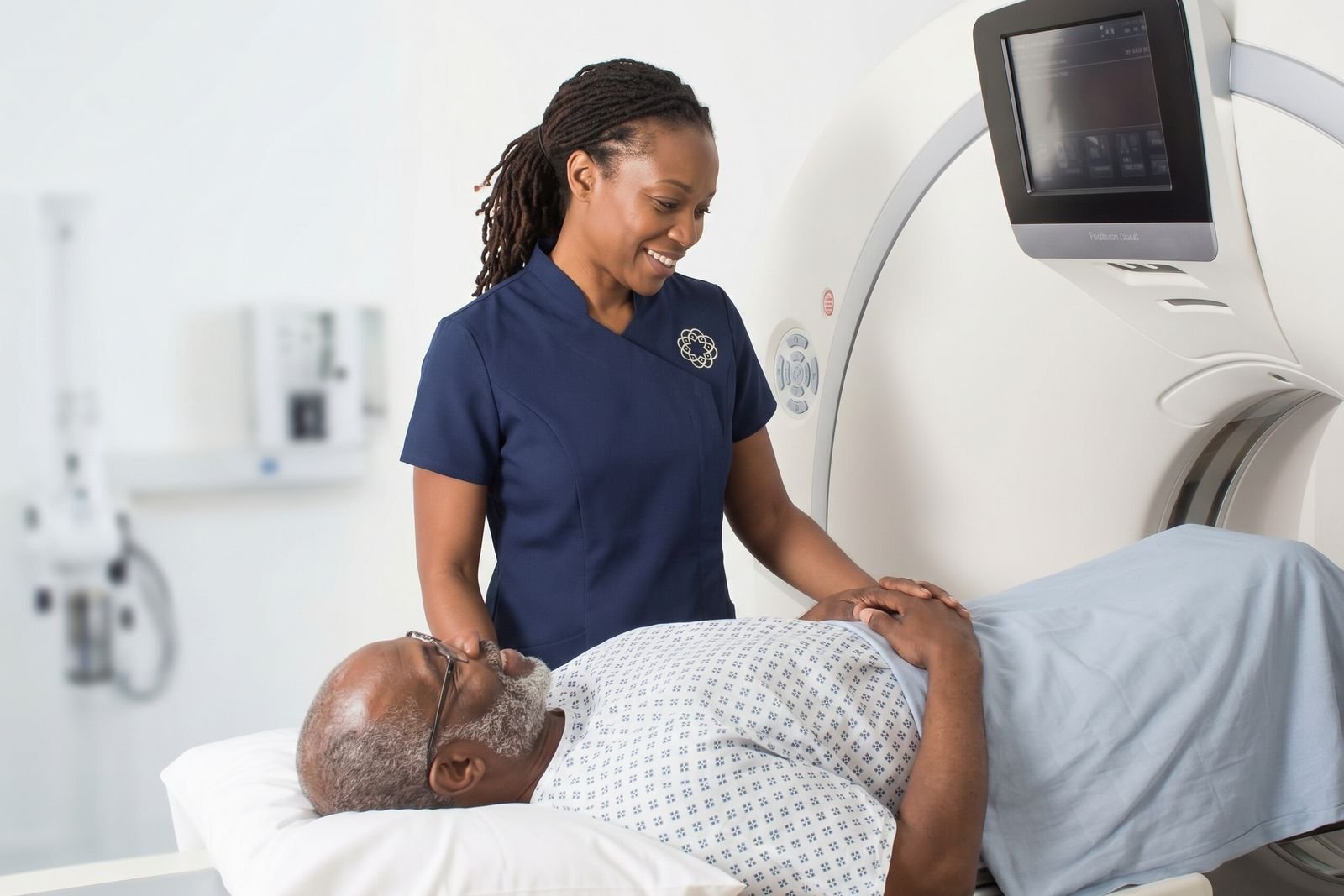
Elbow MRI Scan (MRI Elbow): What It Shows, Which Elbow Pain Scan You May Need, and What to Expect
Most elbow pain, including tennis elbow, is diagnosed by examination and settles without any scan. This guide explains when an elbow MRI or ultrasound can help, the warning signs that mean A&E rather than a scan, and how referral works for a private elbow scan.
Written by the FindScan Editorial Team and reviewed by our Medical Advisor, Dr Mohamed Najjar
Reviewed
An elbow MRI scan, often listed by clinics as an MRI elbow, takes detailed pictures of the inside of the joint, including soft tissues such as ligaments and nerves. It can be a useful elbow pain scan when there is a specific question to answer, but most elbow problems never need one: Versus Arthritis says most can be diagnosed and treated after a simple examination, and it is unlikely you will need special tests.
This guide explains which elbow problems can lead to a scan, how ultrasound, MRI and X-ray compare for the elbow, the warning signs that mean urgent care instead, and what happens at an elbow MRI appointment. If you and your clinician decide a scan is worthwhile, you can compare clinics on our private MRI scan page.
Do you need an elbow pain scan at all?
Tennis elbow and golfer's elbow are the most familiar causes of elbow pain. The NHS tennis elbow page describes pain on the outside of the elbow that can be worse when lifting, gripping or moving the wrist, and says it usually gets better after resting the arm for a few weeks, although it can last longer. Golfer's elbow affects the tendons on the inside of the elbow. Versus Arthritis says both conditions can last between six months and two years, and most people get better within a year.
Neither usually needs imaging first. NHS Greater Glasgow and Clyde's musculoskeletal guidance on elbow tendinopathy lists imaging as not indicated from a musculoskeletal point of view for either condition; the diagnosis rests on where it is tender and how the arm responds to simple tests. Our guide to whether tennis elbow needs a scan covers this in more detail.
The NHS says to see a GP if you still have pain after resting your elbow and trying self-care for at least 2 weeks. Versus Arthritis also advises seeing a doctor if you have tingling, numbness or weakness in your arm or hand.
When elbow pain needs urgent help, not a scan
Some elbow injuries need same-day care rather than a scan you arrange yourself. The NHS page on elbow and arm pain says to go to an urgent treatment centre or A&E if you have severe pain in your arm and it is difficult to move, if you injured your arm and heard a snapping noise or your arm has changed shape, or if your arm tingles or feels numb. Call 999 if arm pain comes on suddenly with pressure, heaviness or squeezing across your chest.
Versus Arthritis adds that you should go to A&E straight away if you think you have fractured your elbow, which usually follows an obvious injury such as a fall onto an outstretched hand, or if severe pain stops you moving your arm and comes with swelling, fever, heat and redness, which can be signs of infection. In these situations the hospital team decides which X-ray or scan is needed.
Elbow problems where an MRI or ultrasound can help
Tendon tears such as distal biceps rupture. Versus Arthritis says the biceps tendon at the front of the elbow can tear, often while lifting something heavy. Signs include sudden, severe pain, bruising around the elbow and forearm, a change in the shape of the muscle sometimes called the 'Popeye sign', and difficulty turning the palm upwards. It says to seek medical attention as soon as possible, at A&E or an urgent GP appointment, because surgery may be needed urgently. A distal biceps leaflet from Wrightington, Wigan and Leigh Teaching Hospitals says the sooner the operation is carried out after the injury the better. Do not wait for a private scan before getting this assessed.
Ligament injuries in throwers. NHS GGC's guidance on less common elbow soft tissue problems says the medial collateral ligament on the inner side of the elbow can be overstretched or torn, and that repeated overuse, such as repeated throwing, is a more common cause than a single injury. It says X-ray, ultrasound and MRI can all be used to show the extent of the injury, and that a full tear causing instability may need referral to an orthopaedic specialist.
Loose bodies. Versus Arthritis says an elbow can occasionally lock in a fixed position, which may be due to a loose bit of bone or cartilage in the joint. NHS GGC's guidance on intra-articular elbow problems describes catching, locking or clicking, starts with an elbow X-ray, and says MRI can be considered if the X-ray is normal and symptoms persist.
Nerve problems such as cubital tunnel syndrome. This happens when the ulnar nerve is squeezed where it passes the inside of the elbow,. Versus Arthritis says it causes tingling and numbness in the ring and little fingers. NHS GGC's guidance on nerve entrapment at the elbow says ultrasound, MRI and nerve conduction studies are all useful tests to confirm where the nerve is trapped, and an X-ray can rule out bony problems or loose bodies. Our guide to whether MRI shows nerve damage explains why nerve tests are often needed alongside a scan.
Elbow MRI vs ultrasound vs X-ray: what each scan shows
X-ray shows bone. Versus Arthritis says an X-ray can show new bone growth, small pieces of loose bone, or arthritis. X-ray uses ionising radiation, so it always needs a referrer; our guide to getting an X-ray without a GP referral explains how private clinics handle this.
Ultrasound uses a small device placed on the skin, with sound waves creating an image of the inside of the body, as Versus Arthritis describes. NHS GGC lists it alongside MRI for ligament injuries and nerve entrapment. You can compare clinics on our private ultrasound scan page.
MRI uses magnetic fields and radio waves to produce detailed images while you lie in the scanner. Based on the NHS GGC guidance above, an elbow MRI can help show the extent of a ligament injury and other structures involved, where a nerve is trapped, and a loose body when an X-ray looks normal. Versus Arthritis says ultrasound or MRI are only very rarely needed to rule out or confirm a diagnosis. Our guide to ultrasound vs MRI compares the two in more depth.
Whichever test you have, the report is read alongside your symptoms and examination. A scan that looks normal does not always explain your pain or rule out every cause, so the clinician who referred you is the right person to talk it through with.
Having an elbow MRI scan: preparation, how long it takes and results
Before an elbow MRI you fill in a safety form. The NHS MRI scan page says to tell staff about any metal in your body, such as surgical clips or a pacemaker, and whether you are or may be pregnant. You will be asked to remove anything containing metal, such as jewellery, hair clips or hearing aids, and you may change into a gown. Our guide to MRI safety and metal implants explains why this matters. Some scans use an injection of contrast dye to show more detail.
The NHS says an MRI usually takes between 15 minutes and 1 hour, but can take longer. You need to lie still so the scanner can take clear images, and it makes loud bangs and clicks, so you are given ear plugs or headphones. If you feel anxious in small spaces, the NHS suggests speaking to a healthcare professional before your appointment; our guide to claustrophobia and MRI covers the options.
A radiologist reviews the images and sends a report to the doctor who referred you. On the NHS this usually takes 1 to 2 weeks. Private clinics set their own reporting times, so ask when you send an enquiry; our guide to how long scan results take has more detail.
Do you need a referral for a private elbow MRI?
MRI and ultrasound do not use ionising radiation, and some private clinics accept self-referral for them, depending on the clinic's own policy and safety screening. Other clinics ask for a referral from a GP, physiotherapist or consultant. Our guide to private MRI without a GP referral explains how this works.
An elbow X-ray is different. Under the Ionising Radiation (Medical Exposure) Regulations 2017, every X-ray needs a referrer and must be justified, so a private X-ray always needs a referral; many private clinics arrange this through their own doctor. Even where self-referral is possible, an examination first often saves an unnecessary scan, and a physiotherapist may be able to refer you if a scan is needed.
Key points
- Tennis elbow and golfer's elbow are usually diagnosed by examination, and imaging is not usually needed first.
- A suspected distal biceps rupture, a fracture, an arm that has changed shape or cannot be moved needs urgent care, not a private scan.
- An elbow MRI can help with ligament injuries, loose bodies and trapped nerves when there is a clear clinical question.
- MRI and ultrasound may be self-referral at some clinics; an X-ray always needs a referrer.
Comparing clinics on FindScan
You can compare clinics offering elbow MRI near you on our private MRI scan page, see each clinic's own listed price, and send an enquiry to the clinic you choose. The clinic contacts you to arrange your scan, confirms the final price and tells you whether it needs a referral.
FindScan is a directory of independent, regulated imaging clinics, not a healthcare provider, and nothing here replaces advice from your GP or the clinician treating you. Speak to them about your symptoms or results; if your symptoms are urgent, call NHS 111, or 999 in an emergency.
Common questions
How long does an elbow MRI scan take?
The NHS says an MRI scan usually takes between 15 minutes and 1 hour, but it can take longer. Allow extra time for the safety form and getting changed. Each clinic sets its own scanning protocol, so ask how long your elbow MRI will take when the clinic contacts you.
Do I need an elbow MRI for tennis elbow?
Usually not. NHS Greater Glasgow and Clyde's musculoskeletal guidance lists imaging as not indicated for tennis elbow or golfer's elbow, and Versus Arthritis says most elbow problems are diagnosed after a simple examination. The NHS says to see a GP if pain has not improved after at least 2 weeks of rest and self-care.
What does an MRI elbow scan show?
An MRI elbow scan gives detailed pictures of the inside of the joint. NHS guidance says it can help show the extent of a ligament injury, where a nerve such as the ulnar nerve is trapped, and loose bodies when an X-ray looks normal. The results are always read alongside your symptoms and examination.
Which elbow pain scan is best: ultrasound, MRI or X-ray?
It depends on the question. Versus Arthritis says X-ray can show loose bone, new bone growth and arthritis. NHS guidance lists ultrasound and MRI for ligament injuries and nerve entrapment, with MRI an option when an X-ray is normal but symptoms persist. Your GP or physiotherapist can advise which, if any, you need.
Can I get a private elbow MRI without a GP referral?
Possibly. MRI does not use ionising radiation, and some private clinics accept self-referral, depending on their own policy and safety screening. Others ask for a referral from a GP, physiotherapist or consultant. An elbow X-ray always needs a referrer, which many private clinics arrange through their own doctor.
When should elbow pain be checked urgently?
The NHS says to go to an urgent treatment centre or A&E if you have severe arm pain and it is difficult to move, if you heard a snap or your arm changed shape after an injury, or if your arm tingles or feels numb. Versus Arthritis says to seek help as soon as possible for a suspected biceps rupture.
References
- Tennis elbow. NHS. Accessed 29 October 2026.
- Elbow and arm pain. NHS. Accessed 29 October 2026.
- MRI scan. NHS. Accessed 29 October 2026.
- Elbow pain. Versus Arthritis. Accessed 29 October 2026.
- Elbow: tendinopathy. NHS Greater Glasgow and Clyde (Right Decision Service MSK Index). Accessed 29 October 2026.
- Elbow: less common soft tissue (collateral ligaments). NHS Greater Glasgow and Clyde (Right Decision Service MSK Index). Accessed 29 October 2026.
- Elbow: neural entrapment (cubital tunnel). NHS Greater Glasgow and Clyde (Right Decision Service MSK Index). Accessed 29 October 2026.
- Elbow: common intra-articular problems (loose bodies). NHS Greater Glasgow and Clyde (Right Decision Service MSK Index). Accessed 29 October 2026.
- Distal Biceps Repair Surgery (with Endobutton), patient leaflet. Wrightington, Wigan and Leigh Teaching Hospitals NHS Foundation Trust. Accessed 29 October 2026.
This article is general information, not medical advice, and it does not replace an assessment by a clinician. If you have symptoms that worry you, speak to your GP or call 111. In an emergency, call 999.