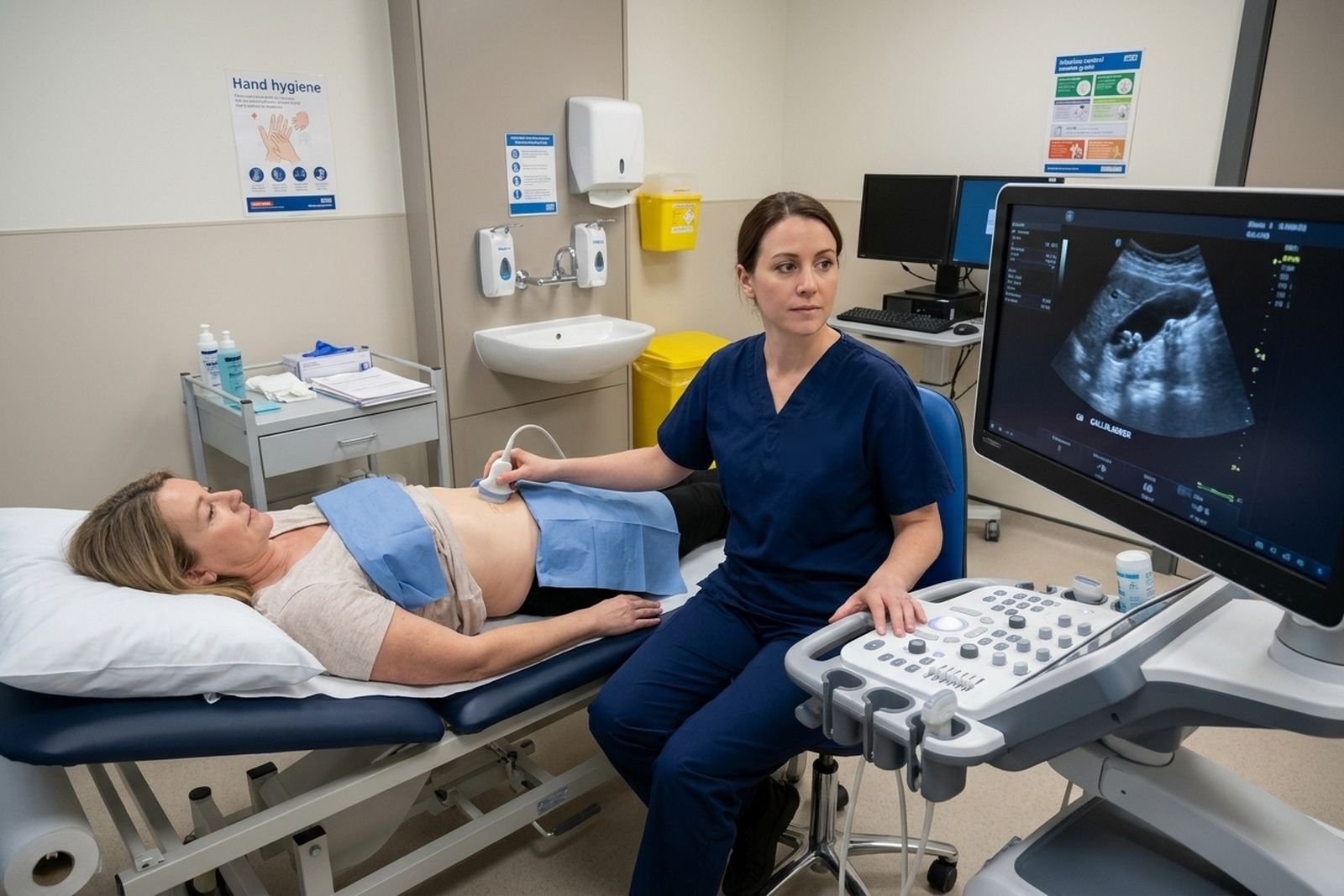
Gallstones and Ultrasound: The Scan the NHS Uses for Pain Under Your Right Ribs
Most gallstones never cause trouble. When one does, an ultrasound scan is where the NHS starts. Here is what the scan looks for, what it can and cannot settle, and the symptoms that should never wait for an appointment.
Written by the FindScan Editorial Team and reviewed by our Medical Advisor, Dr Mohamed Najjar
Reviewed
A steady, severe pain under the right ribs or in the middle of the tummy, often an hour or so after a meal, is the symptom that sends most people to search for gallstones. It usually passes, which is why it is easy to put down to indigestion, and then it comes back.
The NHS says most people who have gallstones do not get symptoms, and that treatment is usually only needed when they do. When they are suspected, the first test is almost always an ultrasound scan. This guide explains what that scan looks for, what it cannot always answer, and which symptoms mean you should call for urgent help rather than wait for a scan of any kind.
What gallstone pain feels like
The NHS describes the pain that happens when a gallstone blocks a bile duct as pain that may feel severe, be constant, last from about 30 minutes up to several hours, sit in the middle of the tummy or just under the right ribs, and make you feel sick or vomit.
The NHS also says that if you have no symptoms, gallstones may be found by chance during a scan or X-ray done for another reason. That is not in itself a reason for treatment: the NHS says treatment is often not needed if there are no symptoms, although follow-up may be offered.
Who is more likely to get them
The NHS lists the people most likely to develop gallstones as those over 40, women, people living with obesity, people whose diet is high in fat and low in fibre, people who have lost weight rapidly, for example after weight loss surgery, and people with conditions such as diabetes or Crohn's disease.
Rapid weight loss is the factor worth pausing on, because many people in the UK are losing weight quickly through medical treatment or surgery. If you are one of them and you get the kind of pain described above, tell the team supervising your weight loss as well as your GP. It is a reason to be assessed, not a reason to stop a treatment on your own.
Why ultrasound is the first test
The NHS says that if you have symptoms, you may have an ultrasound scan and a test on a blood sample. NICE's guideline on gallstone disease (CG188) puts it as a direct recommendation: offer liver function tests and ultrasound to people with suspected gallstone disease. The liver function tests check how the liver and bile ducts are coping; the ultrasound looks at the gallbladder itself.
The NHS describes ultrasound as a scan that uses sound waves to see images of the inside of your body, such as muscles and organs, and says it does not use radiation, unlike X-rays or CT scans. Because it uses no radiation, ultrasound can be arranged without a GP referral at many private clinics, although a GP letter helps the clinic scan the right area and report to the right person.
Clinics often ask you not to eat for several hours before a gallbladder scan, because a gallbladder that has not recently emptied is easier to see. The NHS says the hospital or clinic will tell you if there is anything you need to do beforehand, so follow the instructions you are given. Our guide to eating and drinking before a scan covers the general rules.
What the scan can and cannot settle
An ultrasound of the upper abdomen looks at the gallbladder, any stones inside it, the thickness of its wall, the bile ducts and the liver next door. For a stone sitting in the gallbladder, that is usually enough. Our guide to abdominal ultrasound explains what else the same scan takes in.
A stone that has moved into the bile duct is harder to see. NICE's guideline says to consider a type of MRI called MRCP if ultrasound has not detected common bile duct stones but the bile duct is dilated or the liver function test results are abnormal, and to consider an endoscopic ultrasound if MRCP does not allow a diagnosis. Those are hospital tests that follow a clinician's assessment, not something to arrange directly.
The scan does not decide treatment on its own either. The NHS says the main treatment for gallstones that cause symptoms is surgery to remove the gallbladder, and that while waiting for surgery, painkillers such as paracetamol and ibuprofen, avoiding foods that trigger the pain and a low-fat diet can help. NICE says people with gallstones found in a normal gallbladder, who have no symptoms, should be reassured that they do not need treatment unless they develop symptoms.
When not to wait for a scan
The NHS is specific about urgency, and the timings are the part people most often get wrong.
- Ask for an urgent GP appointment or get help from NHS 111 if you have pain in your tummy that lasts longer than 30 minutes.
- Call 999 or go to A&E if you have sudden, severe pain in your tummy; if you have pain that spreads from your tummy to your back and you are being sick; if your temperature is very high or you feel hot, cold or shivery; or if your skin or the white part of your eyes looks yellow. The NHS says not to drive yourself to A&E and to bring any medicines you take.
- The NHS lists inflammation of the gallbladder or pancreas and jaundice as possible complications, which is why those symptoms are emergencies rather than reasons to look for a private scan.
Where a private ultrasound fits
If a GP agrees that gallstones are the likely cause and the wait for an NHS ultrasound is longer than you want to live with, a private scan can answer the first question sooner. Ultrasound can be arranged without a GP referral at many clinics; a GP letter is still useful, because the clinic will want to know where to send the report.
You can compare abdominal ultrasound clinics near you and send an enquiry; the clinic contacts you to confirm whether it needs a referral and how to prepare. If the scan finds stones, take the report back to your GP, because the next steps the NHS and NICE describe all run through a clinician. FindScan is a directory of independent, regulated imaging clinics: you compare clinics and send an enquiry, and the clinic contacts you. We are not a healthcare provider, and nothing here replaces an assessment by a clinician.
Common questions
Can an ultrasound scan detect gallstones?
Yes. The NHS says that if you have symptoms you may have an ultrasound scan, and NICE's gallstone disease guideline recommends offering liver function tests and ultrasound to people with suspected gallstone disease. Stones that have moved into the bile duct can be harder to see, and NICE describes further tests, such as MRCP, for that situation.
Do I need to fast before a gallbladder ultrasound?
Often yes. Clinics often ask you not to eat for several hours beforehand so the gallbladder is easier to see. The NHS says the hospital or clinic will tell you if there is anything you need to do before an ultrasound scan, so follow the instructions you are given.
Can I have a private gallbladder ultrasound without a GP referral?
Ultrasound uses no radiation, so it can be arranged without a GP referral at many private clinics. A GP letter still helps, because the clinic needs to know what to look for and where to send the report, and the clinic confirms its own requirements when you enquire.
How long does gallstone pain last?
The NHS says the pain caused by a gallstone blocking a bile duct may last from about 30 minutes up to several hours, and advises an urgent GP appointment or NHS 111 for tummy pain that lasts longer than 30 minutes.
If the scan finds gallstones, will I need surgery?
Not necessarily. The NHS says treatment is often not needed if gallstones cause no symptoms, and that the main treatment for gallstones that do cause symptoms is surgery to remove the gallbladder. That decision is made with a doctor who has your results.
References
- Gallstones. NHS. Accessed 27 October 2026.
- Ultrasound scan. NHS. Accessed 27 October 2026.
- Gallstone disease: diagnosis and management (CG188), recommendations. NICE. Accessed 27 October 2026.
This article is general information, not medical advice, and it does not replace an assessment by a clinician. If you have symptoms that worry you, speak to your GP or call 111. In an emergency, call 999.