Which Scan Looks at the Pancreas? CT, MRI and Ultrasound Explained
November is Pancreatic Cancer Awareness Month, and the questions it raises are usually about scans: which test actually shows the pancreas, why a GP might send you for an ultrasound rather than a CT, and what an MRCP is. This guide walks through the NHS pathway from GP assessment to hospital tests, explains what each scan can and cannot see, and is clear about which route to take if you are worried.
Written by the FindScan Editorial Team and reviewed by our Medical Advisor, Dr Mohamed Najjar
Reviewed
The pancreas is an awkward organ to look at. It lies deep in the upper tummy, behind the stomach, surrounded by bowel, which is why a scan that shows the liver well can struggle to show the pancreas at all. The symptoms the NHS links to pancreatic problems are often vague ones, such as tummy or back pain, losing weight without trying and changes in your stools, and Pancreatic Cancer Action notes that most people with these symptoms do not have pancreatic cancer.
This guide explains which tests the NHS uses when the pancreas is in question, what ultrasound, CT, MRI and MRCP each add, and why the first step is almost always a GP rather than a scanner.
Why the GP comes first
The NHS pancreatic cancer symptoms page lists the possible signs: yellowing of the eyes or skin (jaundice), itchy skin, dark urine and pale stools; loss of appetite or losing weight without trying; tiredness; a high temperature or feeling hot or shivery; feeling or being sick, diarrhoea or constipation and bloating; and pain in the upper tummy that may spread to the back. It says to see a GP if you have noticeable weight loss, or if other symptoms get worse or do not improve after 2 weeks.
Some symptoms are more urgent. The NHS says to ask for an urgent GP appointment or get help from NHS 111 if your eyes or skin turn yellow, if you have been vomiting for more than 2 days, if you have had diarrhoea for more than 7 days, or if you are worried and not sure where to get help. Jaundice is not a symptom to research scans for; it is a symptom to be seen about today.
Cancer Research UK describes the GP examining your skin, eyes and tummy, testing samples, and arranging an ultrasound or a CT scan where needed. NICE's suspected cancer guideline (NG12) sets out the rules the GP follows: refer people aged 40 and over with jaundice using a suspected cancer pathway referral, and consider an urgent, direct access CT scan, or an urgent ultrasound if CT is not available, for people aged 60 and over with weight loss and any of diarrhoea, back pain, tummy pain, nausea, vomiting, constipation or new-onset diabetes.
Ultrasound: the usual first look
The NHS says an ultrasound scan uses sound waves and does not use radiation, and that a typical scan takes about 10 to 45 minutes. It is often an early imaging test for upper tummy symptoms because it is quick, safe and good at the organs around the pancreas: the liver, the gallbladder and the bile ducts. Pancreatic Cancer Action describes it as a painless scan that shows the pancreas, the surrounding area and the liver.
Its weakness is the pancreas itself. Because the organ sits behind the stomach and bowel, parts of it can be hidden, so a normal ultrasound does not close the question if symptoms continue. Our guide to abdominal ultrasound explains what the scan does well.
CT: the main pancreas scan
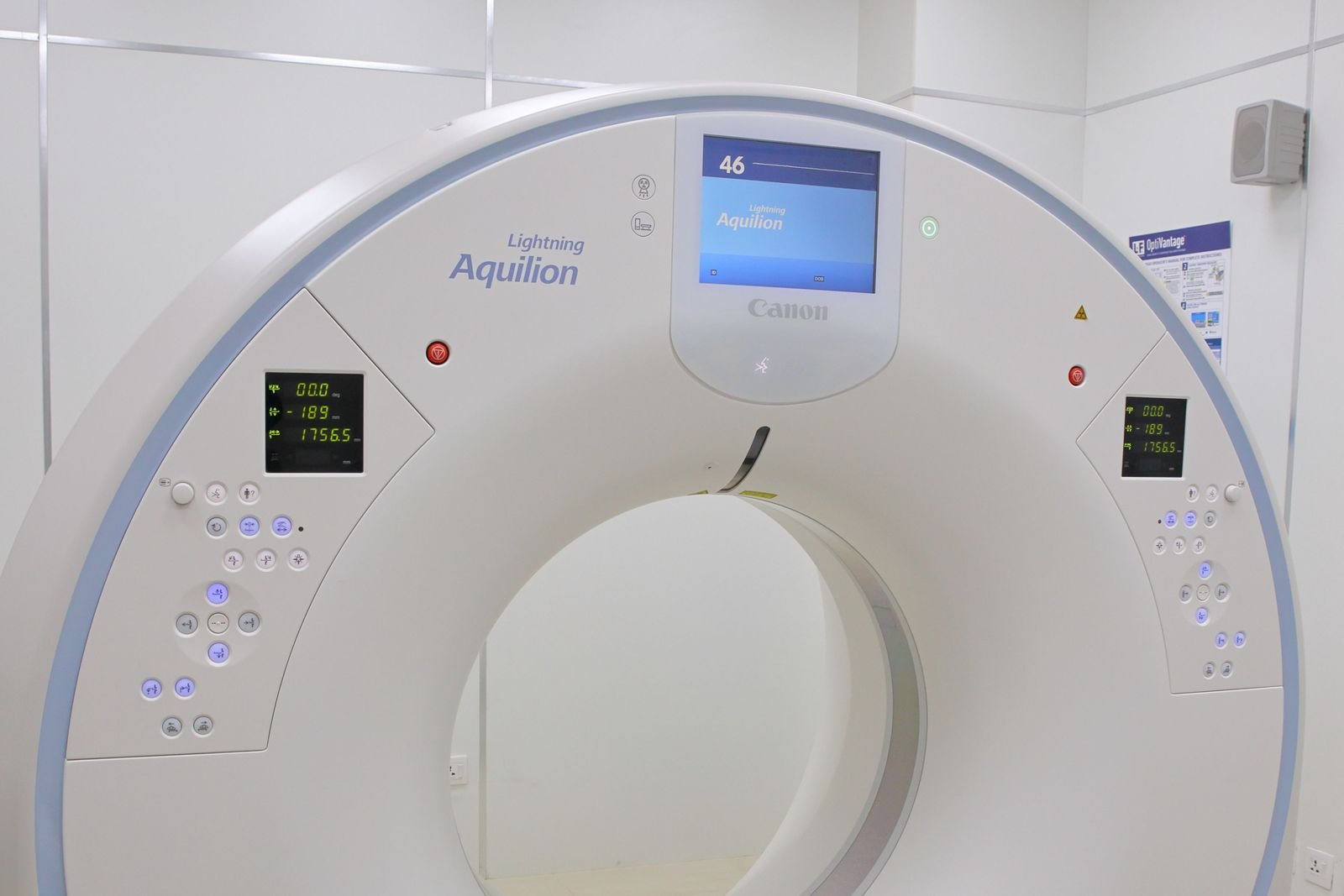
CT is the workhorse for the pancreas. Cancer Research UK says a GP may arrange an ultrasound or CT as an early test, and that CT is used to check for changes in the pancreas or nearby structures. For inflammation the picture is similar: the NHS says acute pancreatitis is usually diagnosed using laboratory tests on a blood sample and sometimes a CT scan, and that for chronic pancreatitis a specialist may arrange tests such as a CT or an ultrasound scan.
The NHS says a CT scan usually takes about 10 to 20 minutes, that some scans use a contrast dye given as a drink or an injection, and that having lots of CT scans carries a very small chance that the radiation could cause cancer, a risk doctors weigh first. Pancreatic Cancer Action says to tell staff about allergies, asthma, diabetes, kidney problems and any medicines you take. See CT abdomen and pelvis and CT with contrast.
Because CT uses ionising radiation, it needs a referral. Under the Ionising Radiation (Medical Exposure) Regulations 2017, every exposure must be justified, with a registered referrer behind it, in private clinics as well as the NHS. It means a clinician has decided a pancreas CT is the right test for you.
MRI and MRCP: the bile ducts in detail
MRI uses a magnetic field and radio waves rather than X-rays, and the NHS says a scan usually takes between 15 minutes and 1 hour. For the pancreas the version you will hear about is MRCP, magnetic resonance cholangiopancreatography. Cancer Research UK says MRCP is a type of MRI scan that gives detailed pictures of the pancreas, gallbladder and bile ducts, can show abnormal areas, may be used to check for pancreatic cancer and, after a diagnosis, can help show its size and spread. Our guide to MRI with contrast explains when an injection is added.
Hospital tests: endoscopic ultrasound, biopsy and more
If a GP refers you to a specialist, the NHS pancreatic cancer tests page says you may have scans (ultrasound, including a version passed inside the body on a thin flexible tube called an endoscope, plus CT, PET or MRI), a biopsy to take a small sample of tissue from the pancreas, and other tests such as a laparoscopy or an ERCP. The NHS says you may not need all of these, that it can take several weeks to get results, and that a wait does not mean anything is definitely wrong. These are hospital tests under a specialist team.
Private scans and the pancreas: what is realistic
People ask about private pancreas scans for two reasons: a GP has arranged an ultrasound or CT and the wait is long, or they are worried and want reassurance. The first is a reasonable use of a private clinic. Many clinics accept self-referral for ultrasound; for CT the clinic will need a referral; and for MRCP most clinics want a clinician's request. You can compare abdominal CT clinics near you on FindScan and send an enquiry; the clinic contacts you to confirm the referral it needs and the next steps. Make sure the report goes back to the clinician who asked the question.
The second reason is where honesty matters. A self-arranged scan of an organ that is hard to image, chosen without a clinician deciding which test fits your symptoms, risks a normal result that does not settle the question or an incidental finding that creates new worry. FindScan is a directory of independent, regulated imaging clinics: you compare clinics and send an enquiry, and the clinic contacts you. We are not a healthcare provider, and nothing here replaces an assessment by a GP. If your skin or eyes have turned yellow, you have been vomiting for more than 2 days or you have severe tummy pain, contact your GP urgently or NHS 111 today, and call 999 if you are seriously unwell.
Common questions
Which scan is best for the pancreas?
It depends on the question. Cancer Research UK says a GP may arrange an ultrasound or CT as an early test, that CT is used to check for changes in the pancreas or nearby structures, and that MRCP (a type of MRI) gives detailed pictures of the pancreas, gallbladder and bile ducts. A clinician chooses the test.
Can an ultrasound see the pancreas?
Partly. Pancreatic Cancer Action describes abdominal ultrasound as showing the pancreas, the surrounding area and the liver, but the organ sits behind the stomach and bowel, so parts of it can be hidden. A normal ultrasound does not end the question if symptoms continue.
What is an MRCP scan?
Magnetic resonance cholangiopancreatography: Cancer Research UK says it is a type of MRI scan that gives detailed pictures of the pancreas, gallbladder and bile ducts. Like other MRI scans it does not use X-rays.
Do I need a referral for a pancreas CT?
Yes. CT uses ionising radiation, so under the Ionising Radiation (Medical Exposure) Regulations 2017 every exposure must be justified with a referral from a registered referrer, in private clinics as well as the NHS.
Which pancreas symptoms are urgent?
The NHS says to ask for an urgent GP appointment or contact NHS 111 if your eyes or skin turn yellow, if you have been vomiting for more than 2 days, if you have had diarrhoea for more than 7 days, or if you are worried and not sure where to get help.
References
- Pancreatic cancer: symptoms. NHS. Accessed 27 October 2026.
- Pancreatic cancer: tests and next steps. NHS. Accessed 27 October 2026.
- Pancreatic cancer: causes. NHS. Accessed 27 October 2026.
- Acute pancreatitis: diagnosis. NHS. Accessed 27 October 2026.
- Chronic pancreatitis: diagnosis. NHS. Accessed 27 October 2026.
- Suspected cancer: recognition and referral (NG12), recommendations 1.2.4 and 1.2.5. NICE. Accessed 27 October 2026.
- Tests for pancreatic cancer. Cancer Research UK. Accessed 27 October 2026.
- CT scan for pancreatic cancer. Cancer Research UK. Accessed 27 October 2026.
- MRI and MRCP scan for pancreatic cancer. Cancer Research UK. Accessed 27 October 2026.
- First line investigations. Pancreatic Cancer Action. Accessed 27 October 2026.
- Pancreatic Cancer Awareness Month, November 2026. Pancreatic Cancer UK. Accessed 27 October 2026.
- CT scan. NHS. Accessed 27 October 2026.
- Ultrasound scan. NHS. Accessed 27 October 2026.
- MRI scan. NHS. Accessed 27 October 2026.
- The Ionising Radiation (Medical Exposure) Regulations 2017. legislation.gov.uk. Accessed 27 October 2026.
This article is general information, not medical advice, and it does not replace an assessment by a clinician. If you have symptoms that worry you, speak to your GP or call 111. In an emergency, call 999.