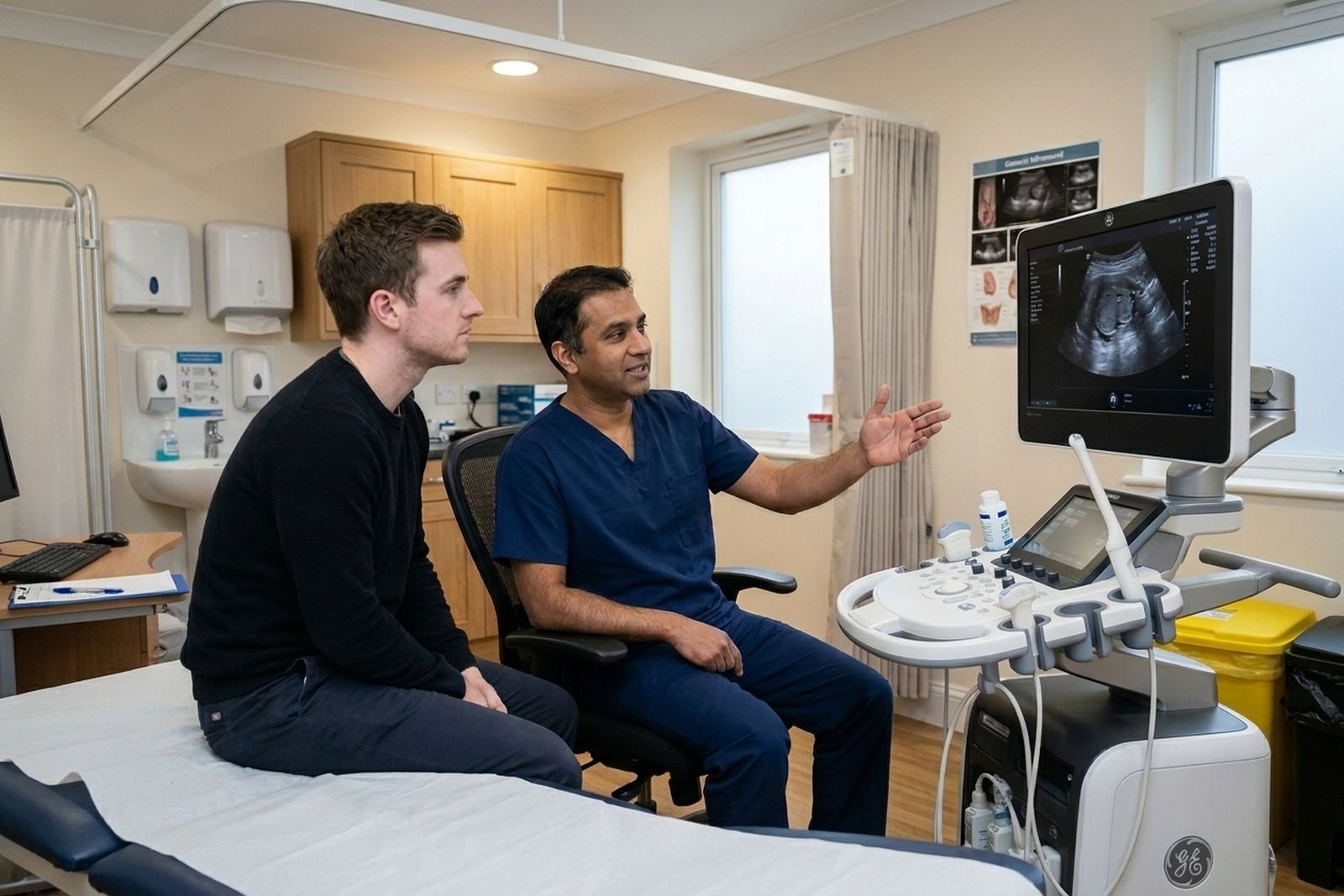
Testicular Ultrasound: What to Expect, and Why a Lump Should See a GP First
A testicular ultrasound is quick, painless and, according to NHS imaging departments, the recommended way to look at a lump or swelling in the testicles. It is also the scan men put off because they are embarrassed. This guide walks through exactly what happens, who is in the room, and why the NHS asks you to see a GP first.
Written by the FindScan Editorial Team and reviewed by our Medical Advisor, Dr Mohamed Najjar
Reviewed
Men search for this scan with a particular word attached: embarrassing. A lump or a change in a testicle is worrying enough, and the idea of a stranger with an ultrasound probe adds a second layer of dread that stops some people getting it checked at all. The NHS is clear that it should be checked, and that the first stop is a GP, not a scanner.
This guide explains why the GP comes first, what the scan involves from the moment you walk into the room, who is there and what you can ask for, how long results take, the kind of testicle pain that is an emergency, and where a private scan fits.
Why the NHS says to see a GP first
The NHS says to see a GP if you have a lump in your testicles, swollen testicles, a change in the shape of your testicles or the way they feel, one testicle that has become bigger than the other, or aching or discomfort that does not go away. Its testicular cancer page adds that these symptoms are very common and can be caused by many different conditions, that having them does not definitely mean you have testicular cancer, but that finding it early may mean it is easier to treat.
Most of the time the cause is not serious. The NHS says lumps and swellings in the testicles are not usually caused by anything serious, and that most are caused by something less serious such as a fluid-filled cyst or swollen veins known as a varicocele. The reason to see a GP is that a GP can do things a scan cannot: the NHS says the GP may examine your testicles, shine a light through the scrotum to check for fluid, and refer you for an ultrasound scan. NICE's suspected cancer guideline (NG12) sits behind that referral: it says GPs should consider a suspected cancer pathway referral for a non-painful enlargement or change in shape or texture of the testis, and consider an urgent, direct access ultrasound scan for unexplained or persistent testicular symptoms. If the examination worries the GP, the NHS route is fast.
What a testicular ultrasound is for
Cambridge University Hospitals describes ultrasound as the recommended method for investigating testicular problems. The NHS says an ultrasound scan uses sound waves to produce images of the inside of your body and does not use radiation.
In practice the sonographer or radiologist looks at the size and texture of both testicles, at any lump and whether it is solid or fluid, at the tubes and veins around the testicle, and at blood flow. What the scan cannot do is tell you on its own what a solid lump is; that is a question for the specialist who receives the report. Our guide to what ultrasound can detect covers the general limits.
What happens in the room, step by step
Two NHS imaging departments describe the appointment in almost the same words. The Royal Berkshire NHS Foundation Trust says you lie on a couch and lower your clothing; cold gel is applied and the probe is moved over both testicles so they can be compared. Cambridge University Hospitals adds that the room lights are dimmed and that you lie under a cover.
It is quick. Cambridge says scanning the testicles takes about 5 to 10 minutes; the Royal Berkshire says about 5 to 15 minutes. It should not hurt: the Royal Berkshire says the scan may feel tender where the probe presses and that you should tell staff if you feel discomfort. Cambridge says the risk of infection from the gel is very low and advises wiping it off thoroughly afterwards. No preparation is needed beyond loose clothing; our guide on preparing for a scan covers the general points.
Who is in the room, and what you can ask for
This is the part most men want to know and few ask about. The scan is done by a sonographer or radiologist, and both NHS departments say that person may be of a different gender to you. Cambridge University Hospitals says that if you want only male staff you should tell the department in advance, because your appointment may need to be moved. Private clinics vary, so ask when you enquire.
A chaperone is standard, not an optional extra. Cambridge says it is hospital policy to have a chaperone present, and that male and female chaperones are available; the Royal Berkshire says a chaperone is present throughout, and that you can decline to have supervised trainees in the room.
How long results take
The sonographer does not usually give a diagnosis in the room. The report goes to the clinician who referred you: the Royal Berkshire says usually within 24 hours, Cambridge says usually within seven to ten days, and it is the referring team's job to tell you the result. The NHS says it can take a few weeks to get test results and that a delay does not definitely mean anything is wrong. Our scan results guide explains the general timelines.
The pain that is an emergency
One set of symptoms should never wait for any appointment. The NHS says to go to A&E immediately or call 999 if you have sudden, severe pain in a testicle, testicle pain along with feeling sick, being sick or pain in your tummy, or testicle pain that has lasted more than an hour or continues when you are resting. The NHS says not to drive yourself to A&E. A private scan arranged for next week is the wrong answer to sudden severe pain today.
Where a private ultrasound fits
If your GP has examined you and suggested an ultrasound, and the NHS appointment is weeks away, a private testicular ultrasound is an option. Ultrasound can be self-referred at many clinics because it does not use ionising radiation, although the clinic will ask what the scan is for, the sonographer or radiologist decides whether it is the right test, and some clinics ask for a GP letter for this scan. Ask whether you can request a male or female sonographer, whether a chaperone is present, and who receives the report. You can compare ultrasound clinics near you on FindScan and send an enquiry; the clinic contacts you to confirm whether it needs a referral and to answer those questions.
FindScan is a directory of independent, regulated imaging clinics: you compare clinics and send an enquiry, and the clinic contacts you. We are not a healthcare provider, and nothing here replaces an examination by a GP. If you have found a lump or a change, see a GP first. If you have sudden, severe testicle pain, go to A&E or call 999 now.
Common questions
Can I have a testicular ultrasound without seeing a GP?
Some private clinics accept self-referral for ultrasound, but the NHS says a lump, swelling or change in a testicle should be checked by a GP, who examines you and may refer you for an ultrasound. See the GP first; the scan is part of that pathway, not a replacement for it.
Is a testicular ultrasound embarrassing or painful?
It is quick and should not hurt. NHS imaging departments say you lie under a cover, the scan of the testicles takes about 5 to 15 minutes, a chaperone is present and you can tell staff if the probe feels tender.
Can I ask for a male sonographer?
Yes. Cambridge University Hospitals says that if you want only male staff you should tell the department in advance, because your appointment may need to be moved. Private clinics vary, so ask when you enquire.
How long do testicular ultrasound results take?
The report goes to the clinician who referred you. The Royal Berkshire NHS Foundation Trust says usually within 24 hours; Cambridge University Hospitals says usually within seven to ten days.
When is testicle pain an emergency?
The NHS says to go to A&E immediately or call 999 for sudden, severe pain in a testicle, testicle pain with feeling sick, being sick or tummy pain, or testicle pain lasting more than an hour or continuing at rest.
References
- Testicle lumps and swellings. NHS. Accessed 27 October 2026.
- Testicular cancer: symptoms. NHS. Accessed 27 October 2026.
- Testicular cancer: tests and next steps. NHS. Accessed 27 October 2026.
- Suspected cancer: recognition and referral (NG12), recommendations 1.6.7 and 1.6.8. NICE. Accessed 27 October 2026.
- Ultrasound scan of the testes. NHS (Cambridge University Hospitals NHS Foundation Trust). Accessed 27 October 2026.
- Having a testicular ultrasound (July 2024). NHS (Royal Berkshire NHS Foundation Trust). Accessed 27 October 2026.
- Ultrasound scan. NHS. Accessed 27 October 2026.
- When to call 999. NHS. Accessed 27 October 2026.
This article is general information, not medical advice, and it does not replace an assessment by a clinician. If you have symptoms that worry you, speak to your GP or call 111. In an emergency, call 999.