Can an MRI Scan Detect Dementia? What a Brain Scan Does and Does Not Show
People worried about their memory often ask whether a brain scan would settle the question. Here is what the NHS and NICE say about where MRI fits in a dementia assessment, what it can show, what it cannot, and why the route starts with a GP rather than a scanner.
Written by the FindScan Editorial Team and reviewed by our Medical Advisor, Dr Mohamed Najjar
Reviewed
When memory starts to slip, many people, and many of their relatives, ask the same question: would a brain scan tell us what is going on? The answer is more useful than a simple yes or no. A brain MRI is a valuable part of a dementia assessment, but it does not diagnose dementia on its own, and nobody arrives at a diagnosis simply by having a scan.
Brain MRI has been in the news this month. On 2 October 2026 UCL announced two projects funded through the UK Research and Innovation Dementia Challenge, one of which, RADIANCE, will test an AI-powered MRI protocol that cuts a brain scan from 20 to 30 minutes to around seven. This guide explains what the scan contributes, what the NHS and NICE say about when it is used, and what to do if you are worried about your own memory or someone else's.
Start with a GP, not a scanner
The NHS says that if you are worried about your memory, it is a good idea to see a GP, and that if you are worried about someone else you can encourage them to make an appointment and offer to go with them. The NHS also says memory problems can have other causes, including depression, anxiety, sudden confusion (delirium) caused by an infection, an underactive thyroid and the side effects of some medicines, and some of these are treatable.
At the appointment the GP will ask about your symptoms and how you are managing daily tasks, may examine you and arrange laboratory tests on blood and urine, and will usually ask you to do a short memory or thinking test. NICE's dementia guideline (NG97) sets out the same sequence: take a history, and if dementia is still suspected after the initial assessment, arrange tests to exclude reversible causes of cognitive decline and use cognitive testing.
The memory clinic and where imaging comes in
If dementia is still suspected, NICE says the person should be referred to a specialist dementia diagnostic service, such as a memory clinic or community old age psychiatry service. The NHS describes this as a referral to a specialist such as an old age psychiatrist, a geriatrician or a neurologist, who may work in a memory clinic, and says the specialist may arrange a brain scan, such as a CT scan or an MRI scan, and more detailed memory tests.
The order matters. The scan sits inside a specialist assessment that already includes a history, cognitive testing and laboratory results. The NHS says most cases of dementia can be diagnosed after these assessments taken together; the scan is one piece of evidence that the clinician weighs with everything else.
What NICE says the scan is for
NICE is specific about the job a brain scan does. Its guideline says to offer structural imaging to rule out reversible causes of cognitive decline and to assist with subtype diagnosis, unless dementia is well established and the subtype is clear.
NICE also says which scan to use. If the subtype is uncertain and vascular dementia is suspected, it says to use MRI, and to use CT if MRI is unavailable or contraindicated. Our guide to MRI versus CT explains the differences.
What the scan cannot tell you
This is the part that matters most for anyone tempted to arrange a scan to get an answer. NICE says not to rule out Alzheimer's disease based solely on the results of CT or MRI scans. A brain that looks unremarkable on a scan does not mean there is no dementia, and the scan is interpreted alongside the memory tests, the history and the laboratory results, which is why it does not stand alone.
Where the diagnosis is still uncertain and Alzheimer's disease is suspected, NICE lists further tests that can be considered, such as an FDG-PET scan, perfusion SPECT if FDG-PET is unavailable, or examination of cerebrospinal fluid. These are arranged through the memory service, not tests you would arrange yourself. Our guide to brain MRI lesions covers how common findings on a brain scan are described.
Why faster scans are in the news
The UCL announcement explains why researchers want shorter brain scans. According to UCL, MRI scans are central to an accurate dementia diagnosis, and they are also required before starting, and for safety monitoring during, the newer disease-modifying treatments. RADIANCE will gather real-world evidence on whether the ultrafast approach is practical and cost-effective, which could support a roll-out across the UK. None of this changes the pathway for patients today: the scan, fast or slow, is still requested by the specialist as part of the assessment.
What having a brain MRI is like
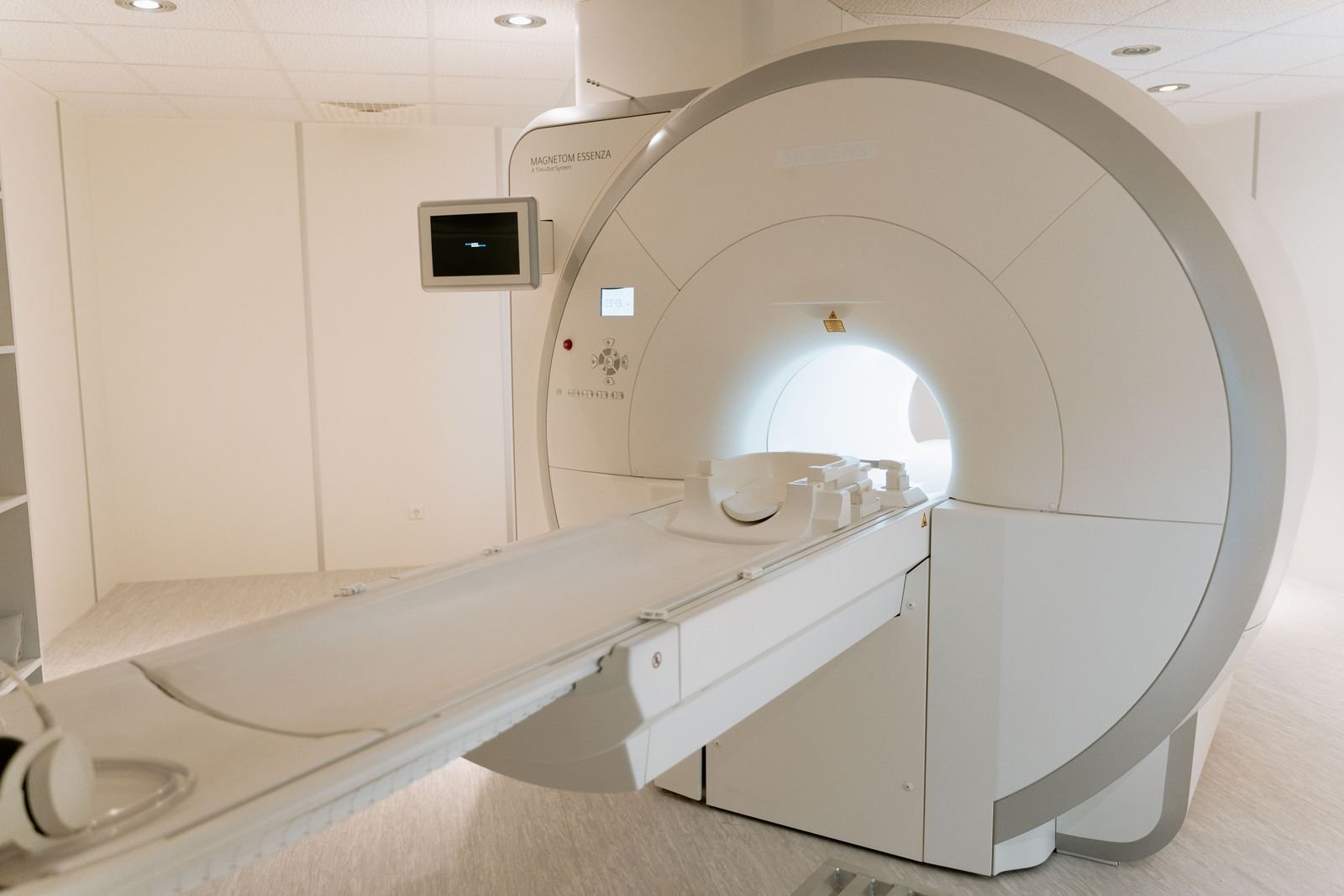
The NHS says an MRI scan usually takes between 15 minutes and an hour, that you need to lie still so the scanner can take clear images, and that the scanner is loud, so you are given earplugs or headphones. Our guides to what to expect at an MRI scan and how long an MRI takes go through the practical side. For someone with memory problems, keeping still, following instructions through the intercom and coping with the noise can be harder, so it helps for a relative or carer to come along and for the clinic to know in advance; the NHS says you can ask to bring someone with you.
Having the scan privately
If a GP or memory clinic has recommended a brain MRI as part of an assessment and the wait is long, it is possible to have the scan at a private clinic and take the report back to the clinician who asked for it. Many clinics accept self-referral for MRI, but for a dementia work-up it is the specialist's request that makes the scan useful, so ask the memory clinic what they need before going ahead. A private scan does not replace the memory assessment and will not, on its own, confirm or rule out dementia.
You can compare brain MRI clinics near you and send an enquiry; the clinic contacts you to confirm whether it needs a referral and the next steps. FindScan is a directory of independent, regulated imaging clinics: you compare clinics and send an enquiry, and the clinic contacts you. We are not a healthcare provider, and whether a scan is right for you is a clinical decision for your GP or specialist. If someone becomes suddenly confused, has a severe headache, weakness on one side, slurred speech or a fall with a head injury, that is an emergency: call 999.
Common questions
Can an MRI scan show dementia?
Not on its own. NICE says a brain scan is offered to rule out reversible causes of cognitive decline and to help identify the type of dementia, and that Alzheimer's disease should not be ruled out based solely on CT or MRI results. The diagnosis comes from the whole assessment.
Should I get a brain MRI if I am worried about my memory?
The NHS advises seeing a GP first. The GP checks for other causes, arranges tests and refers you to a specialist or memory clinic if needed. A scan is arranged as part of that assessment.
Is MRI or CT better for dementia?
NICE says that if the dementia subtype is uncertain and vascular dementia is suspected, MRI should be used, with CT if MRI is unavailable or contraindicated. Otherwise the specialist chooses the scan that fits the question.
What is the ultrafast MRI for dementia in the news?
UCL announced on 2 October 2026 that the RADIANCE project, funded through the UKRI Dementia Challenge, will test an AI-powered MRI protocol that shortens a brain scan from 20 to 30 minutes to around seven, gathering evidence on whether it is practical and cost-effective.
Can a private clinic diagnose dementia from a scan?
No. A private MRI can provide images for the specialist who asked for them, but the diagnosis is made by the memory service using the full assessment. Ask the memory clinic what they need first.
What are the early signs the NHS says to look out for?
The NHS lists memory loss, difficulty concentrating, finding it hard to carry out familiar daily tasks, struggling to follow a conversation or find the right word, being confused about time and place, and mood changes. It advises seeing a GP if you are worried.
References
- Dementia: getting a diagnosis. NHS. Accessed 27 October 2026.
- Dementia: symptoms. NHS. Accessed 27 October 2026.
- Dementia: assessment, management and support for people living with dementia and their carers (NG97), recommendations. NICE. Accessed 27 October 2026.
- MRI scan. NHS. Accessed 27 October 2026.
- Faster MRI scans for dementia to be tested on NHS (2 October 2026). UCL. Accessed 27 October 2026.
This article is general information, not medical advice, and it does not replace an assessment by a clinician. If you have symptoms that worry you, speak to your GP or call 111. In an emergency, call 999.