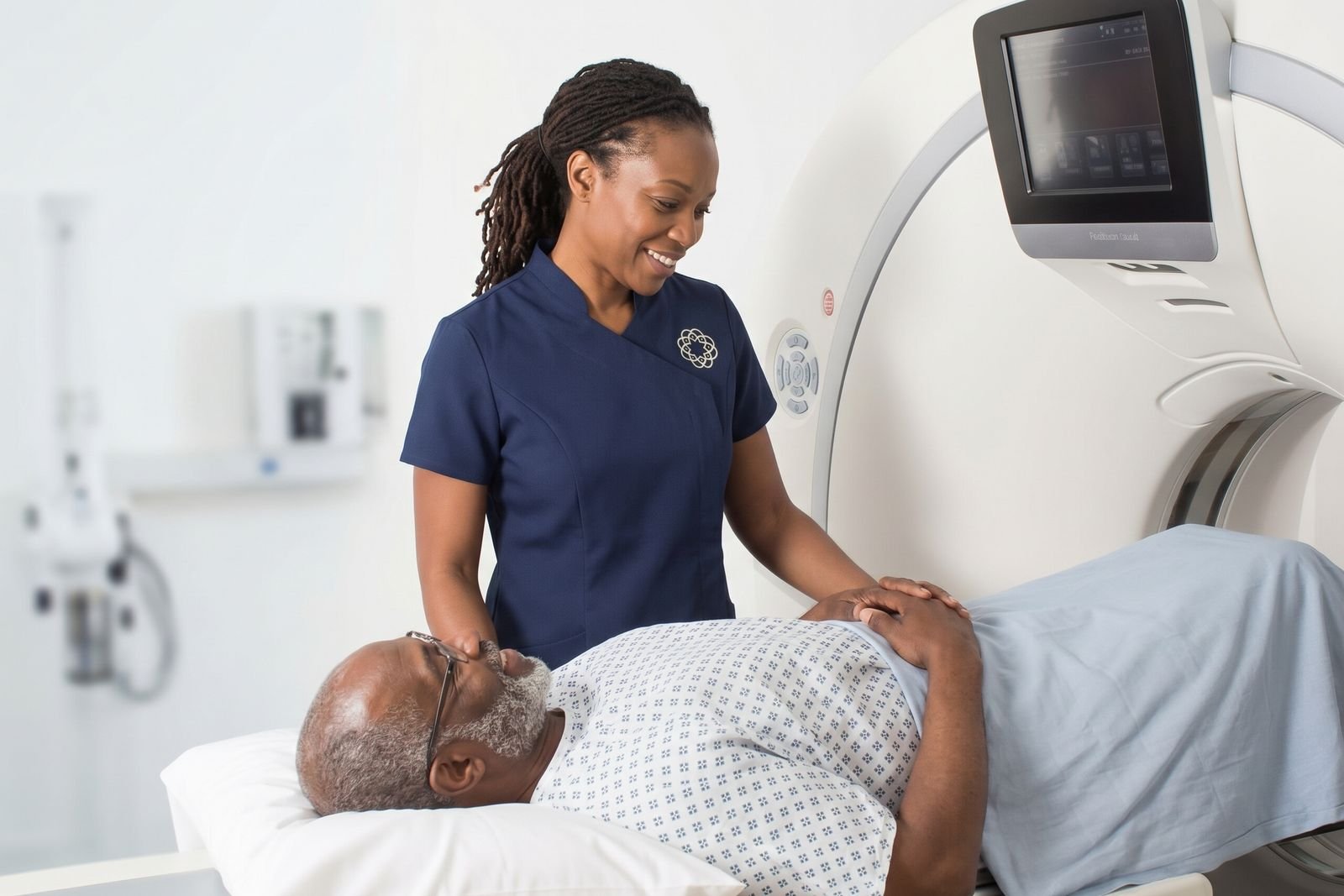
NHS Breast Screening: Who Is Invited, What Happens and How AI Is Being Tested
NHS breast screening uses a mammogram to look for breast cancer before it can be seen or felt. This guide explains who is invited and when, what happens at the appointment, what your result means, the benefits and risks, and what the new EDITH trial of artificial intelligence changes for you, which is very little.
Written by the FindScan Editorial Team
How we write and review our guides
Breast screening is a mammogram, a low-dose X-ray of the breasts, offered by the NHS to women without symptoms to find breast cancer early, when it is often easier to treat. GOV.UK says about 1 in 7 women are diagnosed with breast cancer during their lifetime.
This guide describes the NHS programme in England, which the NHS and GOV.UK pages cited here cover. Scotland, Wales and Northern Ireland run their own breast screening programmes, so if you live there, check the details with your local service.
If you have noticed a change in your breast, do not wait for a screening invitation: the NHS says to see a GP, even if you were screened recently.
Who is invited, and when
The NHS says breast screening is offered to women aged 50 up to their 71st birthday, and that everyone registered with a GP as female will be invited. You will usually get your first invitation between the ages of 50 and 53, and then every 3 years until your 71st birthday.
You need to be registered with a GP surgery to be invited. The NHS says that if you have not been invited by the age of 53 and think you should have been, contact your local breast screening service.
After your 71st birthday you will not be invited automatically, but GOV.UK says you have the right to free screening every 3 years if you ask, and that about 1 in 3 of all breast cancers occur in women aged 71 or over.
Invitations depend on the sex you are registered as at your GP surgery. The NHS explains the rules for trans and non-binary people on its breast screening pages, and your GP can help you arrange screening if you are not invited automatically.
What happens at the appointment
The NHS says breast screening is usually done by a specialist called a mammographer, who will be female, and that the whole appointment should take no longer than 30 minutes. The mammograms themselves only take a few minutes.
Each breast in turn is pressed between 2 plastic plates while an X-ray is taken, then a second X-ray is taken from another angle. The NHS says screening is often uncomfortable and sometimes painful, and that you can ask to stop at any time.
If the appointment worries you, tell the mammographer before you start. Our guide to scanxiety has practical ideas for coping before a scan and while you wait.
Your result, and being called back
The NHS says your results will be sent to you and your GP, usually within 2 weeks. Sometimes you are asked back because the first pictures were not clear enough, which is not a worrying result.
Some people are asked to come back for more tests. GOV.UK's guide to NHS breast screening, updated on 23 February 2026, says that for every 100 people having breast screening, 96 do not need further tests and 4 will, and that of those 4, 1 will be diagnosed with breast cancer. It adds that these figures are only a guide for the general population.
Further tests can include an examination, more mammograms, an ultrasound scan or a biopsy, where a small sample is taken with a needle. The NHS says most people who need further tests will not be diagnosed with breast cancer.
The benefits and the risks
The UK National Screening Committee recommends breast screening. It cites the independent review led by Professor Sir Michael Marmot in 2012, which found that the programme prevents around 1,300 deaths from breast cancer each year.
Screening also has downsides. GOV.UK's guide says the main risk is that screening may find a cancer that would never have caused harm, known as overdiagnosis, and the Marmot review found that for every death prevented, around 3 women are treated for a cancer which would not have harmed them. Nobody can yet tell which cancers those are, so they are treated.
There is also a small radiation dose. GOV.UK says this very slightly increases your lifetime chance of cancer, and that the overall benefits of breast screening outweigh the risks of radiation. Our guide to X-ray radiation safety explains doses in everyday terms.
The EDITH trial: what AI changes at your appointment
As at 25 November 2026: NHS England announced on 23 November 2026 that the first women had joined EDITH, a trial of AI-assisted reading of NHS breast screening mammograms. It says nearly 700,000 women attending routine screening over the next 3 years are set to take part, funded by the government through the National Institute for Health and Care Research, and that recruitment has started at Cambridge University Hospitals, the first of 30 sites across the UK. The study team's information sheet gives a planned 660,000 women. Your invitation letter will say whether your service is taking part.
The Royal College of Radiologists says screening mammograms are usually read by two highly trained clinical radiologists. The University of Warwick, which leads the study, says women will be randomly allocated to one of three groups: one has the standard reading by two NHS experts, and two have AI-assisted reading in different ways. It says all images will be looked at by at least one human expert.
NHS England says the trial will not change what happens at your appointment and that invitation letters include an option to opt out. The study team says you can opt out at any time without giving a reason, and that if you do, your images will be read by two NHS experts without AI. It also says AI may highlight more areas than human experts, which could mean more women are called back.
The Royal College of Radiologists said on 23 November that the trial has real potential to free up radiologists' time but is not a quick fix, because patients face long, anxious waits for scan results due to a shortage of radiologists. Our guide to how AI is used in UK radiology explains the wider picture.
Symptoms: see a GP, do not wait for screening
Screening is for people without symptoms. The NHS says to see a GP if you are worried about symptoms of breast cancer, even if you have recently had breast screening, and not to wait for your next screening appointment.
The NHS lists these reasons to see a GP: a lump or swelling in your breast, chest or armpit; any changes in your breasts or nipples that are not normal for you; or pain in your breast or armpit when relatives have had breast or ovarian cancer. The GP may refer you urgently, which the NHS says does not definitely mean you have cancer. Our guide to urgent suspected cancer referrals explains what happens next.
Private mammograms and breast scans
Mammograms use X-rays, so a private clinic needs a referral from a doctor or another qualified clinician. A private mammogram does not replace free NHS screening, and if you have symptoms the GP is the right first step.
If you are under 50 and worried about family history, or between NHS invitations, speak to a GP first: they can assess your risk and refer you if needed. If a clinician has asked for a mammogram, breast ultrasound or breast MRI, our guide to breast MRI and mammograms explains the difference.
Common questions
At what age does NHS breast screening start?
In England, the NHS says your first invitation usually comes between 50 and 53, then every 3 years until your 71st birthday. You need to be registered with a GP.
Can I have breast screening after 71?
Yes. You are no longer invited automatically, but GOV.UK says you have the right to free screening every 3 years if you ask. Contact your local breast screening service.
How long do breast screening results take?
The NHS says results are usually sent within 2 weeks, to you and to your GP.
Does being called back mean I have cancer?
No. GOV.UK says that of every 100 people screened, 4 need further tests and 1 of those 4 is diagnosed with breast cancer. The NHS says most people who need further tests will not be diagnosed with breast cancer.
Do I have to take part in the EDITH AI trial?
No. NHS England says invitation letters include an option to opt out, and the study team says you can opt out at any time without giving a reason. If you do, your mammograms are read by two NHS experts without AI. Your appointment itself is the same either way.
References
- Who breast screening is for. NHS. Accessed 25 November 2026.
- What happens at your breast screening appointment. NHS. Accessed 25 November 2026.
- Your breast screening results. NHS. Accessed 25 November 2026.
- Symptoms of breast cancer in women. NHS. Accessed 25 November 2026.
- Your guide to NHS breast screening (updated 23 February 2026). GOV.UK (NHS England). Accessed 25 November 2026.
- 71 or over? You can still have breast screening if you choose. GOV.UK (NHS England). Accessed 25 November 2026.
- Breast screening: programme overview. GOV.UK. Accessed 25 November 2026.
- Breast cancer: screening recommendation. UK National Screening Committee. Accessed 25 November 2026.
- First women join world-leading AI-assisted NHS breast screening trial (23 November 2026). NHS England (via WiredGov). Accessed 25 November 2026.
- EDITH trial: information for the public. University of Warwick. Accessed 25 November 2026.
- 'Real potential but not a quick fix': RCR responds to latest phase of EDITH AI breast screening trial (23 November 2026). The Royal College of Radiologists. Accessed 25 November 2026.
FindScan is a directory of independent, regulated imaging clinics. We are not a healthcare provider. This guide is general information and is not medical advice; speak to a GP or your screening service about your own situation.