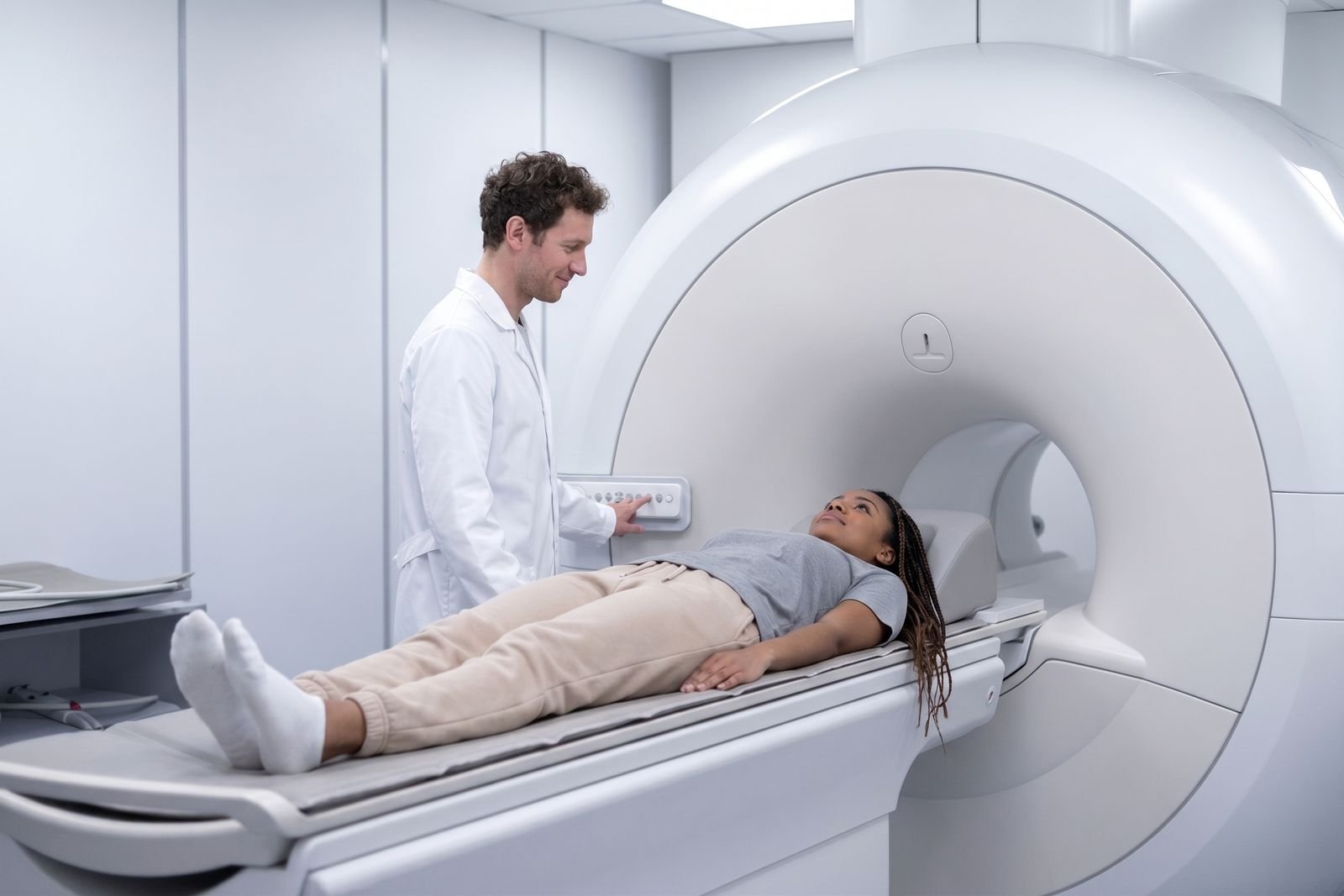
A full body MRI, sometimes sold as a whole body MRI or health MRI, is a package of MRI scans covering several parts of the body in one visit. What is included varies from clinic to clinic: some focus on the chest, abdomen and pelvis, some add the brain or spine, and the level of detail for each area differs. It is different from an MRI requested to investigate a particular symptom.
FindScan is a comparison service, not a healthcare provider. We do not carry out scans or give medical advice. We list private clinics that offer MRI, show each clinic's own listed price, and pass your enquiry to the clinic you choose.
What a full body MRI scan can show
Each clinic designs its own full body MRI package, so the areas covered vary. Many packages include the brain, the neck, the chest, the abdomen (for example the liver, kidneys, pancreas and spleen), the pelvis and the spine. Some clinics offer extra scans, such as the prostate or the heart, as separate options.
MRI is good at showing soft tissues, such as organs, the brain and the spinal cord, and it does not use X-rays. It is less suited to some things. It does not show small changes in the lungs as clearly as CT, it is not designed to look inside the bowel or at the skin, and it does not replace blood tests or the NHS screening programmes.
Before you go ahead, ask the clinic:
- Which body areas the package includes, and whether contrast is used.
- Who reports the images. In the UK this is normally a consultant radiologist.
- How results are explained, and whether a doctor discusses them with you.
- What happens if the scan finds something unexpected, and whether follow-up costs extra.
What UK guidance says about scanning people without symptoms
Screening means testing people who seem healthy to find those who may have an increased chance of a disease or condition. In the UK, an expert group called the UK National Screening Committee (UK NSC) advises the NHS on which screening programmes to offer. Whole body MRI is not one of the NHS screening programmes.
The NHS notes that private companies offer a range of screening tests that you have to pay for, and that some of these are not recommended by the UK NSC because it is not clear that the benefits outweigh the harms.
The Royal College of Radiologists (RCR) said in a 2025 statement that it only recommends body scanning to investigate symptoms of disease, and only under the direction of a doctor. It said that if you have no symptoms, it does not recommend trying to get an MRI scan without being referred by a doctor, because there is a chance of overdiagnosis. It also noted that doing more of these scans in the UK would increase pressure on the health service.
Incidental findings and follow-up tests
Because a full body MRI looks at many areas at once, it can pick up findings that are not causing any symptoms. The RCR says there is a chance of overdiagnosis and treatment of irregularities that turn out to be nothing to worry about, and that this can cause unnecessary anxiety and can even lead to unnecessary treatment.
UK NSC guidance on commercial screening tests makes similar points that apply to any screening test:
- False positive results. A test can show up a potential condition, but further tests then show there is not a problem. The UK NSC says this leads to unnecessary worry, and to follow-up tests and investigations which may carry risks of complications.
- Overdiagnosis. Screening can find conditions that would not have caused a problem in a person's lifetime but which, once found, are treated.
- Follow-up is often up to you. The UK NSC says commercial providers often only offer a test. If you get an abnormal finding, it is up to you to seek advice, further investigation or treatment, and often the tests need to be repeated by the NHS.
Before you choose a clinic, ask what it does when a scan shows something unexpected, whether the report can be shared with your GP, and whether further scans or appointments cost extra.
A normal result is not a guarantee
No screening test is perfect. The NHS says screening tests are not 100% accurate, and that even if a screening result is normal you could still go on to develop the condition. The UK NSC says screening does not guarantee protection. It also explains that false negative results are inevitable in screening: people can be falsely reassured and may ignore signs or symptoms later, which can lead to delays in diagnosis and treatment.
If you develop new symptoms after a full body MRI, see a GP about them, whatever the scan showed.
It does not replace NHS screening programmes
NHS screening programmes are free, and the UK NSC advises the NHS on which programmes to offer. The UK NSC points out that the national NHS screening programmes offer a complete end-to-end service, not just a test, while commercial providers often only offer the test. A full body MRI does not replace any of them, so keep going when you are invited. The NHS adult programmes include:
- Cervical screening for women and people with a cervix aged 25 to 64
- Breast screening for women aged 50 to 70
- Bowel cancer screening, a home test kit offered to everyone aged 50 to 74 every 2 years
- Abdominal aortic aneurysm (AAA) screening for men when they turn 65
- Lung cancer screening for people aged 55 to 74 who have ever smoked, in some areas
- Diabetic eye screening for people with diabetes aged 12 and over
If you have symptoms, see a GP first
The UK NSC says screening is not for people who have symptoms, and that people who have symptoms should always consult their GP. The RCR gives the same advice: if something in your body does not feel right, speak to your doctor, who will refer you for an MRI if it is necessary.
A scan aimed at your symptoms, such as a brain MRI or an abdomen MRI, looks at that area in more detail than a whole body survey. For severe or sudden symptoms, call NHS 111, or 999 in an emergency.
Who might still choose a full body MRI
Some adults decide to pay for a full body MRI after weighing up the points above. That is a personal choice. The UK NSC suggests asking these questions about any commercial screening test:
- Is there evidence that the test prevents future health problems?
- Is this test already offered free by the NHS?
- What are the fees, including for any follow-up tests?
- Does the company give balanced information about the possible harms?
- What happens if the results are unclear?
It also helps to ask the clinic exactly which areas and sequences are included, as packages differ. Our guides on full body MRI screening and the limits of full body health scans go into more detail.
Referral, safety and what happens on the day
MRI does not use ionising radiation, so the Ionising Radiation (Medical Exposure) Regulations 2017 (IR(ME)R), which apply to X-ray and CT, do not apply to it. Many private clinics accept self-referral for MRI, usually after their own safety screening, but each clinic sets its own policy. Some offer a consultation with their own doctor before or after a full body scan.
Before the scan you fill in a safety form that asks, for example, whether you are pregnant and whether you have any metal in your body such as a pacemaker or surgical clips. The NHS says serious complications from an MRI scan are rare, and that a scan usually takes between 15 minutes and 1 hour, but can take longer. A scan covering several areas may take longer than a scan of one area. See what to expect at an MRI and claustrophobia and MRI.
Results and what affects the price
Your images are reported by an appropriately qualified clinician. The clinic will tell you how long its report takes and how the results are explained to you. See scan results.
Each clinic sets its own price, and prices vary. The main factors are how many areas are covered and in how much detail, whether contrast is used, the type of scanner, whether a doctor consultation is included, and where the clinic is. FindScan shows each clinic's own listed price as the clinic sets it, without mark-up. Check what is included, and what any follow-up would cost, before you send an enquiry.
How to compare clinics on FindScan
Use FindScan search to see clinics near you that offer MRI. Compare locations, listed prices and clinic details, then send an enquiry to the clinic you choose. We pass your details to that clinic, and the clinic contacts you to discuss what its scan covers, its referral policy, safety screening, how it handles unexpected findings, and availability.
FindScan is a comparison service, not a healthcare provider, and nothing here is medical advice. Speak to a GP or another clinician about your symptoms.