Private knee MRI scan
A knee MRI takes detailed pictures of the inside of your knee joint. FindScan helps you compare private clinics that offer it and send an enquiry to the one you choose.
Search MRI providers near youA knee MRI takes detailed pictures of the inside of your knee joint. FindScan helps you compare private clinics that offer it and send an enquiry to the one you choose.
Search MRI providers near youA knee MRI scan uses an MRI scanner to take detailed pictures of the inside of your knee. It is often requested after a twisting injury, when a knee keeps giving way, or when knee pain has not settled and the clinician assessing you wants a closer look inside the joint.
FindScan is a comparison service, not a healthcare provider. We do not carry out scans or give medical advice. We list private clinics that offer MRI, show each clinic's own listed price, and pass your enquiry to the clinic you choose.
The NHS describes an MRI scan as a test that takes detailed pictures of the inside of your body. It is used to help find out what is causing symptoms, to check bones and organs, and to see how well a treatment is working.
For the knee, the pictures cover the bones of the joint and the soft tissues around and inside it, such as the menisci (the cartilage between the bones), the ligaments and the tendons. MRI does not use ionising radiation. Our guide to what a knee MRI shows goes into more detail.
The NHS lists a knee that is unstable, gives way when you try to stand or cannot straighten, sometimes with a popping sound during the injury, as possible signs of a torn ligament, tendon or meniscus, or cartilage damage. Conditions where an MRI can play a part include:
Only the clinician assessing you can say whether an MRI is the right test. NHS trust guidance notes that an X-ray may be requested to see if there is arthritis in the joint. If that is what you need, see our knee X-ray page.
The NHS says knee pain can often be treated at home and you should start to feel better in a few days. It suggests putting as little weight as possible on your knee, ice packs, and painkillers such as paracetamol or ibuprofen.
Osteoarthritis is a common cause of knee pain with no obvious injury. The NHS lists pain and stiffness in both knees with mild swelling, more common in older people, as a typical pattern. It says a GP will first ask about your symptoms and examine your joints, and that further tests such as X-rays or blood tests are not usually necessary, although they may be used to rule out other possible causes.
For wear-related meniscus tears, South Tees Hospitals NHS Foundation Trust says an MRI scan will not usually be required, because degenerative meniscal tears occur in most people over 40, and it describes physiotherapy as the most effective way of managing painful degenerative tears.
In many areas you can get help such as physiotherapy from NHS community musculoskeletal (MSK) services without needing a referral from a GP. Our guide to seeing a GP before a scan explains why that first assessment matters.
The NHS says you can also go to an urgent treatment centre if you need to see someone now. If you have any of the urgent symptoms above, do not wait for a private scan.
MRI does not use ionising radiation, so the Ionising Radiation (Medical Exposure) Regulations 2017 (IR(ME)R), which apply to X-ray and CT, do not apply to it. Many private clinics accept self-referral for MRI, usually after their own safety screening, but each clinic sets its own policy. See our guide to private MRI without a GP referral.
The NHS advises not wearing anything with metal in it, such as jewellery or hair clips. You are asked about things such as pregnancy, previous surgery, kidney problems, allergies and any metal parts in your body, such as surgical clips or a pacemaker. If you have had an operation on your knee, tell the clinic when you enquire.
The NHS says serious complications from an MRI scan are rare. The clinic's safety screening decides whether you can have the scan or need extra checks first. See MRI safety and metal implants and how to prepare for your scan.
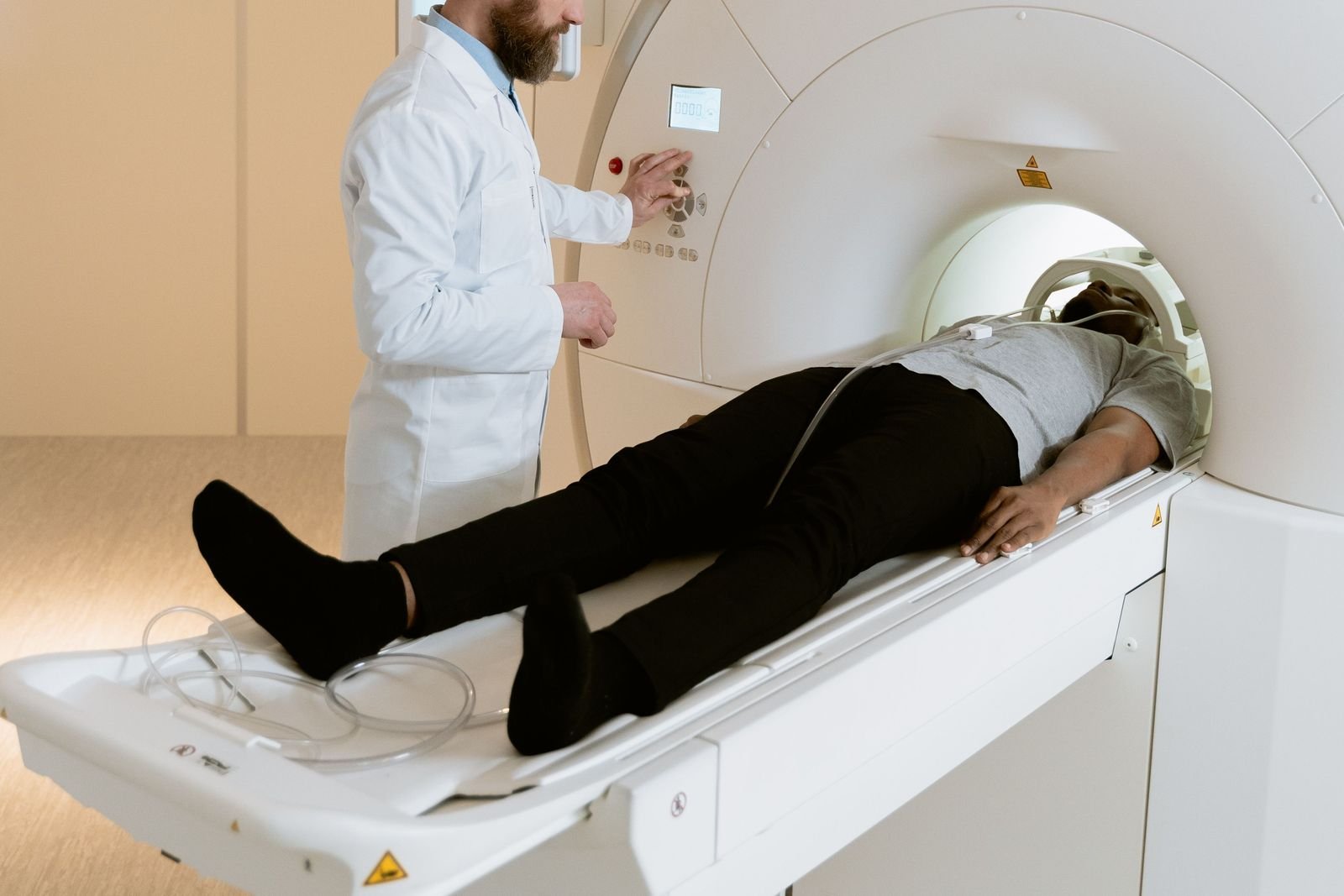
You lie flat on a bed that moves through the scanner and keep still while the pictures are taken. The radiographer controls the scanner from another room but can hear and speak to you, and you are given ear plugs or headphones because the scanner is loud. The NHS says an MRI scan usually takes between 15 minutes and 1 hour, but can take longer. Some scans use an injection of contrast medium (dye), and the clinic will tell you if yours needs it.
If you feel anxious in enclosed spaces, tell the clinic beforehand. See claustrophobia and MRI and open and upright MRI.
Your images are reported by an appropriately qualified clinician. The clinic will tell you how long its report takes and who receives it. Plan to discuss the results with a GP, physiotherapist or specialist who can examine your knee. See scan results.
Each clinic sets its own price, and prices vary. The main factors are whether one or both knees are scanned, whether contrast is needed, the type of scanner (for example a higher field strength or an open scanner), whether a consultation is included, and where the clinic is. FindScan shows each clinic's own listed price as the clinic sets it, without mark-up.
Check what is included, such as the report, before you send an enquiry. See our private MRI cost guide.
Use FindScan search to see clinics near you that offer MRI. Compare locations, listed prices and clinic details, then send an enquiry to the clinic you choose. We pass your details to that clinic, and the clinic contacts you to discuss your request, its referral policy, safety screening and availability.
For other joints, see hip MRI, shoulder MRI and foot and ankle MRI.
Compare private MRI clinics, prices and scanner details in your area:
LondonManchesterBirminghamLeedsBristolGlasgowEdinburghCardiffLiverpoolSheffieldNewcastleNottingham
An MRI takes detailed pictures that a clinician can use to look at the menisci and ligaments, and NHS trust guidance lists MRI among the tests that may be used to assess an ACL injury. Whether the images explain your symptoms is for the clinician assessing you to judge, alongside an examination of your knee.
Usually not to diagnose it. The NHS says a GP will ask about your symptoms and examine your joints, and that further tests such as X-rays or blood tests are not usually necessary, although they may be used to rule out other causes.
MRI does not use ionising radiation, so IR(ME)R does not apply. Many private clinics accept self-referral after their own safety screening, but each clinic sets its own policy. Check with the clinic when you send an enquiry.
It depends on what the clinician is looking for, so ask the person assessing you. NHS trust guidance notes that an X-ray may be requested to check for arthritis in the joint. X-ray uses ionising radiation, so under IR(ME)R it must be requested by a referrer and justified. See knee X-ray.
No. The NHS says to get advice from 111 if your knee locks, gives way or painfully clicks, and to go to A&E if your knee has moved out of place or you have tingling or no feeling in your knee, leg or toes.
Yes. Private clinics offer knee MRI, and some also offer knee X-ray or ultrasound. MRI and ultrasound may be self-referral at some clinics, depending on the clinic's own policy and safety screening. An X-ray uses ionising radiation, so under IR(ME)R 2017 it must be justified and needs a referrer. Many private clinics arrange this through their own doctor. Compare clinics on FindScan, send an enquiry, and the clinic will contact you.
Source: legislation.gov.uk: The Ionising Radiation (Medical Exposure) Regulations 2017, regulation 11; Care Quality Commission: Ionising Radiation (Medical Exposure) Regulations (IR(ME)R)
Search by postcode to see clinics near you that offer this scan, with each clinic’s own listed price. Send an enquiry to the clinic you choose and they will contact you to confirm whether a referral is needed, the final price and an appointment.
FindScan is a comparison service, not a healthcare provider, and nothing here is medical advice. Speak to a GP or another clinician about your symptoms.