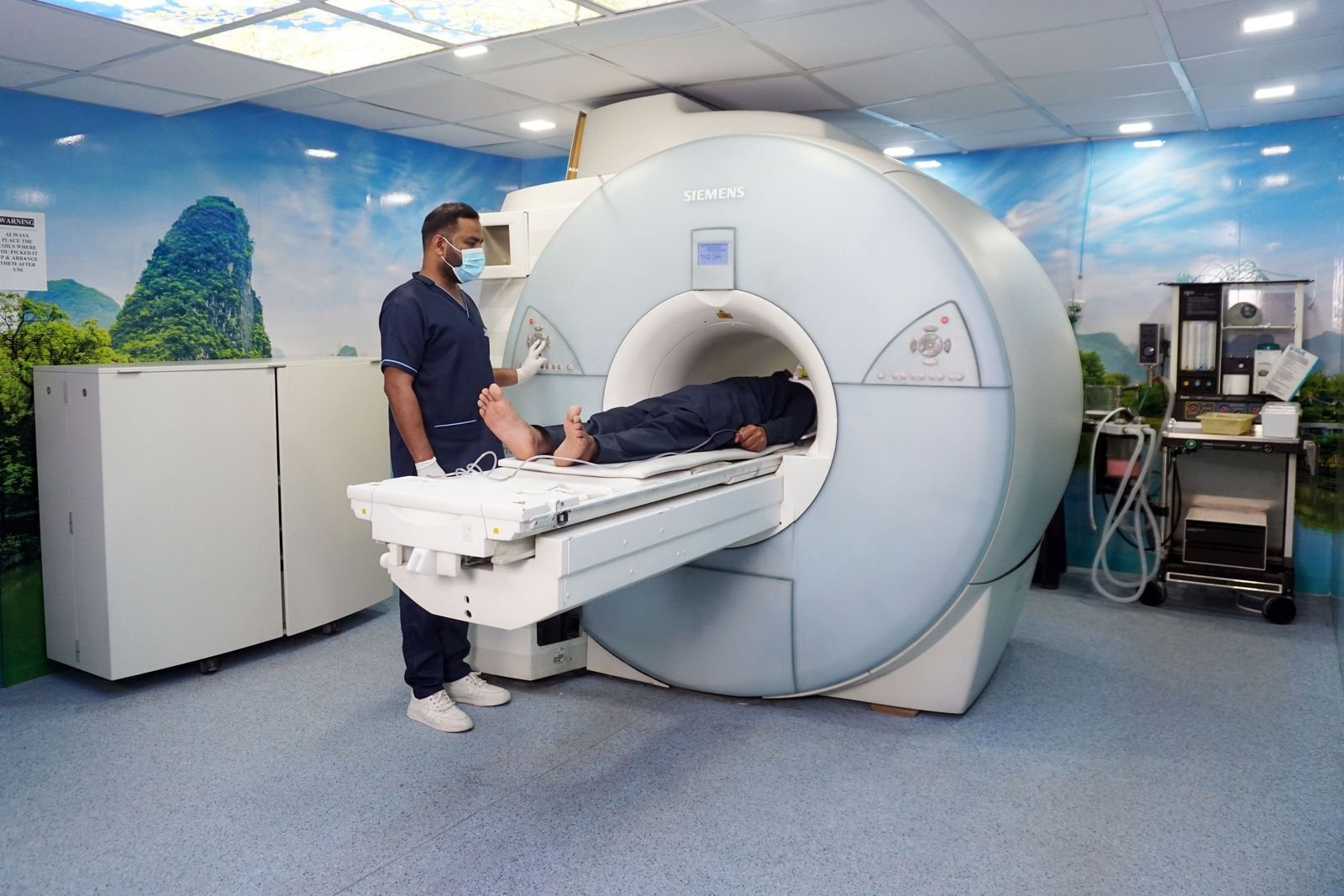
A shoulder MRI scan uses an MRI scanner to take detailed pictures of the shoulder joint and the tissues around it. It is usually requested when shoulder pain or weakness has not settled with home treatment or physiotherapy.
FindScan is a comparison service, not a healthcare provider. We do not carry out scans or give medical advice. We list private clinics that offer MRI, show each clinic's own listed price, and pass your enquiry to the clinic you choose.
What a shoulder MRI scan shows
The NHS describes an MRI scan as a test that takes detailed pictures of the inside of your body. It is used to help find out what is causing symptoms, to check bones and organs, and to see how well a treatment is working.
For the shoulder, the pictures cover the bones of the joint and the soft tissues around it, including the tendons of the rotator cuff and the cartilage on the rim of the socket, often called the labrum. MRI does not use ionising radiation. Our guide to shoulder MRI goes into more detail.
Common reasons a shoulder MRI is requested
Conditions where a shoulder MRI can play a part include:
- Rotator cuff problems. The Dudley Group NHS Foundation Trust explains that the rotator cuff tendon is vulnerable to damage or wear and tear, particularly in the subacromial space, the gap under a bony arch at the top of the shoulder.
- Impingement. Once the tendon is affected it swells, and the tendon and the bursa can become pinched under that arch. The trust describes a painful arc, when the arm is moved out to the side and up to the ear, as typical.
- Shoulder instability and the labrum. The NHS lists a tingling, numb or weak arm, with a feeling that the shoulder is clicking or locking, as a possible sign of shoulder instability. The Dudley Group explains that an over-stretched ligament can pull part of the cartilage off the rim of the socket. It says an X-ray is sometimes done, and sometimes an MRI scan is ordered to assess the damage, usually with a dye injected into the joint.
Only the clinician assessing you can say which test is right. If they want a picture of the bones, see shoulder X-ray. If they think the problem is coming from your neck, see neck MRI.
Ultrasound, MRI or MR arthrogram?
For the rotator cuff, The Dudley Group says an X-ray only shows bones, and that you may be sent for an ultrasound or MRI scan instead: both show the rotator cuff tendons and can highlight if they are torn. Ultrasound also does not use ionising radiation, and many private clinics accept self-referral for it, usually after their own screening, but each clinic sets its own policy. See private ultrasound and our guide to ultrasound vs MRI.
Some shoulder scans are done as an MR arthrogram. South Tees Hospitals NHS Foundation Trust describes this as an MRI scan where a special dye is first put directly into the joint, using fluoroscopy (X-rays) to guide the injection. Because X-rays are used, IR(ME)R applies to that part of the test: it must be requested by a referrer and justified, in the same way as an X-ray.
Frozen shoulder, and when a scan is usually not the first step
The NHS suggests staying active, gentle exercises, good posture, pain relief, and heat or cold packs. It says you usually need to do these things for 2 weeks before shoulder pain starts to ease, and it can take 6 months or longer to recover.
Frozen shoulder means your shoulder is painful and stiff for months, sometimes years. The NHS says you are more likely to get it if you have diabetes, or if you had an injury or surgery that stops you moving your arm normally, and that the pain and stiffness will usually go away eventually. It advises seeing a GP if you have shoulder pain and stiffness that does not go away.
In many areas you can get help such as physiotherapy from NHS community musculoskeletal (MSK) services without needing a referral from a GP. Our guide to seeing a GP before a scan covers this in more detail.
When to see a GP or get urgent help
- See a GP if shoulder pain is getting worse or does not improve after 2 weeks, it is very difficult to move your arm or shoulder, or you have shoulder pain and stiffness that does not go away.
- Ask for an urgent GP appointment or get help from NHS 111 if you have sudden or very bad shoulder pain, you cannot move your arm, your arm or shoulder has changed shape or is badly swollen, you have pins and needles that do not go away, there is no feeling in your arm or shoulder, your arm or shoulder is hot or cold to touch, the pain started after an injury or accident such as a fall, you develop severe pain in both shoulders, or you feel feverish or unwell.
If you have any of the urgent symptoms above, do not wait for a private scan. In an emergency, call 999.
Do you need a referral for a private shoulder MRI?
A standard MRI does not use ionising radiation, so the Ionising Radiation (Medical Exposure) Regulations 2017 (IR(ME)R), which apply to X-ray and CT, do not apply to it. Many private clinics accept self-referral for MRI, usually after their own safety screening, but each clinic sets its own policy. See our guide to private MRI without a GP referral.
Preparing for your scan and safety
The NHS advises not wearing anything with metal in it, such as jewellery or hair clips. You are asked about things such as pregnancy, previous surgery, kidney problems, allergies and any metal parts in your body, such as surgical clips or a pacemaker. If you have had a shoulder operation, tell the clinic when you enquire.
The NHS says serious complications from an MRI scan are rare. The clinic's safety screening decides whether you can have the scan or need extra checks first. See MRI safety and metal implants and how to prepare for your scan.
During the scan, and your results
You lie flat on a bed that moves through the scanner and keep still while the pictures are taken. The radiographer controls the scanner from another room but can hear and speak to you, and you are given ear plugs or headphones because the scanner is loud. The NHS says an MRI scan usually takes between 15 minutes and 1 hour, but can take longer. Some scans use an injection of contrast medium (dye), and the clinic will tell you if yours needs it.
If you feel anxious in enclosed spaces, tell the clinic beforehand. See claustrophobia and MRI and open and upright MRI.
Your images are reported by an appropriately qualified clinician. The clinic will tell you how long its report takes and who receives it. Plan to discuss the results with a GP, physiotherapist or specialist who can examine your shoulder. See scan results.
What affects the price of a shoulder MRI
Each clinic sets its own price, and prices vary. The main factors are whether one or both shoulders are scanned, whether contrast or an arthrogram is needed, the type of scanner (for example a higher field strength or an open scanner), whether a consultation is included, and where the clinic is. FindScan shows each clinic's own listed price as the clinic sets it, without mark-up.
Check what is included, such as the report, before you send an enquiry. See our private MRI cost guide.
How to compare shoulder MRI clinics on FindScan
Use FindScan search to see clinics near you that offer MRI. Compare locations, listed prices and clinic details, then send an enquiry to the clinic you choose. We pass your details to that clinic, and the clinic contacts you to discuss your request, its referral policy, safety screening and availability.
For other joints, see hip MRI and knee MRI.
FindScan is a comparison service, not a healthcare provider, and nothing here is medical advice. Speak to a GP or another clinician about your symptoms.