Which Heart Scan Do You Need?
People search for a heart scan long before they know which one they mean. There are several, and they answer different questions. This guide explains what an echocardiogram, a cardiac MRI, a CT coronary angiogram and a calcium score each show, which need a referral, and why chest pain needs attention before any scan.
Written by the FindScan Editorial Team and reviewed by our Medical Advisor, Dr Mohamed Najjar
Reviewed · How we write and review our guides
Heart scan is not one test. It covers an ultrasound of the heart, two different CT scans and an MRI. One shows how the muscle and valves are moving, one looks inside the coronary arteries, one counts calcium in the artery walls, and one maps the muscle in detail.
Which you need is decided by the question being asked, not by which sounds most thorough. A scan that is excellent for heart failure can be the wrong test for angina.
One thing comes first. If you have chest pain that feels tight or like squeezing, pain spreading to your arms, neck or jaw, or severe difficulty breathing, the NHS says to call 999 immediately, and not to drive yourself to A and E.
Start with the symptom, not the scan
The NHS sets out the order. Its guidance on coronary heart disease says the condition is usually diagnosed after a risk assessment and some further tests, with the assessment first: a GP asks about your medical and family history, checks your blood pressure, measures your cholesterol and asks about exercise and smoking. Only then may you be referred for further tests.
The NHS lists those tests as an electrocardiogram, an exercise stress test, an X-ray, an echocardiogram, angiography, an MRI scan, a CT scan and a myocardial perfusion scan. The list is long because heart symptoms are not one problem. So the first step is getting the symptom assessed, by a GP or by NHS 111. Whoever assesses you can then request the right scan.
Echocardiogram: the ultrasound heart scan
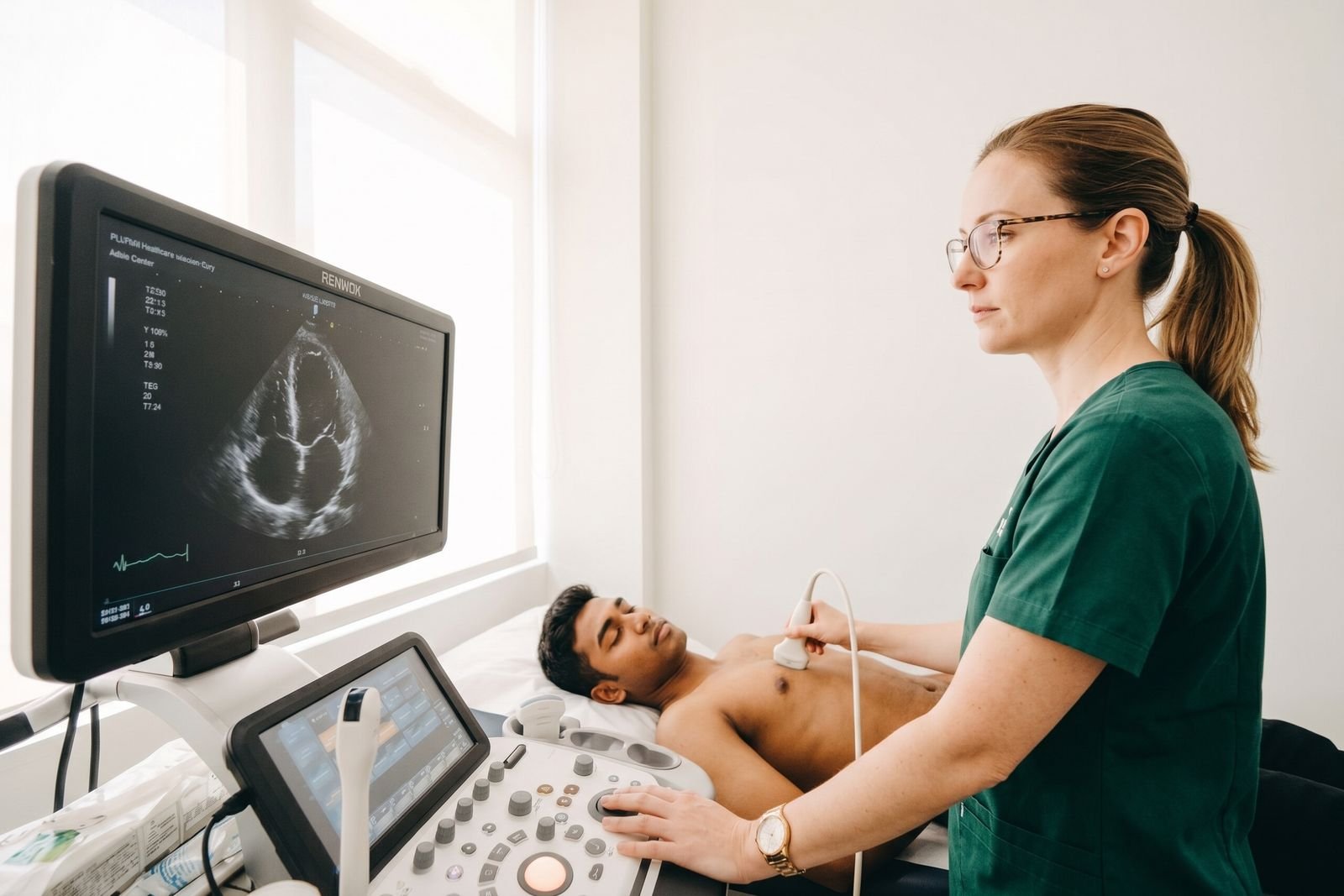
This is the scan most people turn out to need. The NHS describes an echocardiogram as a heart scan that shows how well your heart is working, using ultrasound much as a pregnancy scan does. The NHS says it can help diagnose heart failure, heart valve disease or congenital heart disease, and may be used to check the heart after a heart attack. If a GP has heard a murmur, or someone needs to know how the heart is pumping, this is the scan that answers it.
The common form is the transthoracic echocardiogram, where a sonographer moves an ultrasound device over your chest. The NHS says it takes around 30 to 40 minutes, and there is no radiation. A contrast agent is sometimes injected into a vein in the arm to make the heart clearer. Two variants exist: a transoesophageal echocardiogram passes a small ultrasound device down the oesophagus for a more detailed image, with the throat numbed and sedation available on request; and a stress echocardiogram, done with a treadmill or exercise bike.
CT heart scans: the coronary angiogram and the calcium score
Two quite different tests both get called a CT heart scan. A CT coronary angiogram uses contrast dye to show the inside of the coronary arteries, which is how it answers whether they are narrowed. A CT calcium score uses no dye and does not show inside the arteries; it counts calcium in the artery walls and turns it into a risk number.
The distinction matters, because people often ask for one while describing the other. If the question is whether chest pain on exertion could be angina, the dye study is the one that looks at the arteries. A calcium score alone does not say whether an artery is narrowed enough to cause symptoms. NICE's guideline on recent-onset chest pain, CG95, is built around tests including multislice CT angiography, and NICE last reviewed it on 4 September 2019.
Both are CT, so both need a referral. Under regulation 11 of the Ionising Radiation (Medical Exposure) Regulations 2017, a practitioner must justify the exposure as showing a sufficient net benefit and authorise it. The split across all four scans follows the radiation: ultrasound and MRI use none, so an echocardiogram and a cardiac MRI can often be self-referred at private clinics, while CT, X-rays, DEXA scans and mammograms need a referral. Self-referral is not the same as a good idea, though. A scan arranged without anyone assessing you leaves the hardest part undone: choosing the scan that answers your question, and reading the result alongside everything else about you.
Cardiac MRI: what it adds, and why it is rarely first
Cardiac MRI uses a strong magnetic field rather than radiation, and gives the most detailed look at the heart muscle itself: how much of it is working, whether it is inflamed, scarred or thickened, and how the chambers are performing. It is also used to look at congenital heart problems in adults.
It is rarely the first test, and that is not rationing. An echocardiogram answers many of the same first questions in half an hour with no magnet, no dye and no radiation, and the NHS lists the MRI scan among the further tests used after a risk assessment. The usual MRI safety rules apply: if you have a pacemaker or another cardiac device, say so when the appointment is first discussed rather than on the day, because the department has to check that specific device.
Can you have a heart scan as a check-up?
This is the question behind many heart scan searches, and the official answer is more cautious than the marketing around it. GOV.UK's guidance on private screening for health conditions, updated on 16 July 2026, goes condition by condition through tests sold privately and says of heart disease and stroke risk that screening is not currently recommended.
The reasoning is not that the scanners do not work. It is that finding something in a person with no symptoms only helps if early detection changes what happens next, and if what follows does more good than harm. Regulation 11 takes the same position in law, requiring specific documented justification for scanning a person without symptoms. None of this means a cardiologist is wrong to suggest a calcium score where risk is genuinely uncertain: the scan belongs in that conversation, not instead of it.
Finding a clinic on FindScan
If a clinician has suggested a heart scan, the checks are the same: that the clinic is regulated, that it does the specific scan that was asked for, that it will accept your referral, and that the report goes back to whoever is looking after you.
Common questions
Is a heart scan the same as an ECG?
No. An ECG records the heart's electrical activity and produces a trace, not a picture. A heart scan produces an image: an echocardiogram uses ultrasound, a cardiac MRI a magnetic field, a CT heart scan X-rays. The NHS lists the two as separate tests.
Which heart scan shows blocked or narrowed arteries?
The CT coronary angiogram, which uses contrast dye to show the inside of the coronary arteries. A CT calcium score counts calcium in the artery walls and gives a risk number; it does not show inside the arteries, and an echocardiogram does not show them at all. CT needs a referral.
Do I need a GP referral for a heart scan?
It depends on the scan. An echocardiogram and a cardiac MRI use no radiation, so both can often be self-referred at private clinics. CT scans, including the coronary angiogram and the calcium score, need a referral, because under the Ionising Radiation (Medical Exposure) Regulations 2017 a practitioner has to justify and authorise the exposure.
How long does an echocardiogram take?
The NHS says a transthoracic echocardiogram, the common type where a sonographer moves the device over your chest, takes around 30 to 40 minutes. If you have a contrast agent you may wait up to 30 minutes afterwards so staff can check for a reaction.
Can I have a calcium score if I have no symptoms?
GOV.UK's guidance on private screening says screening for heart disease and stroke risk is not currently recommended, and regulation 11 of the 2017 radiation regulations requires specific documented justification before scanning someone with no symptoms. It is a conversation to have with a GP or cardiologist.
When should I not wait for a scan at all?
The NHS says to call 999 immediately if you have chest pain that feels tight or like squeezing, pain spreading to your arms, neck or jaw, severe difficulty breathing, or if someone has passed out and is not responding normally. The NHS also says do not drive yourself to A and E.
Does FindScan arrange the scan?
FindScan is a directory of independent, regulated imaging clinics. We are not a healthcare provider. You search for clinics near you and send an enquiry, and the clinic then contacts you about your scan.
References
- Echocardiogram. NHS. Accessed 16 November 2026.
- Coronary heart disease: diagnosis. NHS. Accessed 16 November 2026.
- Heart attack. NHS. Accessed 16 November 2026.
- Recent-onset chest pain of suspected cardiac origin: assessment and diagnosis (CG95). NICE. Accessed 16 November 2026.
- Private screening for health conditions: NHS recommendations. GOV.UK. Accessed 16 November 2026.
- The Ionising Radiation (Medical Exposure) Regulations 2017, regulation 11. legislation.gov.uk. Accessed 16 November 2026.
This article is general information, not medical advice, and it does not replace an assessment by a clinician. If you have symptoms that worry you, speak to your GP or call 111. In an emergency, call 999.